Introduction
In our last lesson, we introduced the fundamental concepts of reinsurance, establishing the critical distinction between proportional and non-proportional agreements. You learned to describe the structure of Quota Share, Surplus Share, Excess of Loss, and Stop-Loss treaties. We now move from that conceptual foundation to practical application.
This lesson is focused squarely on calculation. Building on the definitions from last time, you will learn how to compute the precise financial share that the insurer (cedent) and the reinsurer are responsible for when a claim occurs under each of these contract types. Your background in applied probability will be valuable as we work through concrete numerical examples, which are the cornerstone of exam questions on this topic. By the end of this lesson, you will be able to take a given loss amount and a reinsurance structure and determine exactly who pays what.
Calculating Shares for Proportional Reinsurance
As a brief recap, proportional reinsurance involves the cedent and reinsurer sharing premiums and losses in an agreed-upon proportion. The calculation method, however, differs significantly between Quota Share and Surplus Share treaties.
Quota Share Calculation
This is the most straightforward calculation. The reinsurer takes a fixed percentage of all premiums and pays the same fixed percentage of all losses for a given book of business.
Let's say an insurer has a 40% quota share treaty. This means the insurer cedes 40% of its business to the reinsurer and retains 60%.
- Insurer's Retention: 60%
- Reinsurer's Share: 40%
If a loss of $200,000 occurs on a policy covered by this treaty, the split is simple:
- Insurer pays:
- Reinsurer pays:
The video "Treaty Reinsurance" provides another clear, numerical example of this.
This video from the P & C Insurance Helpline gives a quick, practical example of a Quota Share calculation.
Please watch the section from Quota Share. Notice how both the premium and the loss are split according to the same 50% proportion.
Surplus Share Calculation
Surplus share calculations are more involved because the proportion is not fixed across the entire portfolio; it is calculated individually for each risk. The key is to first determine the insurer's retained line and then calculate the ceding percentage for any policy that exceeds this line.
An insurer defines its retained line (e.g., $100,000), which is the maximum amount of risk it wishes to keep for itself on any single policy. The reinsurer then covers a "surplus" amount above this line, up to a specified limit (e.g., 4 "lines," or 4 x $100,000 = $400,000).
For any given policy, the percentage of risk retained by the insurer is:
The reinsurer's share is simply . This percentage is then applied to any loss that occurs.
The following reading provides an excellent, detailed example of this calculation for several different policies.
[PDF] Basics of Reinsurance Pricing - Casualty Actuarial Society
This excerpt from the Casualty Actuarial Society's study note provides a clear table illustrating surplus share calculations.
Please read the section on Proportional Treaties, focusing on the example provided. Start at the definition, and then carefully study the table and its explanation under the Surplus Share example. Pay close attention to how the "Reinsured Portion" and "1st Surplus Percent" are calculated for each risk.
Let's break down Risk 3 from that example:
- Insured Value: $250,000
- Retained Line: $100,000
- Insurer's Retained Portion: $100,000 (the maximum it will keep)
- Reinsured Portion: $150,000 (the surplus)
- 1st Surplus Percent (Reinsurer's Share): .
Therefore, if a $50,000 loss occurs on this policy (Risk 3):
- Insurer pays:
- Reinsurer pays:
It is crucial to remember, as the text notes, that this is not excess insurance. The reinsurer pays 60% of the entire loss from the first dollar, not just the amount of loss exceeding the retained line. The line is only used to establish the percentage share.
Calculating Shares for Non-Proportional Reinsurance
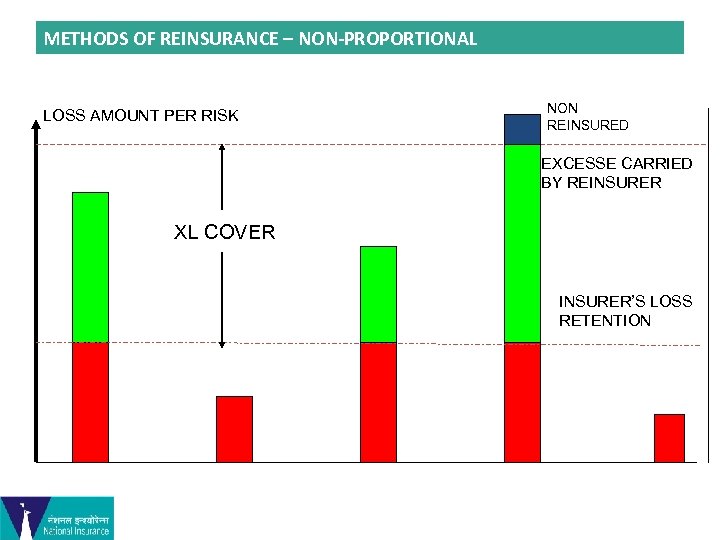
In non-proportional (or Excess of Loss, XL) reinsurance, the calculation is driven by a monetary threshold (the retention), not a percentage. The reinsurer only pays if a loss exceeds this retention.
Excess of Loss (Per Risk) Calculation
The formula for splitting a single loss with a retention level and a reinsurance cover limit of is:
- Insurer pays:
- Reinsurer pays: or
- Unreinsured amount (paid by insurer):
Let's consider a reinsurance treaty described as $400,000 xs $100,000. This means:
- Retention (d): $100,000
- Reinsurance Cover (L): $400,000
- Reinsurance layer: The reinsurer covers losses in the layer from $100,000 up to $500,000.
Now, let's calculate the split for three different loss amounts:
-
Loss of $80,000:
- Insurer pays:
- Reinsurer pays:
-
Loss of $350,000:
- Insurer pays:
- Reinsurer pays:
-
Loss of $700,000:
- Insurer pays: $100,000 (retention) + ($700,000 - $100,000 - $400,000) (unreinsured amount) = $100,000 + $200,000 = $300,000.
- Reinsurer pays: (the full limit).
The "Treaty Reinsurance" video walks through a similar example.
This section of the video demonstrates the basic calculation for an Excess of Loss contract.
Please watch from Excess of Loss. The example uses a limit of $600k, showing that the reinsurance company does not get involved until the loss exceeds this amount.
Stop-Loss (Aggregate XL) Calculation
The calculation for a Stop-Loss treaty is mathematically identical to an Excess of Loss treaty, but the input is different. Instead of applying to a single loss , it applies to the aggregate loss for a portfolio over a specific period (usually one year).
If the aggregate retention is and the cover limit is , then for a total annual loss of :
- Insurer pays: + any amount over the cover limit.
- Reinsurer pays:
To understand this in context, it's helpful to distinguish it from "specific" stop-loss, which is just another name for per-risk Excess of Loss. The following video explains both concepts clearly.
Episode 1. Stop Loss Insurance Explained
This video, "Stop Loss Insurance Explained," provides an excellent visual and numerical explanation of both specific (per-risk) and aggregate stop-loss.
Please watch the following two segments: Specific Insurance: This explains the per-individual calculation, which is the same as the per-risk XL we just covered. Aggregate Insurance: This part explains how the aggregate "attachment point" (retention) works. Notice that it applies to the sum of all the smaller claims that fell below the specific deductible.
For example, consider an insurer with an aggregate stop-loss treaty of $1M xs $5M.
- Aggregate Retention (M): $5,000,000
- Cover Limit (L): $1,000,000
If the total claims for the year amount to $6.2 million:
- The total loss is $6.2M.
- This exceeds the retention of $5M.
- The excess is .
- The reinsurer pays .
- The insurer pays the first $5M (its retention) plus the amount above the reinsurance cover ($0.2M), for a total of $5.2 million.
Advanced Calculation Scenarios
In practice, and on exams, you will encounter more complex scenarios. Two common ones are the layering of different reinsurance treaties and the handling of loss adjustment expenses.
Inuring Reinsurance
Sometimes, one reinsurance treaty applies to the risk that remains after another treaty has already been applied. This is called inuring reinsurance. A common case is a Surplus Share treaty that inures to the benefit of a Per-Risk XL treaty.
To calculate the shares, you must apply the treaties in order:
- First, calculate the insurer's net retained risk after the proportional (Surplus Share) treaty.
- Then, apply the non-proportional (Excess of Loss) treaty to that net loss.
The Basics of Reinsurance Pricing PDF has an excellent worked example of this.
[PDF] Basics of Reinsurance Pricing - Casualty Actuarial Society
This section demonstrates how to calculate shares when an XL treaty is layered on top of a Surplus Share treaty.
Please read section c) Inuring Reinsurance. Follow the example where the company first purchases a surplus share with a $200,000 retention, and then on its net retention, purchases a $100,000 xs $100,000 per-risk XL cover. Pay close attention to the logic in the tables showing how the risk profile is adjusted before the second treaty is applied.
Handling Loss Adjustment Expenses (ALAE)
Allocated Loss Adjustment Expenses (ALAE) are the costs directly associated with settling a specific claim, such as legal fees. Reinsurance treaties must specify how ALAE is handled. There are two common methods:
- Pro-rata with loss: The ALAE is split between the insurer and reinsurer in the same proportion as the loss itself.
- ALAE as Part-of-Loss: The ALAE is added to the loss amount before applying the retention and limits. The sum (Loss + ALAE) is treated as the total loss amount.
The following reading provides clear examples that show the difference in calculation.
[PDF] Basics of Reinsurance Pricing - Casualty Actuarial Society
This reading provides two clear examples of how to calculate the split of ALAE.
Please read the section under Step 3, starting from the paragraph on handling ALAE. Focus on Example 1 and Example 2, and compare the "ALAE as Part-of-Loss" column with the "Pro-Rata Treatment" columns to see the different outcomes.
Let's re-examine Example 1 from the text:
- Loss = $640,000; ALAE = $320,000
- Treaty = $600,000 xs $400,000
Case 1: Pro-rata Treatment
- Loss in layer: goes to the reinsurer. The insurer retains $400,000.
- Reinsurer's share of loss is .
- Reinsurer pays ALAE: .
- Total paid by reinsurer: .
Case 2: ALAE as Part-of-Loss
- Total amount: .
- Amount in treaty layer: .
- Total paid by reinsurer: $560,000.
As you can see, the method for handling ALAE can have a significant financial impact.
Conclusion
In this lesson, we have moved from theory to practice, focusing on the essential calculations for dividing claims under the most common reinsurance treaties.
Key Takeaways:
- Quota Share: Claims are split by a simple, fixed percentage.
- Surplus Share: The sharing percentage is calculated for each risk based on its value relative to the insurer's retained line, and this percentage is then applied to any loss.
- Excess of Loss / Per Risk: The insurer pays up to a monetary retention , and the reinsurer pays the excess, , up to a specified limit.
- Stop-Loss / Aggregate: The calculation is the same as Excess of Loss, but it applies to the total annual claims rather than a single claim .
- Complexities: You must be prepared to handle layered treaties (inuring reinsurance) and different methods for allocating loss adjustment expenses (pro-rata vs. part-of-loss).
Preview of the Next Lesson
You are now equipped to determine the financial impact of reinsurance on individual or aggregate losses. In the next lesson, we will broaden our perspective to the collective risk model. You will learn to state and apply formulas for the moments (mean, variance) of the aggregate claims for an entire portfolio, a fundamental building block for modeling an insurer's overall financial position. This will set the stage for later analyzing how reinsurance affects this aggregate claims distribution and, ultimately, the insurer's probability of ruin.