Introduction
In our last lesson, we explored the fundamental functions of survival analysis—survivor, PDF, hazard, and cumulative hazard—and the crucial relationships that link them. We saw how, given one of these functions, we can derive all the others. Now, we will use that knowledge to compute two of the most important summary statistics in actuarial science: the expected future lifetime and its variance.
This lesson addresses the learning outcome of calculating the complete and curtate expected future lifetimes and their variances from a given survival function. We will distinguish between complete future lifetime (), the exact time until an event, and curtate future lifetime (), which counts only the number of full years completed. For someone with your statistics background, this is the familiar distinction between a continuous random variable and its corresponding discrete, floored integer value. Your goal is to master the specific formulas used in actuarial science to calculate the mean and variance of these two random variables.
The Complete Future Lifetime
The complete future lifetime, , is a continuous random variable representing the remaining time until death for a life currently aged . Its mean is the complete expectation of life, denoted by .
Expectation of
A fundamental result in survival analysis is that the expected future lifetime can be calculated by integrating the survival function. The formula is:
where is the probability that a life aged survives for at least more years. From our previous lesson, we know that , and for a newborn (), this simplifies to .
To see how this elegant formula arises, the following video provides a clear and rigorous derivation using integration by parts, a technique you'll be familiar with.
The Survival Function, p and q Notation
This video, "The Survival Function, p and q Notation" by Mike, the Mathematician, provides an excellent proof for the expectation formula.
Please watch the segment from the derivation. Focus on how the definition of expectation, E[T_x] = \int_0^\infty t f_{T_x}(t) dt, is transformed into an integral of the survival function.
Variance of
To find the variance, we use the standard formula . A similar integration-by-parts argument can be used to show that the second moment is given by:
This leads to the formula for the variance:
The following resource formally states this result.
This document provides concise formulas for the moments of the complete future lifetime.
Please read the short section that begins with this text, which presents the formulas for the second moment and variance of T_x.
Worked Example: Complete Lifetime
Let's work through an example. Suppose the survival function for a newborn is given by for . Let's calculate and .
-
Calculate the expectation, :
This is a standard integral:
-
Calculate the variance, :
First, we find the second moment, :Expanding the integrand: .
Finally, the variance is:
The Curtate Future Lifetime
The curtate future lifetime, , is a discrete random variable representing the number of completed future years of life for an individual aged . It is defined as . Its mean is the curtate expectation of life, denoted by .
Expectation of
Because is discrete, its expectation is found using a summation rather than an integration. A convenient formula for the curtate expectation is:
This formula is derived from the definition by rearranging the sum. Essentially, surviving one year contributes 1 to the sum, surviving a second year contributes another 1, and so on.
Variance of
The variance of follows the familiar pattern: . A useful formula for the second moment, derived similarly to the expectation formula, is:
This leads to the following expression for the variance:
Alternatively, noting that , you may sometimes see the variance written as:
While equivalent, the first form using is often more direct for calculation. The resource below presents the standard formulas for calculating the mean and variance of the curtate future lifetime.
This part of the document defines the curtate future lifetime and its moments.
Please read Section 1.12.2 on "Curtate expectation of life". Focus on the definition of the random variable K_x and the resulting formulas for its expectation, e_x, and its variance, Var(K_x). Note that the formula for variance in the text is given in terms of E[K_x^2], which we will use.
Application: An Exam-Style Problem
Let's apply these concepts to a typical exam problem. This will require you to first derive the necessary survival probabilities from a given survival function and then use the summation formulas for the curtate lifetime.
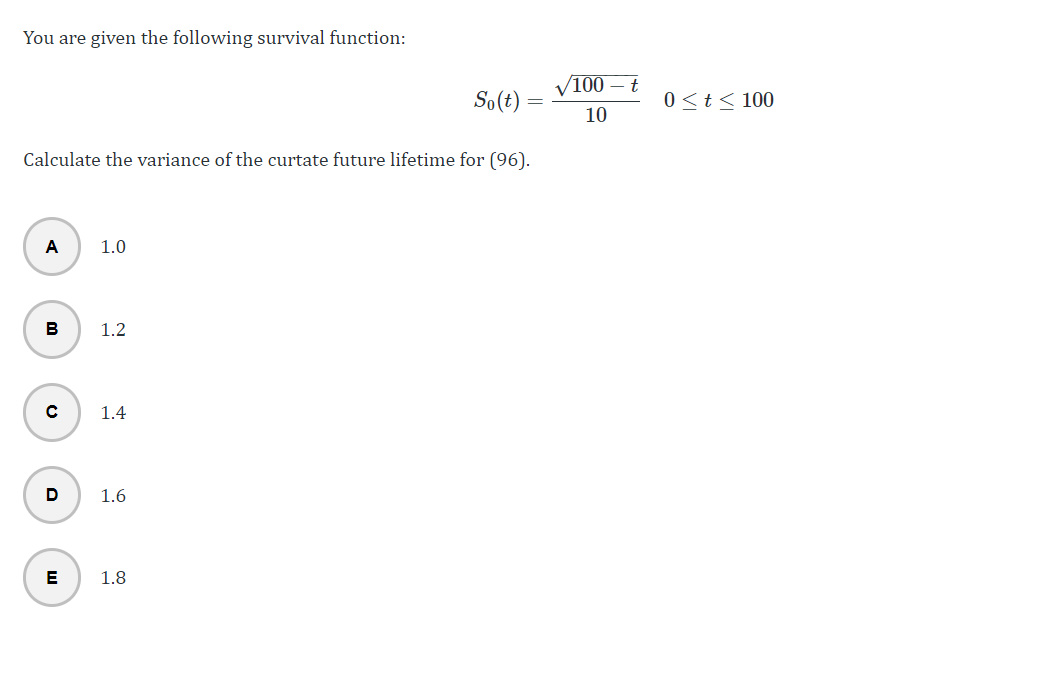
Problem: You are given the survival function for a newborn: for . Calculate the variance of the curtate future lifetime for (96).
Solution Strategy:
- Identify the random variable of interest: . The maximum age is , so a person aged 96 can live for at most 4 more years. This means can only take values 0, 1, 2, or 3.
- Calculate the required survival probabilities, , for .
- Use the probabilities to calculate the expectation, .
- Use the probabilities to calculate the second moment, .
- Finally, compute the variance: .
Step-by-step Calculation:
-
Survival Probabilities :
The formula is . Here, .
First, .- For : . So, .
- For : . So, .
- For : . So, .
- For : , so .
-
Expectation :
-
Second Moment :
-
Variance :
The closest answer is 1.2.
Conclusion
This lesson has equipped you with the primary formulas for calculating the moments of both complete and curtate future lifetimes. These are fundamental calculations in actuarial work, turning a complex survival function into tangible, interpretable metrics like life expectancy.
Key Takeaways:
- The complete expectation of life () is found by integrating the survival function: .
- The variance of the complete lifetime is .
- The curtate expectation of life () is found by summing survival probabilities: .
- The variance of the curtate lifetime is .
In our next lesson, we will begin our exploration of specific, named survival distributions that are commonly used in actuarial models, such as the Gompertz, Makeham, and Weibull laws. We will see how their specific mathematical forms simplify the calculation of these and other actuarial quantities.