Introduction
Welcome to Module 8: "LLM Evaluation Frameworks and Practices." In the previous module, we honed our skills in prompt engineering, culminating in techniques to make prompts robust, structured, and efficient. You learned to treat prompts as engineered artifacts. Now, we pivot from creating instructions for models to measuring the performance of the models themselves. This is a critical transition for an applied scientist, moving from user to evaluator.
Today's lesson addresses the learning outcome: Evaluate LLMs using standardized academic benchmarks (e.g., MMLU, HumanEval, GSM8K, TruthfulQA). When you see a new model released, accompanied by charts boasting superior performance, this lesson will equip you to understand what those charts mean. We will explore why standardized benchmarks are the bedrock of objective LLM comparison and dive into the specifics of several key benchmarks that measure everything from general knowledge to coding prowess.
1. The Need for a Standardized Yardstick
In the rapidly evolving landscape of LLMs, new models are released constantly. To make informed decisions—whether choosing a base model for fine-tuning or selecting a third-party API—we need an objective, reproducible way to compare them. This is where standardized benchmarks come in.
Top LLM Evaluation Benchmarks and How They Work
To start, let's establish why benchmarking is so fundamental in the field of AI. This article from Deepchecks provides a clear rationale.
Read the 'Introduction' and 'Why LLM Benchmarking Matters' sections. Focus on the core arguments for why a common evaluation standard is necessary for transparency and progress.
As the article highlights, benchmarks provide:
- Transparency and Objectivity: They ensure every model is tested under the same conditions, allowing for fair comparisons.
- Reproducibility: They enable independent researchers and engineers like yourself to verify the performance claims made by model providers.
- Identifying Strengths and Weaknesses: They help dissect a model's capabilities, showing where it excels (e.g., coding) and where it struggles (e.g., multi-step reasoning).
Without these shared standards, we would be left comparing models based on anecdotal evidence or proprietary, non-comparable metrics.
2. A Tour of Foundational Benchmarks
LLM evaluation isn't a single score; it's a multi-faceted assessment of different capabilities. Different benchmarks are designed to probe different skills. Let's explore some of the most common ones you'll see on model leaderboards.
To get a quick overview, this video introduces several popular benchmarks.
7 Popular LLM Benchmarks Explained [OpenLLM Leaderboard & Chatbot Arena]
This short video by bycloud provides a concise explanation of seven widely-used benchmarks.
Watch the segments explaining the following benchmarks. For each one, note what it measures and its question format: MMLU (00:49 - 01:33) ARC (01:33 - 02:07) HellaSwag (02:07 - 03:05) TruthfulQA (03:19 - 03:48) GSM8K (03:48 - 04:19)
Now, let's consolidate that information and add another crucial benchmark, HumanEval, into a more detailed breakdown.
General Knowledge and Reasoning
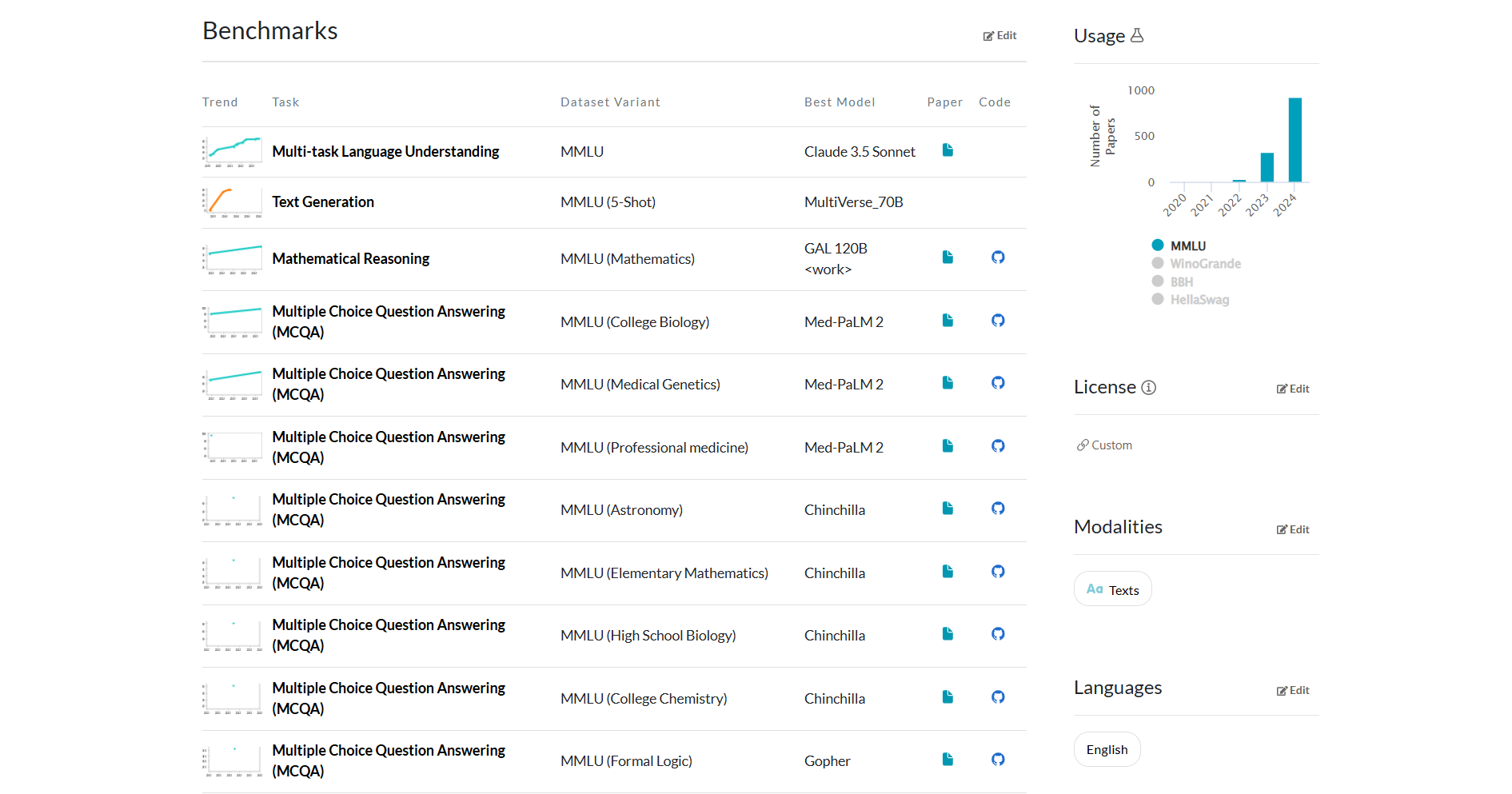
- MMLU (Massive Multitask Language Understanding): This is the heavyweight champion for testing broad, general knowledge. It comprises over 15,000 multiple-choice questions across 57 subjects, including humanities, social sciences, STEM, and more, with difficulties ranging from elementary to professional level. A high MMLU score suggests a model has a vast and accessible store of world knowledge.
- GSM8K (Grade School Math 8K): This benchmark tests a model's ability to perform multi-step mathematical reasoning. The problems are simple enough that a grade-schooler could solve them, but they require a sequence of logical steps (e.g., "Janet has 5 apples. She buys 3 more and gives half to her friend. How many does she have left?"). This is a surprisingly difficult task for many LLMs and serves as a strong indicator of their reasoning capabilities.
- ARC (AI2 Reasoning Challenge): This benchmark focuses on grade-school science questions that require genuine reasoning rather than simple information retrieval. The questions are often complex and cannot be easily answered by just searching for keywords.
Language and Commonsense Understanding
- HellaSwag: A test of commonsense inference. The model is given a context and must choose the most plausible ending from four options. The incorrect options are specifically generated to be tricky and fool models that rely on statistical patterns without true understanding.
- TruthfulQA: This benchmark is designed to probe a model's truthfulness and its tendency to repeat common misconceptions found in its training data. For example, it asks questions where a popularly believed but false answer exists. A good score indicates the model is less likely to generate "fluent falsehoods."
Domain-Specific Capability: Coding
- HumanEval: This is the standard for evaluating code generation. It consists of 164 programming problems, each with a function signature, a detailed docstring explaining the task, and a set of unit tests. The model's task is to write the Python code to complete the function. The evaluation is functional: the generated code is executed against the hidden unit tests. The score (
pass@k) measures the percentage of problems for which at least one ofkgenerated solutions passes the tests. A high HumanEval score is a strong signal of a model's proficiency as a coding assistant.
Test your understanding!
You are tasked with selecting an open-source model for three different projects:
- A chatbot that helps students with their high school math homework.
- An internal coding assistant to help your engineering team write Python scripts.
- A general-purpose Q&A bot for a public library website, where factual accuracy is paramount.
For each project, which academic benchmark would be most relevant for your initial model selection? Justify your choice.
Show answer
- Math Homework Bot: The most relevant benchmark is GSM8K. It directly measures the model's ability to handle multi-step mathematical reasoning, which is the core task of this application.
- Internal Coding Assistant: The most relevant benchmark is HumanEval. It specifically tests the model's ability to generate functionally correct Python code, which is exactly what this tool needs to do.
- Public Library Q&A Bot: The most relevant benchmark is TruthfulQA. While MMLU is important for general knowledge, TruthfulQA specifically tests the model's reliability and its ability to avoid spreading misinformation, which is a critical requirement for a public-facing informational bot.
3. How to Run Benchmarks: A Practical Walkthrough
Understanding the "what" and "why" of benchmarks is important, but as an engineer, you also need to know "how." The lm-evaluation-harness by EleutherAI is an open-source framework that provides a standardized way to run these evaluations on any model available on the Hugging Face Hub.
The following video is a comprehensive tutorial on using this framework. It covers the motivation, an overview of more benchmarks, and a step-by-step coding demonstration. We will focus on the practical implementation part.
What Do LLM Benchmarks Actually Tell Us? (+ How to Run Your Own)
This video by Adam Lucek provides an excellent, in-depth guide to LLM benchmarks, including a practical demonstration of running them yourself. We will walk through the entire process, from theory to execution.
This is a central resource for the lesson. Please watch the following segments carefully: Introduction (00:00 - 01:28): Reinforces why standardized evaluations are crucial. Benchmark Explanations (01:28 - 08:21): This provides a great review of MMLU, GSM8K, and other common benchmarks. Pay attention to the concept of n-shot evaluation (providing examples in the prompt). The Practical Walkthrough (14:33 - 27:06): This is the most critical part. Follow along as the presenter: Introduces the lm-evaluation-harness repository. Sets up the environment and dependencies. Constructs the command to run an evaluation (specifying the model, task, and number of shots). Explains the highly efficient log-likelihood scoring method for multiple-choice questions (24:45). This is a key technical detail that avoids slow, full text generation. Analyzes the resulting JSON output file.
Key Technical Insight: Log-Likelihood Evaluation
As highlighted in the video (24:45), for multiple-choice benchmarks like MMLU and ARC, the evaluation harness doesn't just ask the model to generate "A", "B", "C", or "D". That would be slow and unreliable to parse.
Instead, it uses a more clever and efficient method:
- For each possible answer choice (e.g., "A. Dry palms"), it appends that choice to the question prompt.
- It then calculates the log-likelihood of that complete sequence according to the model. This is essentially asking the model: "How probable would it have been for you to generate this exact text?"
- The answer choice that results in the highest probability (highest log-likelihood) is considered the model's "chosen" answer.
- This predicted answer is then compared to the ground truth to calculate accuracy.
This method is much faster as it only requires forward passes (inference) rather than iterative, token-by-token generation. Your experience with model internals and probabilities from traditional data science should make the elegance of this approach clear.
4. Interpreting the Bigger Picture: Leaderboards
Individual benchmark scores are useful, but they are often aggregated into public leaderboards to provide a single, comparative ranking. The most well-known is the Hugging Face Open LLM Leaderboard.
These leaderboards typically run a suite of key benchmarks (e.g., ARC, HellaSwag, MMLU, TruthfulQA) on a wide range of open-source models and calculate a weighted average score. This provides a quick way to see how models stack up against each other in terms of general capabilities.
However, a high rank on a leaderboard is a starting point, not a final decision. As we've seen, different tasks require different capabilities. A model at the top of the leaderboard might not be the best for your specific use case if its strengths don't align with your needs.
Top LLM Evaluation Benchmarks and How They Work
Let's revisit the Deepchecks article to understand the limitations of relying solely on benchmarks.
Read the section 'Limitations and Criticisms'. This is crucial for developing a critical eye as an engineer. Pay close attention to issues like data contamination and the gap between benchmark performance and real-world performance.
Conclusion
Today you've taken a significant step in your journey to becoming an elite AI engineer. You've moved beyond simply using LLMs to objectively measuring and comparing them. This skill is fundamental for model selection, evaluating fine-tuning experiments, and contributing to the broader field.
Key Takeaways:
- Standardized benchmarks are essential: They provide an objective, reproducible way to compare LLMs, using metrics like accuracy on tasks like MMLU (general knowledge), GSM8K (math reasoning), HumanEval (coding), and TruthfulQA (factuality).
- Evaluation is capability-specific: No single number tells the whole story. You must choose benchmarks that align with the target capabilities of your application.
- Practical tools exist: The
lm-evaluation-harnessis a powerful, standard framework for running these benchmarks on any model in the Hugging Face ecosystem. - Evaluation methods are sophisticated: Techniques like log-likelihood scoring are used for efficiency and accuracy in multiple-choice tasks.
- Be a critical consumer of results: Leaderboard rankings are useful but not absolute. Always consider the limitations of benchmarks and how they relate to your specific problem.
What's Next?
We've established the "what" and "how" of using standardized benchmarks. However, as the last reading pointed out, these benchmarks are not perfect. They can suffer from data contamination, they may not reflect real-world user interactions, and they can be blind to important factors like bias.
In the next lesson, we will build on this foundation to critically analyze the limitations, potential biases, and relevance of standard LLM benchmarks for specific applications. This will sharpen your analytical skills and prepare you to design more comprehensive and meaningful evaluation strategies.