Introduction
In our last lesson, we explored the "what" and "how" of standardized academic benchmarks, establishing them as an essential toolkit for objectively comparing LLMs. You learned to run these evaluations yourself using frameworks like lm-evaluation-harness.
Today, we transition from being a user of benchmarks to being a critical analyst. This is a crucial step in your journey toward becoming a top-tier applied scientist. While leaderboards provide a convenient score, a deep understanding of their limitations is what separates engineers who build fragile demos from those who build robust, reliable production systems. This lesson directly addresses the learning outcome: Critically analyze the limitations, potential biases, and relevance of standard LLM benchmarks for specific applications. We will deconstruct the hype around benchmark scores and equip you with the skepticism needed to make truly informed decisions.
1. The Benchmark Treadmill: Goodhart's Law in Action
A common sight in the AI world is a new model being released with a chart showing it topping leaderboards. Shortly after, the community adapts, and a new, harder benchmark is needed. This cycle is a manifestation of a principle you may know from other fields: Goodhart's Law.
"When a measure becomes a target, it ceases to be a good measure."
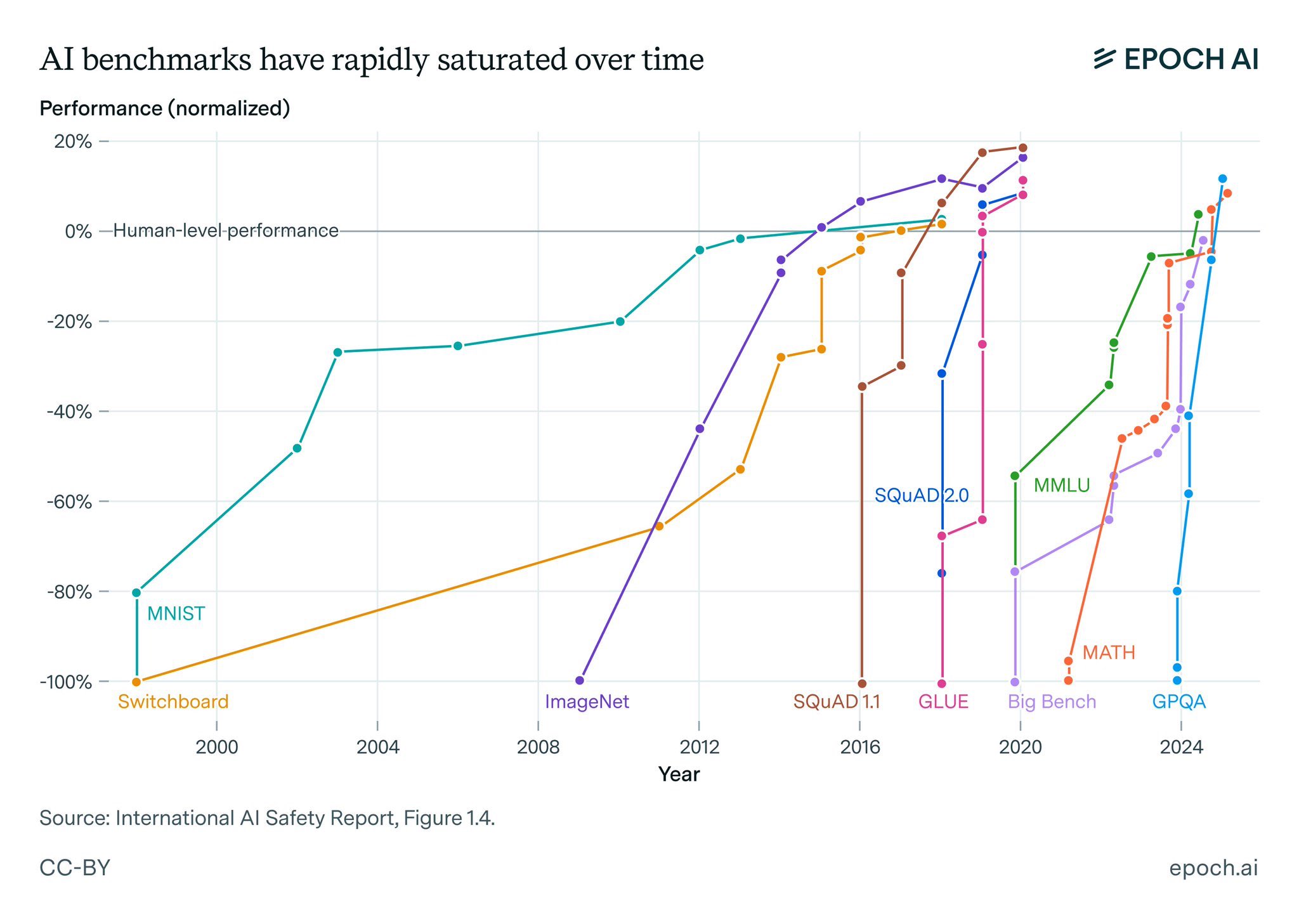
In the context of LLMs, this means that as soon as a benchmark like MMLU becomes the primary target for model developers, models become optimized to "win" the test, often without a corresponding improvement in the general capability the test was designed to measure.
To start, let's ground this critique in a rigorous analysis.
Line Goes Up? Inherent Limitations of Benchmarks for ...
This paper, 'Line Goes Up?', provides a strong theoretical and empirical argument against over-relying on benchmark scores. We will use it as a foundational text for our critique.
Read the Abstract, Introduction, and the section titled 'Problems with benchmarks', focusing specifically on subsection '2.1 Over-fitting to the benchmarks'. Pay close attention to the concepts of Goodhart's Law, data contamination, and task contamination. Notice the parallel drawn with psychometrics and IQ tests.
As the paper argues, this "teaching to the test" happens in two main ways:
- Data Contamination: The most direct form of overfitting. The benchmark's questions and answers are inadvertently (or intentionally) included in the model's massive training dataset. The model memorizes the answers, leading to an inflated score that reflects memory, not reasoning.
- Task Contamination: A more subtle problem. The model isn't trained on the exact questions but on the style and format of the benchmark. It learns statistical shortcuts and heuristics specific to the test, which don't generalize to real-world problems.
This image powerfully illustrates the rapid saturation of benchmarks, a direct consequence of this phenomenon.
2. The Fragility of Performance
If a model has truly learned a general skill, its performance should be robust to trivial changes in the problem's presentation. However, many models that top leaderboards are surprisingly fragile, revealing that they have learned superficial patterns rather than deep understanding.
This video provides striking examples of how sensitive benchmark rankings are to minor, irrelevant changes.
Everything WRONG with LLM Benchmarks (ft. MMLU)!!!
This video, titled 'Everything WRONG with LLM Benchmarks', gives concrete examples of the theoretical issues we just read about. It's a practical demonstration of benchmark fragility.
Watch the following segments carefully. They analyze a research paper that tested benchmark stability: Introduction to the problem (03:06 - 04:18): Understand the core thesis of the paper being discussed—that LLM leaderboards are highly sensitive to minute details. Symbol and Position Bias (05:16 - 06:29): Observe how dramatically model rankings change simply by altering the symbols for multiple-choice answers (e.g., A,B,C -> I,II,III) or by fixing the answer position in few-shot examples. Summary of Findings (07:09 - 08:41): This summarizes the key takeaways, including the susceptibility to various biases (symbol, order, few-shot) and the potential for benchmark leakage.
The video highlights several critical vulnerabilities:
- Symbol Bias: A model may perform worse if answers are labeled with
(i), (ii), (iii)instead of(A), (B), (C). - Positional Bias: A model might have a tendency to prefer answer
BorC, regardless of the content. - Few-Shot Bias: In few-shot prompting, if the examples provided all have
Aas the correct answer, the model might learn to just answerAfor the real question, ignoring the problem itself.
This fragility is a strong indicator that the model hasn't achieved robust, generalizable reasoning. It has simply overfit to the statistical properties of the benchmark's format.
3. The Gap Between Benchmarks and Reality
Perhaps the most significant limitation for an applied scientist is the disconnect between benchmark tasks and real-world application needs. A model can have a state-of-the-art MMLU score and still fail spectacularly at the specific task you need it for.
Evaluating LLM-based Applications
This presentation from Databricks offers a product-oriented perspective on why public benchmarks are fundamentally flawed for evaluating specific applications.
Watch these two key sections: Why Traditional ML Evaluation Fails (10:14 - 13:59): The speaker explains why the classic train/test/validation paradigm doesn't apply cleanly to pre-trained LLMs. This helps connect to your existing ML knowledge. Critique of Public Benchmarks (14:50 - 17:34): This is the core segment. The speaker argues that public benchmarks are flawed because they don't include your task and don't account for your specific setup (e.g., prompts, RAG system).
As an engineer building a product, you care about performance on your data, for your use case, with your system's specific prompts and context. An academic benchmark measuring knowledge of college-level chemistry is unlikely to be a good predictor of how well a model will perform as a customer service bot for a retail company.
The following reading provides a structured summary of these and other challenges.
Exploring LLM evaluations and benchmarking
This article from Weights & Biases provides an excellent, structured list of the key limitations you must consider when looking at benchmark scores.
Read the sections 'Key challenges in LLM evaluation' and 'Limitations of LLM benchmarks and how they affect evaluation'. This will give you a comprehensive checklist of potential issues, including: Non-deterministic outputs Lack of ground truth for open tasks Context and prompt sensitivity Bias in the benchmarks themselves
Test your understanding!
A startup announces "Pioneer-1," a new open-source model. Their blog post prominently features a chart showing Pioneer-1 outperforming Llama 3 and Mistral on the GSM8K benchmark by 5%.
Your team is considering using Pioneer-1 for a financial analysis application that requires summarizing reports and performing calculations. Based on today's lesson, what are three critical questions you would ask or lines of investigation you would pursue before trusting this benchmark score?
Show answer
Here are three excellent lines of inquiry:
- Investigate Data Contamination: Was GSM8K or a similar dataset part of Pioneer-1's training data? You could probe the model with exact questions from the GSM8K test set to see if it provides suspiciously perfect, memorized answers. A truly capable model should solve variants of the problems, not just the exact ones it might have seen.
- Test for Robustness and Fragility: Does the 5% lead hold up under minor perturbations? You could test Pioneer-1 on GSM8K-style problems with irrelevant information, different phrasing, or extra distractor numbers. If its performance degrades significantly more than Llama 3's, the benchmark "win" is likely due to overfitting to the benchmark's specific format, not superior reasoning.
- Question the Relevance: Does performance on grade-school math problems (GSM8K) actually predict performance on your financial analysis task? The tasks are different. GSM8K involves simple, multi-step arithmetic. Financial analysis involves parsing dense text, understanding domain-specific jargon, and potentially more complex calculations. You would need to create a small, custom evaluation set of real financial tasks to see if Pioneer-1's supposed reasoning advantage translates to your domain.
Conclusion
Today we peeled back the veneer of objectivity from LLM benchmarks. While they serve a purpose in tracking broad progress, you now have the critical framework to understand their profound limitations. A high score can be an illusion, masking a lack of true generalization and robustness.
Key Takeaways:
- Benchmarks are subject to Goodhart's Law: When they become targets, models are trained to "win the test," often through memorization (data contamination) or learning superficial patterns (task contamination).
- Benchmark performance is often fragile: Models can be highly sensitive to irrelevant changes in prompt format, wording, or answer choice symbols, indicating a lack of deep understanding.
- Benchmarks lack real-world relevance: Academic benchmarks rarely reflect the messy, specific, and dynamic nature of a production application. A model's score is not a reliable predictor of its performance on your specific task.
- Evaluation is multi-dimensional: Beyond correctness, benchmarks often fail to capture crucial aspects like safety, bias, fairness, and tone, which are critical for user-facing applications.
Being an elite AI engineer means questioning the numbers. It means understanding that a leaderboard is just one data point, and a flawed one at that. Your job is to build systems that work in the real world, and that requires moving beyond standardized tests.
What's Next?
We've established a strong case for why standard benchmarks are insufficient. This naturally leads to the question: "So, what should I do instead?"
In our next lesson, we will answer that question directly. We will move from critique to construction, learning how to design and curate custom evaluation datasets tailored to a specific business use case or domain. You will learn the practical steps for building a "private benchmark" that truly measures what matters for your application, forming the foundation of a robust and reliable evaluation workflow.