Introduction
In our previous lesson, we focused on building robust prompts that could handle ambiguous inputs and edge cases by adding detailed instructions, conditional logic, and examples. While this makes our applications more reliable, it introduces a new engineering challenge: long, verbose prompts are slow and expensive. They consume more tokens, leading to higher API costs and increased latency.
Today, we'll tackle this problem head-on. This lesson is designed to meet the learning outcome: Measure prompt token efficiency and apply techniques like prompt compression to reduce cost and latency. You will learn how to quantify the efficiency of your prompts and explore two categories of techniques—manual refinement and automated compression—to optimize them for production environments. This is a critical skill for an applied engineer, as it directly impacts the performance and operational cost of any LLM-powered system.
1. Why Token Efficiency Matters: Cost and Latency
Before we can optimize, we must understand what we're optimizing for. In LLM applications, token count is the fundamental unit of work, and it directly influences two critical performance indicators: cost and latency.
- Cost: API providers charge per token. A prompt that is twice as long costs twice as much to process. For an application handling thousands or millions of requests, even small reductions in prompt length can lead to substantial financial savings.
- Latency: The time it takes for a user to get a response is a key factor in user experience.
To understand latency, it helps to review the two-step process of text generation.
LLM Inference Performance Engineering: Best Practices
This article from Databricks provides an excellent overview of LLM inference performance. We'll use it to define the key metrics that prompt efficiency impacts.
Read the first two sections: 'Understanding LLM Text Generation' and 'Important Metrics for LLM Serving'. Focus on the distinction between 'prefill' and 'decoding', and understand the definitions of Time To First Token (TTFT) and Time Per Output Token (TPOT).
As you just read, latency has two main components:
- Time To First Token (TTFT): This is the time a user waits after sending their request before the first word of the response appears. It's heavily influenced by the "prefill" step, where the model processes the entire input prompt. A shorter prompt means a faster prefill and a lower TTFT, making your application feel more responsive.
- Time Per Output Token (TPOT): This is the speed at which subsequent tokens are generated. While less directly affected by the input prompt length, overall system load (driven by many long prompts) can impact this.
Therefore, prompt compression is primarily a lever to reduce cost and improve TTFT.
2. Manual Prompt Compression: The Art of Brevity
The first and most accessible way to improve prompt efficiency is through careful writing and structuring. This involves removing verbosity while preserving the core instructions. Think of it as refactoring your prompt's "code."
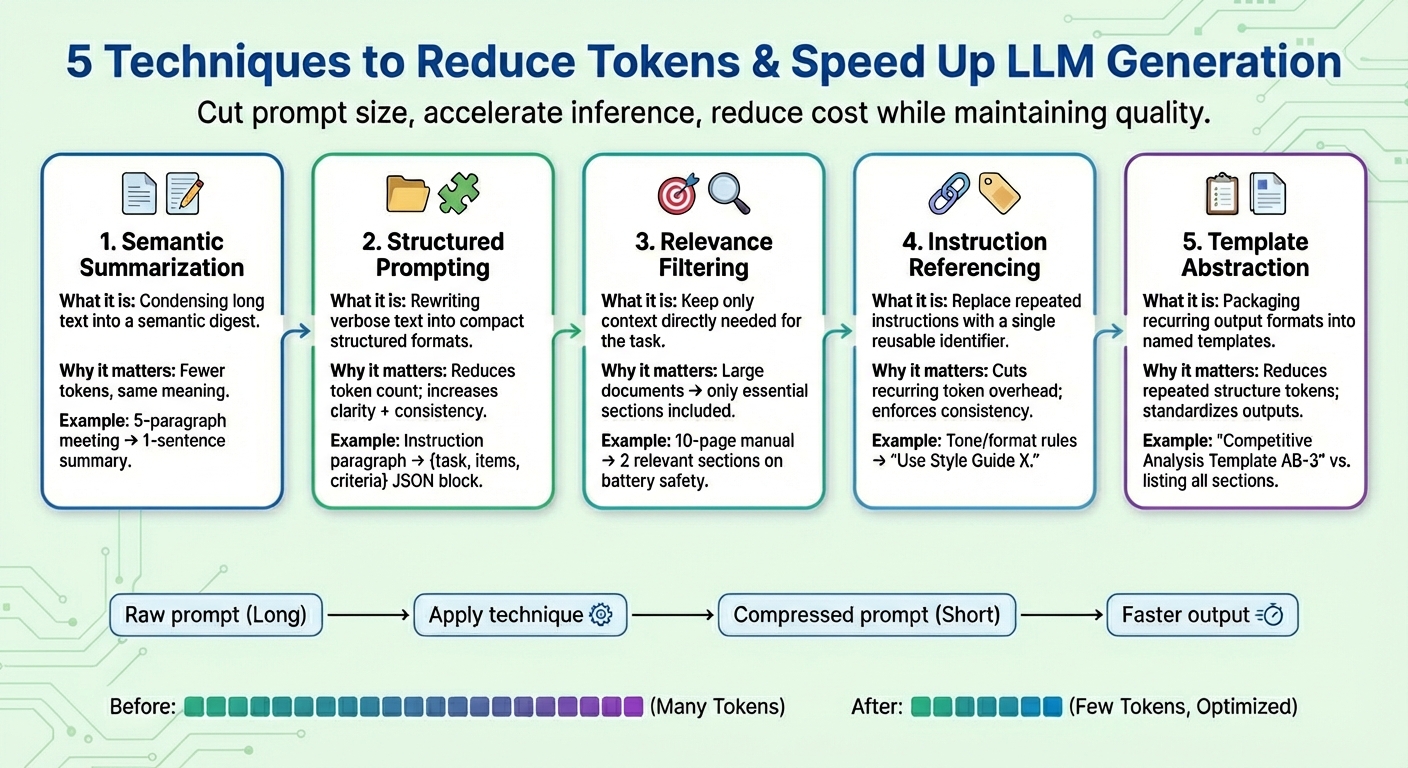
Let's break down these techniques:
-
Semantic Summarization & Relevance Filtering: Go through your prompt and ruthlessly cut filler words, redundant phrases, and polite but unnecessary sentences.
- Verbose: "Please kindly act as an expert AI assistant and provide me with a detailed summary of the following text." (20 tokens)
- Concise: "Summarize the following text:" (4 tokens)
-
Structured Prompting: Use markdown (like lists, headings, and code blocks) to structure your prompt. This is often more token-efficient and easier for the model to parse than long paragraphs of prose. We've been using this technique throughout the course.
-
Instruction Referencing & Template Abstraction: Separate your complex instructions from the data they operate on. Instead of repeating a long set of rules in every prompt, you can define them once and reference them. This is the core idea behind prompt templates.
- Inefficient:
prompt = "Rules: [all 500 tokens of rules]. Data: [user data]. Task: Apply the rules to the data." - Efficient:
template = "Rules: [all 500 tokens of rules]. Data: {user_data}. Task: Apply the rules to the data."and you only sendtemplate.format(user_data=...)for each call. The real savings come when you can store the rules and reference them with a short key.
- Inefficient:
Test your understanding!
Recall the robust IT helpdesk prompt from our previous lesson. The final version was quite detailed.
Original Snippet:You are an IT Helpdesk Bot for password resets. Your goal is to guide employees through resetting their password for one of the three supported systems: "Email", "VPN", or "HR-Portal". If a user's request is ambiguous (e.g., "I can't log in," "password help"), your response MUST be to ask for clarification. Respond with: "I can help with that. Are you trying to reset your password for Email, VPN, or HR-Portal?"
Apply at least two manual compression techniques to this snippet to reduce its token count while preserving its core logic.
Show answer
Here is one possible compressed version:
Role: IT password reset bot. Systems: "Email", "VPN", "HR-Portal". Task: Provide reset link for supported systems. If request is ambiguous (e.g., "I can't log in"): Ask: "I can help. Reset password for Email, VPN, or HR-Portal?"
Techniques Applied:
- Structured Prompting: Replaced prose with a key-value and list format (
Role:,Systems:,Task:). - Semantic Summarization/Relevance Filtering: "guide employees through resetting their password" became "Provide reset link". "your response MUST be to ask for clarification. Respond with:" became "Ask:". This is much more direct and token-efficient.
3. Algorithmic Prompt Compression with LLMLingua
Manual compression is a great start, but for maximum efficiency, especially with very long contexts like in RAG systems, we can turn to algorithmic solutions. The leading open-source framework for this is Microsoft's LLMLingua.
The core idea is to use a small, efficient language model (like GPT-2 or a specialized BERT model) to "pre-process" your prompt and remove tokens that are least likely to affect the final output.
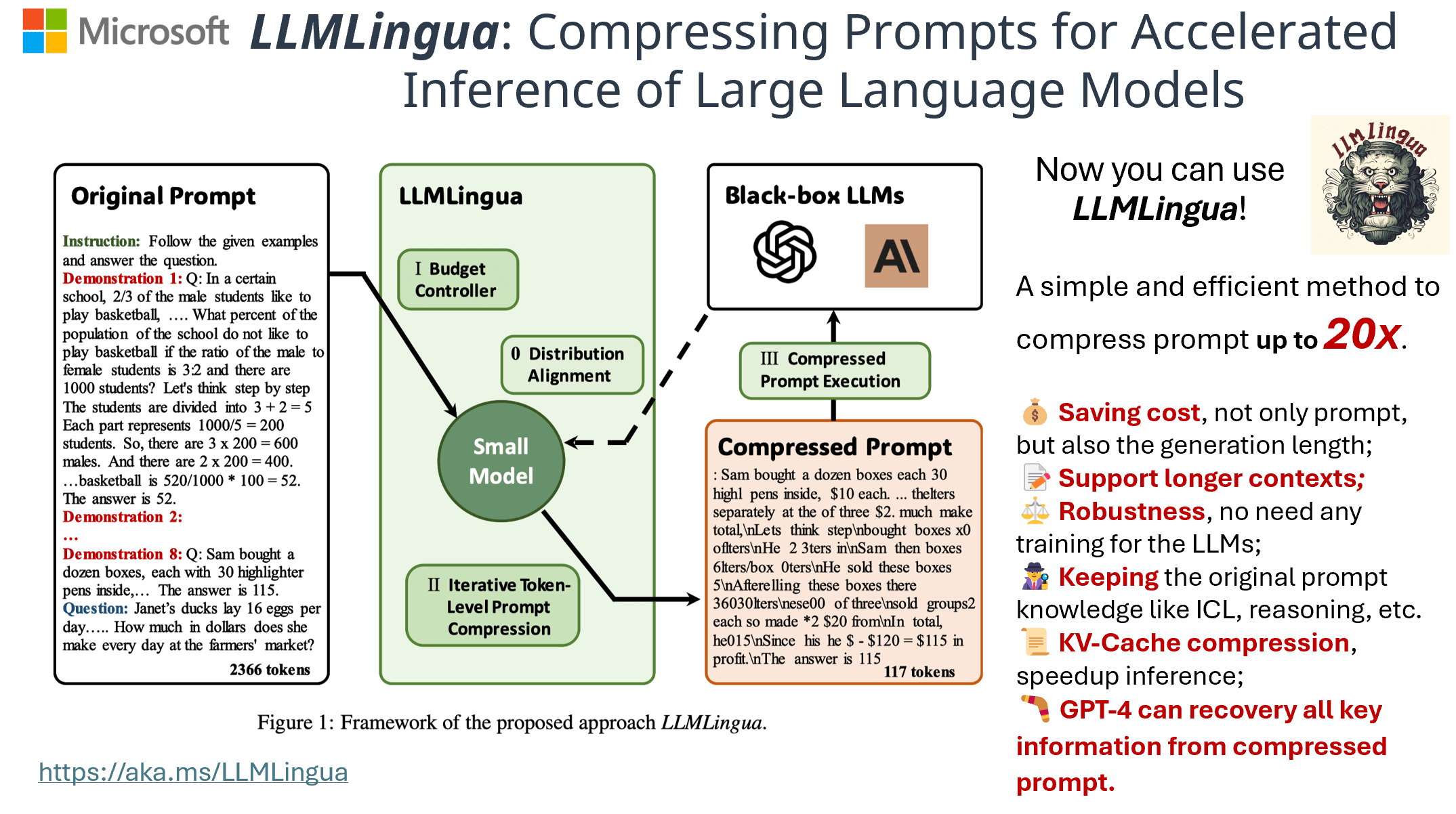
How does it decide which tokens to remove? The key concept is perplexity.
A Deep Dive into Microsoft's LLMLingua Prompt Compression
This article provides a superb deep dive into LLMLingua. It explains the core concepts, provides code, and analyzes the results.
Read the section 'How Does LLMLingua Work?'. Focus on understanding the principle of 'Perplexity-Based Token Importance' and the 'Coarse-to-Fine Compression' strategy.
In essence, LLMLingua calculates how "surprising" each token is.
- Low-perplexity tokens are predictable and common (e.g., "the", "is", "a", "please"). These are candidates for removal.
- High-perplexity tokens are informative and surprising (e.g., "refund", "deadline", "SQL-injection"). These are preserved.
LLMLingua then iteratively prunes the low-perplexity tokens until a target compression ratio is met, resulting in a prompt that may look like broken English to a human but contains the essential semantic kernels for the LLM.
Let's watch a video that demonstrates both a simple natural language approach and the more technical LLMLingua approach.
How Prompt Compression Can Make You a Better Prompt Engineer
This video by Mark Kashef provides a great practical overview of prompt compression, contrasting a simple 'lazy method' with the more technical LLMLingua method.
Watch the following two segments: The 'Lazy' Method (03:17 - 05:30): This demonstrates using an LLM itself to perform manual compression techniques, similar to what we discussed earlier. Notice how it removes filler and consolidates instructions into a list. The Technical Method (07:07 - 10:00): This shows the output of an LLMLingua-style algorithm. Pay close attention to how the compressed prompt is grammatically incorrect but retains key nouns, verbs, and entities. This highlights the difference between summarizing for humans and compressing for machines.
4. Implementation, Measurement, and Trade-offs
As an engineer, your job isn't just to apply a technique but to measure its impact and understand its limitations. Prompt compression is a classic engineering trade-off between efficiency and fidelity.
Measuring the Gains
The best way to measure efficiency is to compare the token counts and costs before and after compression.
A Deep Dive into Microsoft's LLMLingua Prompt Compression
Let's return to the LLMLingua article to see a practical example of how to implement and measure the results.
This is a key resource. Please review these sections carefully: 'Hands-On: Using LLMLingua': Skim the Basic Usage code snippet to see how simple it is to call the compressor. 'Code Snippets and results': Study the 'Results Comparison' and 'COST ANALYSIS' output tables. This is exactly how you measure efficiency. 'Limitations and Considerations': Read this section fully. Understanding the risks (information loss, compression overhead) is crucial. 'When Should You Use LLMLingua?': Review the decision flowchart. This provides a mental model for when to apply this technique in production.
As the article highlights, a 50% compression can yield a 30-40% reduction in latency and a 50% reduction in cost, which is significant at scale.
The Trade-Offs
However, compression is not free.
- Information Loss: Aggressive compression can remove critical details. A prompt about a "deadline of March 15, 2024" might be over-compressed to "deadline March", losing essential information.
- Latency Overhead: The compression model itself takes time to run. For very short prompts (<500 tokens), the time spent compressing might be greater than the time saved in the main LLM call.
- Task Sensitivity: For tasks requiring high precision, like legal analysis or code generation, the exact wording matters, and compression can degrade quality.
The key is to start with a conservative compression ratio (e.g., 20-30% reduction) and rigorously evaluate the output quality against a baseline before deploying in production.
Conclusion
You've now learned that prompt engineering is not just about effectiveness and robustness, but also about efficiency. A production-grade prompt is a balance of all three. You have added critical tools to your engineering toolkit for controlling the cost and latency of your LLM applications.
Key Takeaways:
- Token efficiency is a first-class concern: It directly impacts cost and user-perceived latency (TTFT).
- Start with manual compression: Clear, concise, and structured writing is the foundation of an efficient prompt.
- Use algorithmic compression for scale: Tools like LLMLingua offer powerful, automated compression for long-context applications like RAG by intelligently removing low-information tokens.
- Compression is a trade-off: Always measure the impact. Quantify the savings in tokens and cost, but also evaluate the final output quality to ensure you haven't lost critical information.
What's Next?
Over the last few lessons, you have learned to design prompts that are robust, can produce structured output, and are now efficient. As these prompts become more complex and refined, you'll need a way to manage them systematically. Simply copying and pasting long strings of text is not a scalable or maintainable engineering practice.
In our next lesson, we will address this by learning how to create and manage a library of prompt templates, turning your expert prompts into reusable, version-controlled, and easily integrated assets for your applications.