Welcome to your sixth lesson. In our last session, we built the professional's flywheel: you learned how a small, quantifiable edge (positive Expected Value), when executed repeatedly, leverages the Law of Large Numbers and the power of compounding to generate exponential returns. You now understand the mathematics of a winning game.
Today, we confront a harder truth: what happens when the game itself is not what you think it is? This lesson addresses the crucial distinction between Risk and Uncertainty. We will dismantle the amateur belief in certainty and replace it with the professional's framework for navigating a future that is fundamentally unknowable. Your goal is to internalize why "I was sure" is the most expensive sentence in finance and how to operate in a world where probabilities are, at best, educated guesses.
The Professional's Mindset: Thinking in Probabilities
Before we dissect the difference between risk and uncertainty, let's solidify the mindset of a professional operator. Amateurs look for tips and certainties; professionals think in statistical edges. The casino is the classic model for this mindset. A casino doesn't know the outcome of the next hand of blackjack, but it knows its precise statistical edge over the player. By playing thousands of hands, that edge is guaranteed to manifest as profit.
Thinking in Probabilities (Episode 011)
The video "Thinking in Probabilities" lays out this professional mindset. It explains how consistent results can be produced from uncertain individual events.
Watch the following segments: The Premise: Start with the core idea from the market's fundamental characteristic. The speaker contrasts trading based on statistics with trading on "gut feel" or hype. The Casino Paradox: The section from thinking like the casino explains how casinos achieve consistent profits from random outcomes. The key is having an edge and a large enough sample size. Two Layers of Belief: Pay close attention to the discussion on the micro and macro levels. This is the core mental model: accepting unpredictability on an individual trade (micro) while believing in predictability over a series of trades (macro).
This is the world of Risk. It is a domain where the potential outcomes and their probabilities are known, or at least can be estimated with reasonable confidence. The casino knows the rules of the game and the odds. This is a known-unknown. You don't know what the next card will be, but you know the statistical properties of the deck.
But what if a new law makes gambling illegal overnight? What if a power grid failure shuts down Las Vegas for a week? That is not risk. That is Uncertainty.
What Risk Is Not: The Fallacy of Volatility
Academic finance often equates risk with volatility, typically measured by standard deviation. This is a convenient definition because it's easily quantifiable. Your background in IT makes you familiar with using metrics because they are available, not necessarily because they are correct. As you'll see, this is a prime example.
Legendary investor Howard Marks provides a much more practical and profound framework. The following talk is one of the most important distillations of investment philosophy you will encounter.
Howard Marks, @oaktreecapital Co-Chairman, on Investing Risk – Wharton School Investor Series
This lecture by Howard Marks, Co-Chairman of Oaktree Capital, delivered at the Wharton School, deconstructs the conventional wisdom on risk.
This is a dense video, so we will tackle it in parts. First, watch from the critique of volatility. Marks argues that volatility is a symptom, but the true risk for an investor is the permanent loss of capital and the risk of missing major opportunities (opportunity cost). Next, watch the segment from "risk is unquantifiable". This is the heart of the lesson. Absorb these key points: Risk is a subjective opinion about the future; it cannot be precisely measured in advance. Crucially, risk is not quantifiable even after the fact. A profitable investment might have been a lucky bet on a risky proposition. A losing investment might have been an unlucky outcome from a prudent decision. This directly invalidates the "I was sure" mindset—the outcome alone tells you very little about the quality of the decision. Finally, watch his explanation of the classic risk-return graph from rethinking risk-return. This is a critical mental model.
Marks's key insight is that the simple, upward-sloping line taught in textbooks is dangerously misleading. It implies that taking more risk reliably gives you more return. If that were true, the investment wouldn't be risky by definition.
A more honest depiction looks like this:

This brings us to the core of the problem. Your Expected Value calculations from the last lesson work perfectly within one of these distributions. But Uncertainty is the possibility that you're in a different distribution than you thought, or that the distribution itself changes shape without warning.
Uncertainty and the Risk of Ruin
Uncertainty is the realm of the "unknown unknowns." These are the events you can't model, the risks you can't price, the outcomes you can't even imagine. The COVID-19 pandemic was an example of uncertainty. Geopolitical conflicts are driven by uncertainty.
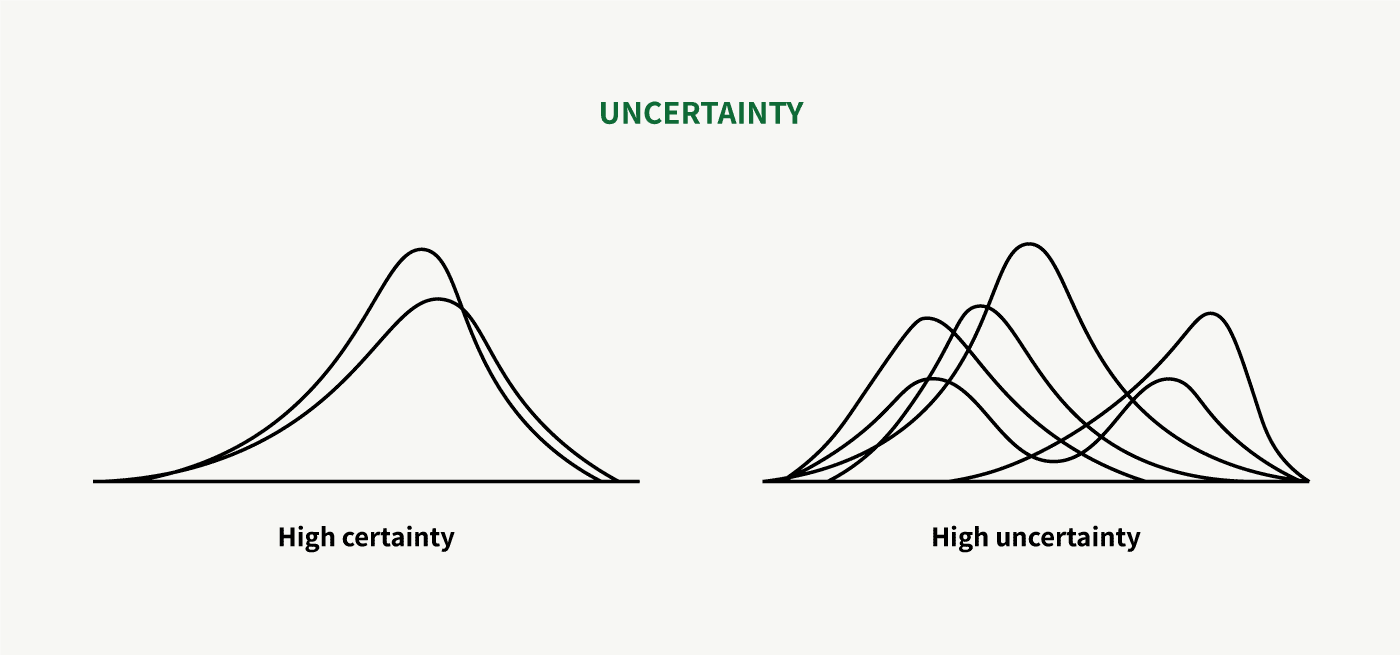
Amateurs conflate risk and uncertainty. They believe they can eliminate all bad outcomes through analysis. Professionals know this is impossible. Instead, they focus on one thing: survival. The most dangerous aspect of uncertainty is the risk of ruin—an event so catastrophic that it removes you from the game entirely, making it impossible for your edge to play out.
Mental Models – An Operator's Blog
This blog post from "An Operator's Blog" provides an excellent breakdown of this concept, drawing on the work of Nassim Nicholas Taleb.
Read the article from the beginning, focusing on the section on "defense". Pay close attention to the distinction between Ensemble Probability (a group of people each taking a risk once) and Time Probability (one person taking a risk repeatedly). As an investor, you live in the world of time probability. A small chance of a catastrophic loss, if taken repeatedly, guarantees ruin.
This is why the phrase "I was sure" is so lethal. It implies a belief that the risk of ruin is zero. It mistakes the most likely outcome for the only outcome. This is the "turkey problem" described by Nassim Taleb: a turkey is fed for 1,000 days, and every day its confidence grows that the farmer is its friend. On day 1,001, its model of reality is catastrophically invalidated. The turkey was "sure," based on all available data, but it was operating under a profound state of uncertainty it couldn't perceive.
John Maynard Keynes captured this perfectly with his famous warning, which is the ultimate counter-argument to stubborn conviction in the face of market action:
"Markets can remain irrational longer than you can remain solvent."
Your analysis might be perfect. You might be "right" about the intrinsic value of a company. But if the market decides to behave irrationally due to forces you can't model (uncertainty), and you are over-leveraged or haven't managed your risk, you will be forced to sell at a loss. Your brilliant analysis becomes worthless because you didn't survive.
Dealing with an Unknowable Future
So, if risk is only part of the story and uncertainty is un-modelable, how do you operate?
- Acknowledge Uncertainty: The first step is humility. Accept that the future is a probability distribution, not a single point you can predict. As Howard Marks says, "you can't predict, you can prepare."
- Focus on Process, Not Outcome: Since any single outcome can be the result of luck, you must judge yourself on the quality of your decision-making process, not the result of one trade. Did you have a positive EV? Did you size your position correctly? Did you respect your stop-loss? This is what separates professionals from gamblers.
- Ensure Survival: The primary goal is not to maximize returns; it is to stay in the game. This means avoiding leverage that can wipe you out, managing position size, and never betting the farm on a single outcome, no matter how "sure" you are.
- Build a Margin of Safety: This concept, which we will explore deeply in the valuation module, is about buying assets for significantly less than you believe they are worth. This buffer provides protection not just against errors in your own risk assessment, but against the blows of true uncertainty.
Howard Marks, @oaktreecapital Co-Chairman, on Investing Risk – Wharton School Investor Series
Let's return to the Howard Marks video for his conclusion on how to handle risk.
Watch the final segment on how risk should be handled. He emphasizes that risk control should be consistent, like car insurance—you don't only have it on days you expect a crash. It's about building an asymmetric portfolio: one that does well if things go right, but is protected if things go wrong.
Conclusion
You have now moved from the clean, mathematical world of expected value into the messy, unpredictable reality of markets.
- Risk is the enemy you can see. It involves known probabilities within a defined game. You can measure it, manage it, and price it. This is the world of your EV calculations.
- Uncertainty is the enemy you can't see. It involves unknown probabilities and unknown outcomes. It is the possibility that the rules of the game change without notice. You cannot eliminate it; you can only build a system robust enough to survive it.
The amateur believes their job is to be right. They say "I was sure" and are shocked when the world doesn't comply. The professional knows their job is to manage probabilities and survive. They say "I don't know," and build a process that doesn't require them to. This distinction is not academic; it is the fundamental dividing line between long-term success and eventual failure.
In our next lesson, we will explore the specific psychological biases that make it so difficult for humans to think this way. We will cover Market Myths and Dangerous Mindsets, examining the cognitive traps like overconfidence and narrative addiction that lure investors into ignoring uncertainty and paying the ultimate price.