In our last lesson, we drew a critical distinction between measurable risk and the profound, unknowable nature of uncertainty. You learned that the professional's primary concern isn't volatility but the permanent loss of capital, and that survival is the prerequisite for any strategy. We ended with Keynes's stark warning: "Markets can remain irrational longer than you can remain solvent."
Today, we're going to put that warning under a microscope. This lesson is designed to answer the very questions you've expressed a desire to master: Why do apparently good companies see their stocks collapse? How can objectively bad businesses suddenly "pump" to absurd heights? You're here to learn how to "smell" a stock, and that starts with understanding the market's most common and dangerous paradoxes. By the end of this session, you will be able to explain the core mechanisms behind these seemingly illogical market behaviors.
The Great Disconnect: Why Good Companies Can Be Terrible Investments
The amateur investor's first mistake is equating a good business with a good stock. They find a company they admire—one with great products, happy customers, and growing revenues—and assume it must be a great investment. This is a fatal error. The quality of the business is only one variable; the price you pay for it is what determines your return.
Legendary investor Howard Marks has a simple, powerful philosophy on this.
Howard Marks: In Investing Price Over Quality Every Time
This short memo from Howard Marks, co-founder of Oaktree Capital, distills this core principle into its most potent form.
Read the main body of the article, from the start of the memo to its conclusion. Focus on his statement: “everything is triple-A at the right price.” This is the foundation of the professional operator's mindset.
Marks's point is that paying too much for even the highest quality asset is a guaranteed way to lose money or achieve poor returns. The risk of overpaying is always present, especially when a company becomes a market darling and "everyone knows" it's a winner.
Let's look at a historical example that proves this on a grand scale.
[PDF] Are You an Investor or a Speculator? - Oaktree Capital Management
In this memo, Howard Marks provides a classic case study of what happens when investors forget that price matters.
Read the section discussing the "Nifty-Fifty" companies. Find the paragraph that starts here. Note what happened to the stocks of "America's greatest companies" when people believed it didn't matter what price they paid.
The Nifty-Fifty were the blue-chip stocks of the 1960s and 70s—companies like Xerox, IBM, Polaroid, and Coca-Cola. The belief was they were so good you could buy them at any price and hold them forever. The result? Many of these stocks fell 70-90% and took over a decade to recover, not because the businesses failed, but because their stock prices were bid up to irrational, unsustainable valuations.
This relationship between a company's performance and its stock price is often mediated by a key metric: the Price-to-Earnings (P/E) multiple. Think of the P/E as the price you're willing to pay for one dollar of a company's annual earnings.

A high P/E isn't inherently bad; it signifies high expectations for future growth. The danger arises when those expectations are already "priced in." If a company is trading at a P/E of 80, the market is expecting phenomenal growth for years to come. If the company delivers merely very good growth, the stock can get crushed as that high multiple contracts to a more reasonable level. The investment fails not because the company was bad, but because the starting price was set for an impossible level of perfection.
The Anatomy of a Pump: Why Bad Companies Can Skyrocket
Now for the opposite scenario, the one that truly separates a market operator from a textbook analyst. How does a company with questionable fundamentals—or even one on the verge of bankruptcy—see its stock price multiply by 10, 50, or 100 times?
This is not about value. It is about narrative, sentiment, and market mechanics.
The "Meme Stock" phenomenon provides a perfect template for this process.
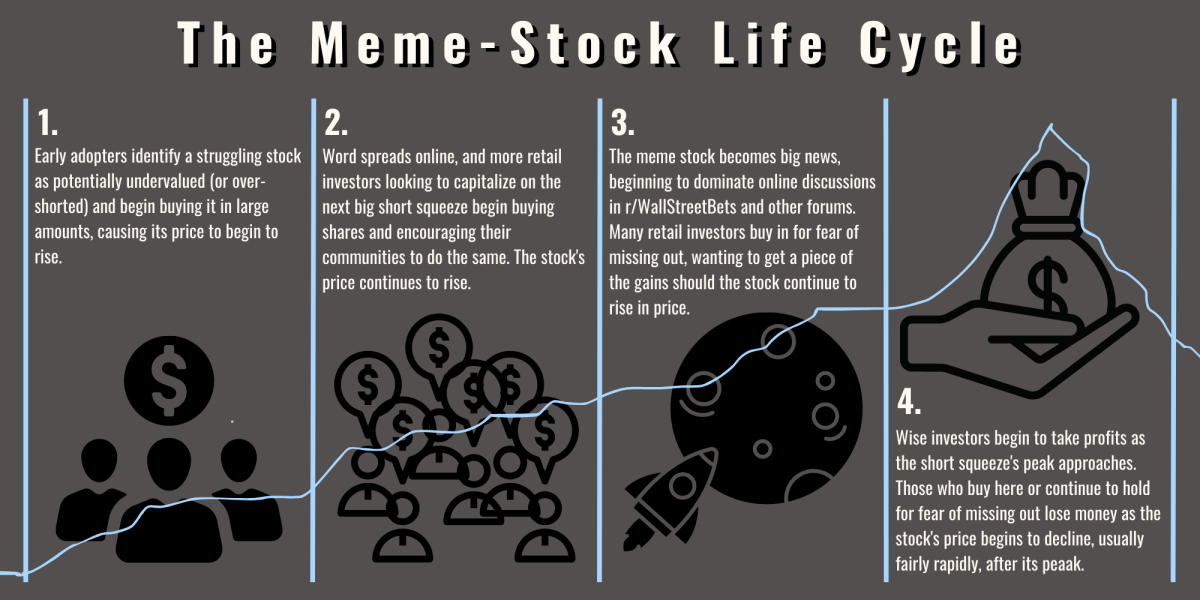
This is not a model of business fundamentals. It's a model of social contagion. But what is the fuel that allows this social fire to become a market inferno? Often, it's a powerful market mechanic called a short squeeze, which can be amplified into a gamma squeeze.
Let's dissect the most famous case study: GameStop (GME).
Gamma Squeeze Explained: Gamestop 2021 Short Squeeze Explained with Examples
The video "Gamma Squeeze Explained" breaks down the technical forces that powered the GameStop mania. Your IT background will be an advantage here, as this is fundamentally a systems problem where feedback loops run out of control.
Watch these segments in order: The Short Squeeze: First, understand the basic mechanism. Watch from the garden variety short squeeze. The key is the feedback loop: short sellers bet a stock will fall. If it rises instead, they are forced to buy shares to cover their losing position. This buying pressure pushes the stock even higher, forcing more shorts to cover. The Amplifier - Call Options: Now for the "steroids." Watch the primer on call options from the call option explanation. The critical takeaway is that options offer massive leverage, allowing speculators to control a large number of shares with a small amount of capital. The Gamma Squeeze: This is the core of the explosion. Watch from the explanation of market makers and gamma. This is the most complex part, but here is the logic: Retail speculators buy huge volumes of call options. Market makers (usually large banks or trading firms) are the ones who sell them these options. To stay neutral, the market maker must hedge their position by buying some of the underlying stock. For every call option they sell, they buy a certain number of shares (this is called "delta hedging"). As the stock price rises, the math of the option (its "gamma") forces the market maker to buy more and more shares to remain hedged. This creates an insane feedback loop: Speculators buy calls -> Market makers buy stock to hedge -> Stock price rises -> Market makers are forced to buy even more stock -> Stock price explodes. Putting It All Together: Finally, watch the summary from how it all happened. This connects the fundamental story (a struggling business), the short squeeze, the social narrative (WallStreetBets vs. hedge funds), and the gamma squeeze into one cohesive event.
The GameStop saga is the ultimate proof that a stock's price can become completely untethered from the underlying business's reality. The price was not driven by GameStop's sales figures; it was driven by a chain reaction of forced buying from different market participants trapped in a reflexive loop.
The Operator's Creed: Survival Over Solvency
We have now seen both sides of the coin: good companies that are terrible investments due to high prices, and bad companies that become rocket ships due to speculative mechanics. Both scenarios lead to a market that appears irrational.
This brings us back to the central theme from our last lesson. You can have a perfect valuation model showing that a Nifty-Fifty stock is worth only half its current price. You can have a detailed report proving a meme stock is fundamentally worthless. You can be 100% "right." But if you bet against the irrational tide with too much size or leverage, you will go broke long before the market comes to its senses.
Warren Buffett and his partner Charlie Munger built their fortunes by navigating this very problem.
How to Tell When a Stock is Cheap/Expensive (Masterclass in Stock Valuation)
The video "How to Tell When a Stock is Cheap/Expensive" contains several pearls of wisdom from these legendary investors that directly address today's topic.
First, watch the segment from the pitfalls of relative valuation. This gives a perfect example of how an entire sector can become irrationally overpriced, like during the dot-com bubble. Being "cheaper" than other insane valuations is not the same as being a good investment. Next, listen to Buffett explain his philosophy from his preference for predictable businesses. He states he views change as a threat, not an opportunity. This is the mindset of an operator focused on avoiding uncertainty, even if it means missing out on some "good" but unpredictable companies. Finally, hear Charlie Munger's take from on finding intrinsic value. He confirms there is no single, mechanical method. It's a game of multiple techniques and experience.
Conclusion
You came into this course wanting to understand why stocks really move. Today's lesson provides the foundational framework for that understanding. It's rarely a simple case of "good company, stock up; bad company, stock down."
Here are the key takeaways:
- A good company is not a good investment if the price is too high. The market's expectations, reflected in the valuation multiple (like P/E), are what matter. Overpaying is the easiest way to lose.
- Bad companies can "pump" due to forces completely unrelated to their business. Speculative narratives, social media hype, and powerful market mechanics like short and gamma squeezes can create price action that defies fundamental gravity.
- The market's irrationality can outlast your capital. Your primary job is not to be "right" but to survive. Fighting a powerful trend, no matter how fundamentally unjustified, is a losing game if you haven't managed your risk.
So what drives these waves of irrationality? They aren't random acts of nature. They are fueled by predictable, deeply ingrained flaws in human psychology. In our next lesson, we will dissect these Market Myths and Dangerous Mindsets, examining the cognitive traps like overconfidence, FOMO, narrative addiction, and hindsight bias that cause investors to overpay for quality and chase garbage to the moon.