In our last lesson, we established that markets are often not a reflection of a company's fundamental quality. You saw how great businesses can become terrible investments when overpriced and how fundamentally weak companies can "pump" to absurd heights on the back of pure speculation. We concluded that the market's irrationality can outlast your capital, making survival your primary job.
Today, we drill down to the source code of that irrationality: the human mind. The market seems chaotic because it's a massive aggregation of human decisions, and the human brain is riddled with predictable, exploitable flaws. This lesson isn't about "soft skills"; it's a technical examination of the cognitive bugs that cause the vast majority of traders to fail. Your background in technology will be an advantage here, as we'll be treating these psychological traps like bugs in an operating system that need to be identified, understood, and patched.
By the end of this session, you will be able to identify the four cognitive traps that destroy most traders: overconfidence, revenge trading, hindsight bias, and the most seductive of all, narrative addiction.
The Core Problem: An Ancient Brain in a Modern Arena
Before we dissect the specific traps, we must understand the root of the problem. Your brain did not evolve to trade financial markets. It evolved to ensure survival in a world of physical threats and immediate rewards. It's designed to make snap judgments, seek safety, avoid pain, and find patterns in randomness. As the article "Trading Psychology: How to Control Yourself in the Markets" explains, this wiring is the opposite of what successful trading requires.
Trading Psychology: How to Control Yourself in the Markets
This article provides a critical framework for understanding why trading feels so counter-intuitive. It moves beyond the simple "control your emotions" advice to dissect the brain's underlying architecture.
Read the following sections to build a foundational model: Start from the introduction to understand why your brain's evolutionary design is a mismatch for the market environment. Next, study the three-layer model. This cognitive/emotional/identity framework is key. Finally, read about the two competing voices. Pay close attention to the description of the "Narrative Voice."
The key takeaway is that you have a slow, logical "Rational Voice" and a fast, emotional "Narrative Voice." Most trading mistakes happen when the Narrative Voice hijacks your decision-making. The professional operator's job is to build a system that allows the Rational Voice to stay in command, especially under pressure. Let's look at the bugs the Narrative Voice exploits.
Trap 1: Narrative Addiction
This is the most pervasive trap. It’s the compulsion to weave a story around price movements to make them feel understandable and predictable. Amateurs look for a reason why a stock is moving; professionals analyze how it's moving and who is being forced to act.
A narrative provides comfort and the illusion of control. It turns a probabilistic environment into a simple, linear story: "The AI narrative is hot, so this AI stock must go up." This addiction is fueled by confirmation bias, the tendency to seek out information that supports our story while ignoring anything that challenges it.
This annotated chart provides a perfect visual representation of a narrative's lifecycle.
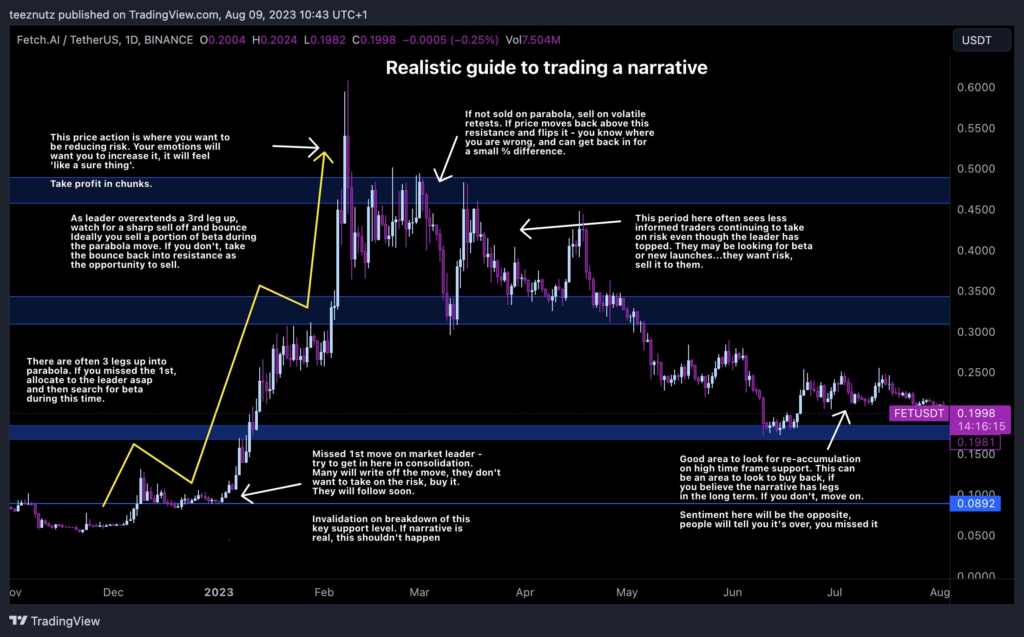
Notice how the annotations are not about fundamentals, but about sentiment and expectation. "This price action is where you will want to de-risk... your emotions will tell you to stay... it will feel 'like a sure thing'." This is the Narrative Voice at work.
Professional trader Tom Hougaard describes this trap as the "Illusion of Control."
5 Psychological Traps Even Pro Traders Fall For (Tom Hougaard)
In his video "5 Psychological Traps Even Pro Traders Fall For," Tom Hougaard explains how even the most basic trading activities can feed this illusion.
Watch these two key segments: First, watch his explanation of the Illusion of Control. He argues that most analysis is done not for analytical edge, but for the comfort of feeling like you know what will happen next. Then, watch his breakdown of Confirmation Bias. This is the engine that keeps a faulty narrative running, as your brain actively filters out evidence that you might be wrong.
The professional operator accepts they cannot control or predict the market. Their goal is not to write the story, but to respond to the price action as it unfolds, knowing that the story most people are telling themselves is likely wrong or, at best, already priced in.
Trap 2: Overconfidence
Overconfidence is the winner's curse. After a string of successful trades, your brain makes a critical error: it attributes what may have been a statistical fluke or good luck to superior skill.
This leads to a predictable set of mistakes:
- Increasing position size beyond your risk limits.
- Bending or breaking your established rules. ("This time is different.")
- Trading setups that don't meet your A+ criteria.
9 Years of Trading Psychology in 9 Minutes
The video "9 Years of Trading Psychology in 9 Minutes" offers a raw, first-hand account of this trap.
Listen to the speaker's personal story about how overconfidence cost him nearly $90,000. He had a fantastic year, felt invincible, and then gave back a huge chunk of his profits by forgetting his primary job: risk management. Then, watch his take on FOMO (Fear of Missing Out), a close cousin of overconfidence that compels you to chase trades you've missed.
Overconfidence is not the same as the genuine confidence you build in a proven, tested system. Overconfidence is an emotional state tied to recent outcomes. True confidence is a belief in your process, regardless of the last few results. The practical defense, as suggested in the "Cognitive Traps in Trading" article, is a simple pre-trade question: "Would I still take this if my last three trades were losers?" If the answer is no, you are being driven by emotion, not process.
Trap 3: Revenge Trading
When an overconfident position inevitably leads to a significant loss, the ego is wounded. The Narrative Voice screams, "You have to make it back!" This triggers revenge trading.
As Tom Hougaard masterfully explains, revenge trading doesn't feel like anger in the moment. It feels like opportunity.
5 Psychological Traps Even Pro Traders Fall For (Tom Hougaard)
This is perhaps the most important segment of Hougaard's video. He dissects the internal experience of revenge trading with chilling accuracy.
Watch his entire breakdown of Revenge Trading. The key insight is that you are not looking for a good trade; you are looking for relief from the pain of the loss. This is why it almost always leads to another, often bigger, loss.
Revenge trading is an emotional conversation with yourself, not a rational one with the market. You're trying to restore your sense of competence and control. The only way to win this fight is to not have it. The professional's protocol is mechanical: after a significant loss or a set number of consecutive losses, you walk away. You close the platform. You give the emotional response time to dissolve so the rational mind can come back online.
Trap 4: Hindsight Bias
This is the most insidious trap because it prevents you from learning from all the others. Hindsight bias is the tendency to look at past events and believe they were predictable. After a stock collapses, the Narrative Voice says, "I knew it all along."

This bias is a formidable enemy of progress.
- If you have a winning trade, hindsight bias tells you it was skill, feeding overconfidence.
- If you have a losing trade, it might tell you the outcome was an obvious fluke you should have seen, prompting you to ignore flaws in your process.
The defense against hindsight bias is brutal honesty, enforced by a trading journal. Not just a record of P/L, but a decision journal, as we will discuss in a future lesson. You must document your thesis and expectations before the trade, not after. This creates an unchangeable record of your thinking, preventing your memory from conveniently rewriting history to protect your ego. This is what the trader in the "9 Years of Trading Psychology" video means by holding yourself accountable.
Conclusion: The Operator's Toolkit
These four traps often form a vicious cycle: a compelling narrative leads to a winning streak, which breeds overconfidence. An unexpected loss then wounds the ego, triggering revenge trading. Afterward, hindsight bias prevents an honest post-mortem, ensuring the cycle repeats.
Breaking this cycle is the core of moving from amateur to professional. It is not about eliminating emotion—that's impossible. It's about building a robust process that functions despite these cognitive bugs. It's about creating a gap between feeling and action.
Key takeaways from this lesson:
- Narrative Addiction: The market is a probabilistic system, not a storybook. Your job is to react to price, not predict the plot.
- Overconfidence: Anchor your confidence in your process, not your recent P/L. A winning streak is often the most dangerous time to be trading.
- Revenge Trading: A loss is a sunk cost. Trying to "win it back" is an emotional act that leads to bigger losses. Have a hard rule for walking away.
- Hindsight Bias: You cannot trust your memory of past trades. Keep a journal to force an honest assessment of your decision-making process.
In our final lesson of this introductory module, we will shift from identifying these flaws to actively building the mindset to overcome them. We will cover "Building a Finance Brain," where we'll discuss the mental models and analytical habits required to question assumptions, verify data, and maintain emotional discipline—the very software that professional operators run.