Introduction
In our last lesson, we took a top-down view, learning how to read the macroeconomic weather—interest rates, inflation, and currency movements—to identify which sectors are likely to have the wind at their back. This is how you pick the right game to play. Today, we forge the tool you'll use to pick the winning horse in that game, especially when you're walking into an unfamiliar stable.
The objective of this lesson is to develop a universal checklist of key questions for analyzing a company, even in an industry you've never encountered. This isn't a rigid, bureaucratic form to fill out. Think of it as an analyst's operating system or a pilot's pre-flight check. It's a systematic process designed to enforce discipline, force you to confront critical questions, and prevent the emotional mistakes that wipe out most market participants. Mastering this framework is a crucial step toward building the "operational instinct" you seek—an instinct that is not magic, but the result of a deeply internalized, repeatable process.
The Philosophy of a Checklist
Before we build the checklist, we need to understand why it's one of the most powerful tools in an investor's arsenal. Legendary investor Charlie Munger was a fierce advocate for checklists, recognizing that they are the most effective defense against the brain's natural tendency to take shortcuts, overlook critical details, and fall for compelling but flawed narratives.
A checklist forces you to slow down and think. It ensures you assess a business from multiple angles—qualitative, quantitative, managerial, and competitive—before you even consider the price. The video below makes an excellent point about this process.
How I Research Stocks - Step-by-Step Fundamental Analysis
This clip from The Plain Bagel explains a key insight: the checklist isn't something you just find; it's something you build and refine over time as you gain experience.
Watch the short segment from this point. The key idea is that your checklist becomes a living document that captures your learning and hard-won experience. Today, we are building your version 1.0.
Our goal is to create a tiered checklist. This structure allows you to be brutally efficient, filtering out low-quality ideas in minutes, while providing a deep framework for the ones that survive the initial screen.
Tier 1: The 30-Minute Filter (Dealbreakers)
When you encounter a company in an unfamiliar industry, your first job is not to find reasons to invest, but to find reasons to disqualify it and move on. Time is your most valuable asset. This first tier of questions should be answerable within 30 minutes by reviewing the company's investor relations website, the latest investor presentation, and a quick scan of its financials. If the answer to any of these is a clear "no," you discard the idea.
- Can I understand how it makes money? If you can't explain the business model (e.g., "They sell enterprise software subscriptions to manage customer relationships") in a single sentence, it's outside your circle of competence for now.
- Does it generate actual cash? Profits can be an accounting fiction. Cash is reality. A simple but powerful test is to check if Cash Flow from Operations (CFO) is consistently greater than Net Income. If a "profitable" company is constantly burning cash, it's a massive red flag.
- Is the balance sheet a time bomb? Look at the total debt. A quick rule of thumb for non-financial companies is to be wary of a Debt-to-EBITDA ratio over 4x. Is there enough cash on hand to survive a tough year?
- Are there obvious integrity issues? Have there been recent accounting restatements? Did the auditor resign? Has management been sanctioned by regulators? These are what Brian Feroldi calls "gauntlet" items—instant disqualifiers.
- Is it being existentially disrupted? Is there a clear technological or business model shift that threatens to make this company obsolete? (e.g., A traditional broadcaster in the age of streaming, a physical retailer with no online strategy).
If a company passes this initial screen, it earns the right to a more significant allocation of your time.
Tier 2: The Core Analysis (The Deep Dive)
This is where the real work begins. We will systematically deconstruct the business using a framework synthesized from the best practices of professional analysts.
The Business, Its Industry, and Its Moat
First, you need to understand the company's place in the world. What game is it playing and how does it win?
How I Research Stocks - Step-by-Step Fundamental Analysis
In this clip, The Plain Bagel outlines the first step of any deep dive: understanding the business operations from top to bottom.
Watch the segment from this part. Pay close attention to the mention of sector-specific Key Performance Indicators (KPIs). This is the single most important key to analyzing a company in an unfamiliar industry.
To find these KPIs, read the "Business" section of the company's annual report (10-K) and look at its latest investor presentation. The company will tell you the metrics it uses to measure its own success. For a social media company, it might be Daily Active Users (DAUs); for a retailer, Same-Store Sales Growth; for a SaaS company, Annual Recurring Revenue (ARR).
Once you have the KPIs, you can assess the industry structure and the company's competitive advantage, or "moat." Porter's Five Forces is the classic framework for this.
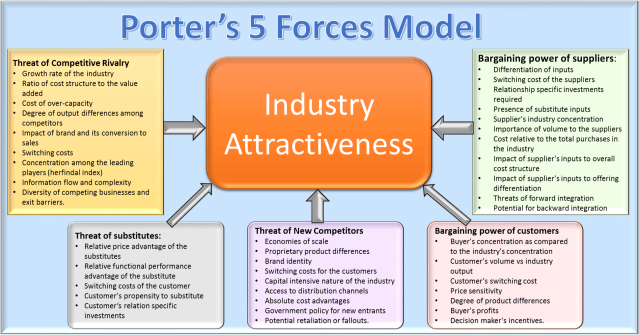
A moat is what protects a company from the brutal competition that Porter's model describes. Identifying the source of a company's moat is one of the most critical analytical tasks.
Brian Feroldi's Stock Investing Checklist: A Step By Step Guide
Brian Feroldi provides an outstanding, practical breakdown of the primary sources of competitive moats. This is a mental model you should commit to memory.
Watch the detailed explanation from the Moat section. He covers: Network Effect: The service gets more valuable as more people use it (e.g., Facebook, Visa). Switching Costs: It's painful (in terms of time, money, or effort) for customers to leave (e.g., your bank, Microsoft Excel). Durable Cost Advantage: The company can produce its product or service cheaper than rivals, usually due to scale (e.g., Walmart, Amazon's fulfillment network). Intangibles: Brand name that commands premium pricing (e.g., Apple, Tiffany), patents, or regulatory licenses. Counter-Positioning: A new business model that incumbents cannot easily copy without hurting their existing business (e.g., Netflix vs. Blockbuster).
Financial Health and Profitability
Numbers tell the story of a business. Your IT background gives you a significant advantage in systematically interrogating financial data. The goal is to use ratios not as answers, but as a way to ask better questions. The resource below provides an exhaustive list with current benchmarks.
Fundamental analysis checklist: Build your stock picking system
This article from Winvesta is a goldmine of quantitative benchmarks. It moves beyond generic definitions to provide real-world data on what constitutes 'good' performance.
Read the section titled "Financial health checks". Focus on understanding these key diagnostic clusters: Profitability: How effectively does the company generate profit from its capital? Look at Return on Equity (ROE) and Return on Invested Capital (ROIC). As the article notes, ROIC > 15% is a sign of an excellent business. Liquidity & Solvency: Can the company meet its short-term and long-term obligations? Look at the Current Ratio, Debt-to-Equity, and Interest Coverage Ratio. Earnings Quality & Fraud Detection: Are the reported profits real? Look at the Operating Cash Flow vs. Net Income ratio (should be > 1.0). The article also introduces two powerful forensic tools: the Altman Z-Score for bankruptcy risk and the Beneish M-Score for detecting earnings manipulation. These are advanced but incredibly valuable.
Growth and Future Potential
A great business is not enough; you need a great business with a pathway to grow and become more valuable.
Brian Feroldi's Stock Investing Checklist: A Step By Step Guide
Let's return to Brian Feroldi's checklist for a breakdown of what drives future growth. This is about looking forward, not just backward.
Watch the segment on the Potential section. He introduces two critical concepts: Optionality: A company's ability to launch new products and services, creating new revenue streams you can't even foresee today (Amazon Web Services is the classic example). Operating Leverage: The potential for profits to grow faster than revenue as the company scales. This happens when a business has high fixed costs that are already covered, so each additional dollar of sales brings in a much higher percentage of profit.
Tier 3: Conviction Builders
If a company has a clean bill of health and a solid business model, you move to the final tier. These are often qualitative factors that separate a good investment from a truly great one. They are about management's character and alignment with shareholders.
Brian Feroldi's Stock Investing Checklist: A Step By Step Guide
This final analytical section of Feroldi's framework covers the "softer" but crucial elements of management and culture.
Watch his breakdown of the management section, from this segment. Key questions to ask: Soul in the Game: Is the company run by a founder, or a hired CEO with a long tenure? Founders and long-term insiders often care more about the company's legacy than their next paycheck. Insider Ownership: Do managers own a significant amount of stock? You want their financial fortunes to rise and fall with yours. Glassdoor Ratings: Is it a place where talented people want to work? A toxic culture is a leading indicator of future problems. Mission Statement: Is it clear, concise, and inspiring, or is it corporate jargon? A clear mission helps guide decision-making throughout the organization.
Your Actionable Checklist (v1.0)
Here is a consolidated checklist based on our analysis. This is your starting point. Use it, test it, and adapt it.
Free Stock Analysis Checklist for Investment Research - Tiny Taikun
This resource from Tiny Taikun provides an excellent, well-structured checklist that you can download and use immediately. It aligns perfectly with the framework we've built.
First, read the introduction and the overview of the checklist's sections. Then, go to the download section and grab the Excel or Google Sheets version. This will be your personal template. Download the checklist and open it. As you review it, notice how its sections map to our tiered analysis: Understanding the Business & Industry Dynamics: This is the core of your analysis when facing an unfamiliar industry. Financial Strength: Our Tier 2 quantitative deep dive. Management Integrity & Capital Allocation: Our Tier 3 conviction builders. Growth, Valuation, Risk: These are the final outputs of your analysis.
Conclusion
Today, you've constructed a powerful tool: a systematic, multi-layered checklist for analyzing any company from a cold start. This process is your defense against narrative-driven investing and emotional errors. It forces you to be a detective, not a storyteller.
Key Takeaways:
- Checklists Enforce Discipline: They are a pre-mortem for your investment thesis, forcing you to consider what could go wrong before you commit capital.
- Use a Tiered Approach: Screen broadly for dealbreakers first (Tier 1), then commit time to a deep dive on the survivors (Tier 2 & 3). This optimizes your most valuable resource: your attention.
- Focus on Sector-Specific KPIs: When analyzing an unfamiliar industry, your first job is to identify the 2-3 metrics that truly drive success in that sector.
- Your Checklist is a Living Document: The template you downloaded today is version 1.0. With every company you analyze—every success and every failure—you will learn something new to add, refine, or emphasize.
We have now concluded our module on Sector Playbooks. You've learned to analyze specific industries and now have a universal framework for tackling any company. In our next module, "Derivatives: Weapons, Not Toys," we will shift gears. With a solid foundation in fundamental business analysis, you will be ready to explore the instruments that professionals use to express sophisticated views on risk, volatility, and timing.