Introduction
Welcome to Module 8. In the previous modules, you've built a solid foundation in analyzing businesses from the ground up and understanding the macroeconomic forces that shape the market. You know how to value a company and how to read the economic weather. Now, we shift from analysis to execution with advanced instruments. This module is about the "weapons, not toys" that professionals use to express sophisticated market views, manage risk, and construct targeted positions.
Today's lesson begins this journey by tackling the foundational building blocks of the derivatives world: futures and forward contracts. Our goal is to explain precisely how these instruments work and to dissect their two primary, and opposing, functions: hedging risk and speculating on price. Understanding this duality is the key to seeing derivatives not as gambling instruments, but as powerful tools for financial engineering.
The Fundamental Agreement: Locking in a Future Price
At its core, a derivative is a contract whose value is derived from an underlying asset. The simplest forms are forward and futures contracts. Let's start with the ancestor: the forward contract.
A forward contract is a private, customized agreement between two parties to buy or sell an asset at a specified price on a future date. It's like a handshake deal, legally binding but created "over-the-counter" (OTC), meaning not on a formal exchange.
To see this in action, watch the beginning of the following video, which uses a trade in barrels of oil to explain the basic premise.
Futures Contracts Explained: An Insight into Futures and Forwards
This video from Ryan O'Connell, CFA, FRM, provides a clear, step-by-step introduction to forward and futures contracts.
Watch the first three minutes, which cover the definition of a forward contract and a practical example of a payoff. Focus on how two parties agree today on a price for a transaction that will happen in the future. Pay attention to the concept of a zero-sum game, where one party's gain is the other's loss.
This raises a fundamental question: Why would anyone lock in a future price instead of just waiting and transacting at the spot price on that day? The answer lies in two opposing motivations: the desire to eliminate uncertainty (hedging) and the desire to profit from it (speculation).
The most intuitive use is hedging. Imagine a corn farmer who plants in the spring but harvests in the fall. She faces the risk that by harvest time, a bumper crop across the country could cause prices to crash, ruining her profitability. On the other side, a cereal company needs to buy corn all year. It faces the risk that a drought could cause prices to skyrocket, destroying its margins.
Both parties face price risk. A forward contract allows them to eliminate it. The farmer can agree to sell her corn at a fixed price, and the cereal company can agree to buy at that same fixed price. Both give up the chance of a windfall (if prices move favorably for them) in exchange for certainty.
This short animation beautifully illustrates this core purpose of risk management.
This video from Harvest Public Media simplifies the "why" of the futures market using the classic example of a corn farmer and a cereal company.
Watch the entire video. It's short and highly effective. Notice how it explains the problem for both the producer and the consumer of the commodity. Then, observe how a contract provides a hedge against price changes for both. The key insight is in the final section, explaining that this is a risk management tool, not a profit maximization tool.
From Handshakes to Exchanges: The Evolution to Futures
Forward contracts have major drawbacks. What if the cereal company goes bankrupt and can't honor the contract? This is counterparty risk. What if the farmer wants to get out of her contract early? It's difficult because the contract is a private, non-standard agreement. This is illiquidity.
To solve these problems, organized exchanges created futures contracts.
A futures contract is a standardized forward contract traded on a regulated exchange. The exchange acts as the middleman for all transactions, effectively eliminating counterparty risk. Let's break down this evolution and the key differences.
[PDF] A Trader's Guide to Futures - CME
This guide from CME Group, one of the world's largest derivatives exchanges, explains the origin and definition of futures.
Read the section "What Are Futures?". It begins after the table of contents. Focus on the distinction between private forward contracts and exchange-traded futures. Pay attention to the description of how futures contracts are standardized, leaving only price to be determined by the market.
The standardization of futures contracts introduces several critical differences from forwards. The video from Ryan O'Connell that you started earlier provides an excellent, structured comparison.
Futures Contracts Explained: An Insight into Futures and Forwards
Let's return to the Ryan O'Connell video for a detailed breakdown of the differences between forwards and futures.
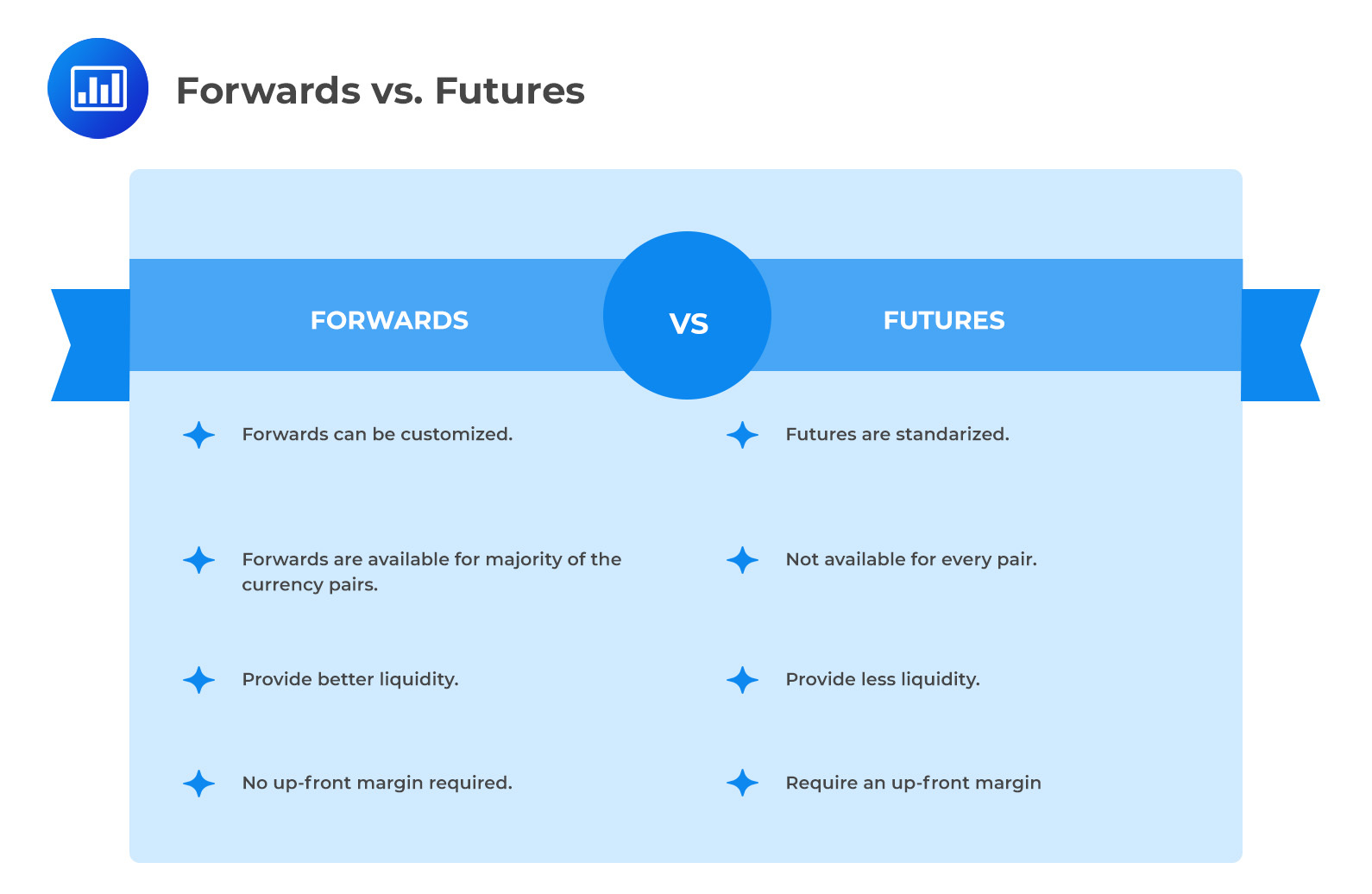
Watch the section from this point to the end. The video outlines seven key distinctions. As you watch, focus on these critical mechanics: Standardization: Futures contracts have fixed sizes (e.g., 1,000 barrels of oil, 5,000 bushels of corn) and quality grades, unlike customizable forwards. Settlement (Mark-to-Market): This is a crucial concept. Instead of settling once at the end, futures accounts are settled daily. If you make a profit on your position today, cash is credited to your account. If you lose, it's debited. This prevents large losses from accumulating and causing a default. Credit Risk: With futures, the exchange's clearinghouse guarantees every trade. Your counterparty is the exchange, not another trader, virtually eliminating the risk of default. Liquidity: Because contracts are standardized and fungible, it's very easy to enter and exit positions by trading on the exchange.
The image below summarizes the most important of these distinctions.
The Two Faces of the Market: Hedgers and Speculators
Now that we understand the mechanics, let's revisit the two types of market participants.
-
Hedgers: These are commercial players—like the farmer or the cereal company—who use futures to manage price risk inherent in their business operations. They have an underlying physical position or business need for the commodity or financial asset. Their goal is to reduce uncertainty and lock in costs or revenues.
-
Speculators: These are traders who accept the risk that hedgers want to offload. They have no underlying business interest in the asset. Their goal is to profit from accurately predicting price movements. They might be individual traders, proprietary trading firms, or hedge funds.
It's a common misconception to view speculators as mere gamblers. In reality, they play a vital role. Without speculators willing to take the other side of the hedgers' trades, the market would be illiquid and inefficient. Speculators provide the constant flow of bids and offers that allows a hedger to enter or exit a position at a fair price, exactly when they need to.
This symbiotic relationship is the engine of the futures market.
[PDF] A Trader's Guide to Futures - CME
This section from the CME guide explicitly defines the roles of hedgers and speculators.
Read the section titled "Who Trades Futures?". The key takeaway is that while futures help hedgers manage risk, the market would not be possible without speculators providing the necessary liquidity.
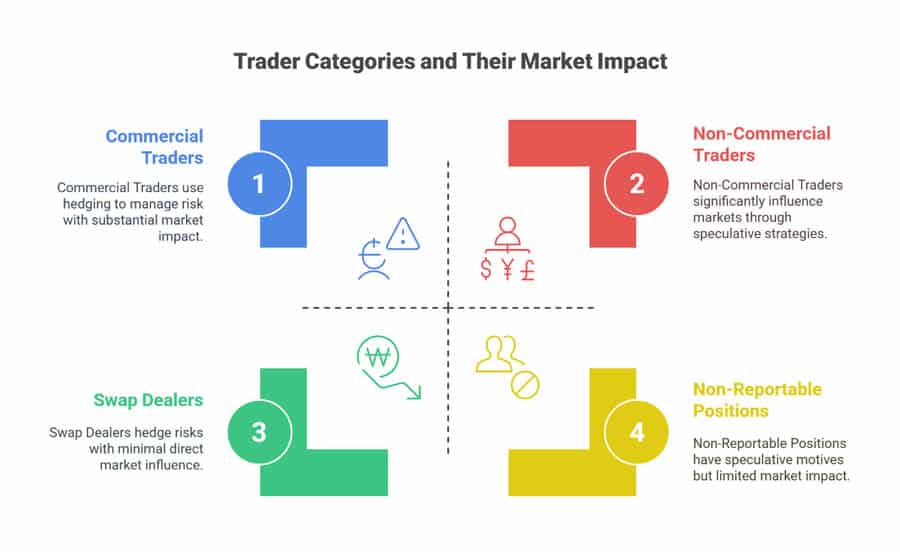
The following image provides a useful categorization of market participants often seen in market reports. "Commercial Traders" are the hedgers, while "Non-Commercial Traders" are the large speculators.
A Deeper Look at Hedging in Action
Let's make hedging more concrete with a detailed example. Imagine a US-based company agrees to buy equipment from a German manufacturer for €1 million, with payment due in three months. The US company is exposed to the risk that the Euro will strengthen against the Dollar, making the equipment more expensive.
[PDF] A Trader's Guide to Futures - CME
The CME guide provides excellent, detailed examples of hedging.
First, quickly review the example of the corn farmer to see the concepts from the animated video applied with real numbers. Then, focus your attention on the section "Hedging Currency Risk". This is a perfect illustration of a financial hedge. Walk through the math and see how buying Euro FX futures contracts offsets the loss from the strengthening currency, effectively locking in the initial cost of the equipment.
The Power of Leverage
One of the main reasons speculators are attracted to futures is leverage. Unlike in the stock market where buying on margin means taking out a loan, margin in the futures market is a "performance bond" or good-faith deposit. You only need to post a small fraction of the contract's total value (e.g., 3-12%) to control the entire position.
This capital efficiency allows a trader to control a large amount of an asset with a relatively small amount of capital. For a speculator, this magnifies potential profits (and losses). For a hedger, it means they can protect a large physical position without tying up huge amounts of working capital. Your IT background makes you comfortable with optimization; think of futures leverage as a tool for extreme capital efficiency.
Conclusion
In this lesson, we have deconstructed futures and forwards, the cornerstones of the derivatives market. You have learned not just what they are, but how they function and, crucially, why they exist.
Key Takeaways:
- Forwards vs. Futures: Forwards are private, customizable (OTC) contracts with counterparty risk. Futures are standardized, exchange-traded contracts with daily settlement (mark-to-market) and virtually no counterparty risk due to the clearinghouse guarantee.
- Hedging vs. Speculation: These are the two primary functions. Hedgers are commercial participants seeking to reduce pre-existing business risk. Speculators are traders who assume that risk in the hope of profiting from price changes.
- A Symbiotic Relationship: Speculators provide the essential liquidity that allows hedgers to manage their risks efficiently. One cannot function effectively without the other.
- Leverage: Futures offer high capital efficiency through performance bond margins, allowing participants to control large contract values with a small amount of capital. This magnifies both risk and reward.
Having mastered the mechanics of linear derivatives like futures, you are now ready to tackle their more complex cousins. In our next lesson, we will dive into the world of options. We will dissect the components of call and put options—strike price, expiry, and premium—and begin to understand why their non-linear payoffs make them some of the most versatile financial instruments ever created.