Introduction
In our last lesson, we deconstructed futures and forwards, establishing them as linear contracts with a firm obligation to transact at a future date. You learned that these are powerful tools for both hedging and speculation, but their payoff is symmetric: for every dollar of gain, there is a corresponding dollar of potential loss.
Today, we move from the world of obligations to the world of rights. We will deconstruct the fundamental components of an option contract, a financial instrument that offers one of the most powerful concepts in finance: asymmetric risk. Unlike a futures contract, an option gives the holder the right, but not the obligation, to buy or sell an asset. This distinction is the key that unlocks a universe of sophisticated strategies. Our objective is to dissect the anatomy of an option: its type (call or put), its core parameters (strike price and expiry), and its price (the premium), breaking the premium down into its two critical components: intrinsic and extrinsic value.
The Right, But Not the Obligation
At its heart, an options contract is a derivative that gives its buyer a choice. This is fundamentally different from the binding agreement of a futures contract. The price paid for this choice is called the premium. For the buyer, this premium represents their maximum possible loss.
There are two primary types of options:
- Call Option: Gives the holder the right to buy an underlying asset at a specified price. You buy a call when you are bullish and expect the asset's price to rise.
- Put Option: Gives the holder the right to sell an underlying asset at a specified price. You buy a put when you are bearish and expect the asset's price to fall.
To begin, let's watch a clear, visual explanation of how these two contract types work.
Options Trading for Beginners: Total Guide with Examples!
This guide from the "Business With Brian" channel provides an excellent introduction to the core concepts of options.
Watch the following segments to get a foundational understanding: What is an option? This section defines the contract and introduces the standard multiplier (1 contract = 100 shares). Call Options Explained: Watch from this segment to understand the mechanics of buying a call, including strike price, premium, and a profit/loss example. Put Options Explained: Continue watching from this segment to see how put options work as a mirror image for bearish bets. Recap: The final summary reinforces the key terms.
As the video explained, every option contract is defined by a few key parameters:
- Underlying Asset: The stock, ETF, or index the option is based on.
- Strike Price (or Exercise Price): The fixed price at which the holder has the right to buy (for a call) or sell (for a put).
- Expiration Date (Expiry): The date on which the option contract becomes void. The right must be exercised on or before this date.
Payoff and Profit: The Asymmetric Profile
The power of an option lies in its payoff structure. As an engineer, you can think of the payoff as a function with a floor at zero.
For a call option buyer, the payoff at expiration is:
Where:
- is the price of the underlying asset at expiration.
- is the strike price.
For a put option buyer, the payoff at expiration is:
The profit is simply the payoff minus the initial cost (the premium).
Call & Put Option Payoff Charts + Formulas (CFA/FRM)
This article from AnalystPrep provides the formal mathematical definitions and payoff charts for options, which will solidify the concepts from the video.
Read the following sections to master the calculations: Start with the introduction, which frames the risk/reward for buyers versus sellers. Read the section on Call Options. Pay close attention to the payoff and profit formulas. Next, read the section on Put Options, noting the symmetry in the formulas compared to calls. Finally, work through the two examples to see the formulas in action.
This asymmetric payoff is what makes options so compelling. The buyer's loss is capped at the premium paid, while their potential profit can be substantial. The seller (or "writer") of the option has the opposite profile: their gain is capped at the premium received, while their potential loss is theoretically unlimited (for a call) or very large (for a put).
Deconstructing the Premium: Intrinsic and Time Value
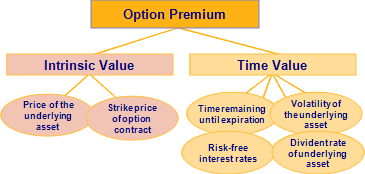
You now understand that an option has a price, the premium. But what determines this price? A common mistake is to think the premium is just a simple bet on direction. The reality is more structured. An option's premium is composed of two distinct parts: intrinsic value and extrinsic value (also known as time value).
1. Intrinsic Value
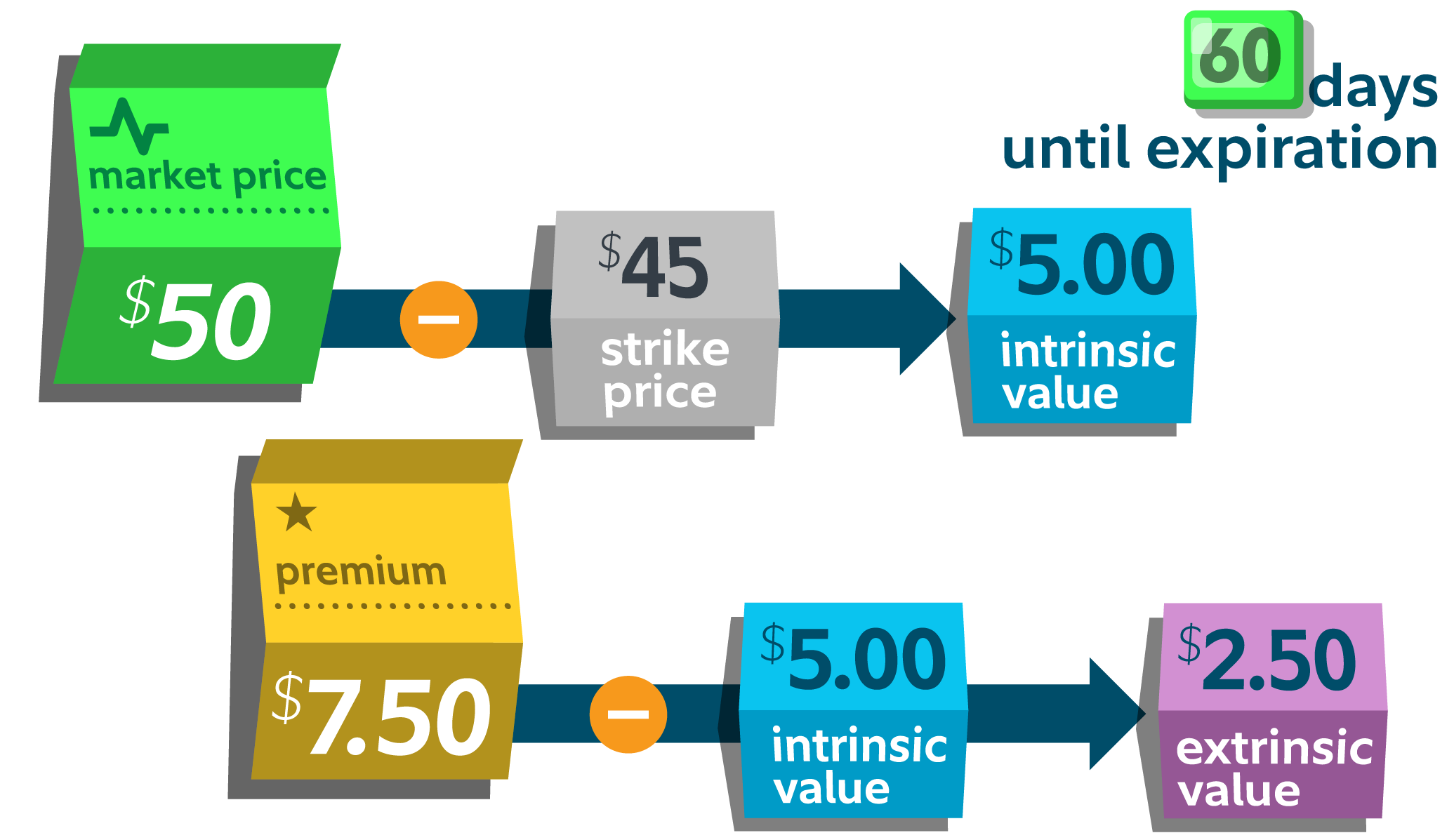
Intrinsic value is the value an option would have if it were exercised immediately. It is the "real" part of the option's value, representing the direct profit from the difference between the strike price and the current market price.
- For a Call Option: Intrinsic Value =
- For a Put Option: Intrinsic Value =
An option can only have positive intrinsic value. If the formula results in a negative number, the intrinsic value is simply zero.
This concept gives rise to the terminology of "moneyness":
- In-the-Money (ITM): The option has intrinsic value. A call is ITM when the stock price is above the strike price. A put is ITM when the stock price is below the strike price.
- Out-of-the-Money (OTM): The option has zero intrinsic value. A call is OTM when the stock price is below the strike price. A put is OTM when the stock price is above the strike price.
- At-the-Money (ATM): The stock price is very close to the strike price. These options have little to no intrinsic value.
2. Extrinsic (Time) Value
If an option has zero intrinsic value (it's OTM), why would anyone pay for it? The answer is extrinsic value. This is the portion of the premium that represents the possibility that the option could become profitable before it expires. It is the price of uncertainty and time.
Extrinsic value is driven by several factors, but the two most important are:
- Time to Expiration: The more time an option has until it expires, the more opportunity there is for the underlying stock to move into a profitable position. Therefore, its extrinsic value is higher. As an option approaches its expiration date, its time value decays, a process known as theta decay.
- Implied Volatility: This is the market's forecast of how much the stock price is likely to move. Higher expected volatility means a greater chance of large price swings, making the option more valuable.
The following image provides a concrete example of this breakdown.
To see how these concepts play out in a real trading environment, the following video offers an excellent practical demonstration.
Understanding ITM vs OTM Options (How To Pick The Strike Price)
This video from "Black Girl Stocks" provides a sharp, practical breakdown of "moneyness" and simulates how ITM, ATM, and OTM options behave differently.
Watch the following segments to get an operator's view of these concepts: Introduction to Moneyness: This defines moneyness and the difference between intrinsic and extrinsic value. ITM, OTM, and ATM Explained: This section details the characteristics of each state, including their relative cost and risk. Live Trade Example: This is the most critical part. The speaker simulates buying ITM, ATM, and OTM options to show how their profit and loss profiles differ over both short-term (day trade) and longer-term (swing trade) horizons. Pay close attention to how the cheaper OTM option can offer high percentage returns on quick moves, while the more expensive ITM option behaves more like owning the stock.
The simulation in the video is a critical piece of insight. It shows that there is no single "best" strike price to choose; it depends entirely on your strategy, your time horizon, and your view on volatility. This is a core part of moving from academic knowledge to an operator's instinct.
Conclusion
This lesson has armed you with the essential vocabulary and structural understanding of options contracts. You have moved beyond the linear world of futures into the non-linear, asymmetric domain of options.
Key Takeaways:
- Right, Not Obligation: An option grants the buyer a right to transact, with risk limited to the premium paid. This creates an asymmetric risk profile, a fundamental tool for traders.
- Calls and Puts: Calls are for bullish views (right to buy), and puts are for bearish views (right to sell).
- Core Components: Every option is defined by its underlying asset, strike price (the price of the right), and expiration date (the lifespan of the right).
- The Anatomy of a Premium: An option's price (premium) is not arbitrary. It is a sum of its intrinsic value (its immediate, exercisable worth) and its extrinsic value (the value of time and potential volatility).
- Moneyness (ITM, ATM, OTM): This classification describes an option's intrinsic value relative to the current stock price and is crucial for selecting a strategy.
You can now look at an options chain and understand what each contract represents. However, we have only covered the static components. The real power comes from understanding how an option's value changes dynamically as the market moves. In our next lesson, we will introduce the Option Greeks (Delta, Gamma, Theta, and Vega). These are the first derivatives of the option pricing model, and for an operator, they are the dashboard metrics that tell you exactly how sensitive your position is to changes in stock price, time, and volatility.