Introduction
In our last lesson, we established the fundamental structure of an option contract, breaking its price—the premium—down into intrinsic and extrinsic value. You learned that this price is not static; it's a living number that reflects the market's evolving expectations. But to move from simply understanding what an option is to predicting how it will behave, we need a more precise language.
This lesson introduces the Option Greeks: Delta, Gamma, and Theta. These are not just abstract letters; they are the core metrics on a professional trader's dashboard. For someone with your background in IT, you can think of them as the first- and second-order partial derivatives of the option pricing function. They measure the instantaneous rate of change of an option's value with respect to its key drivers: the underlying stock price, the rate of change of that price sensitivity, and the passage of time. Mastering the Greeks is the step that separates amateurs who are merely guessing from operators who are quantifying and managing risk.
Our objective is to explain the primary Greeks and how stock price movement and time decay directly alter an option's value. We will also touch upon Vega, the sensitivity to volatility, which is crucial for understanding why options can behave in non-intuitive ways.
The Dynamics of Option Pricing: An Overview
Before we dissect each Greek individually, it's helpful to get a high-level overview. The Greeks provide a framework for understanding and predicting how an option's price will react to changing market conditions.
Stock Option Greeks: Delta, Theta, Vega, Rho, & Gamma - Finance for Aspiring Quants
This video from the Socratica channel, aimed at aspiring quants, provides a concise and mathematically grounded introduction to the main Greeks. It frames them perfectly as the partial derivatives that describe the forces acting on an option's price.
Watch the following segments to build a conceptual map: Introduction: Understand what the Greeks are and their purpose. Delta: See how delta measures sensitivity to the stock price. Theta: Learn about time decay, the constant enemy of the option buyer. Gamma: This section explains gamma as a second-order effect—the rate of change of delta itself.
As the video highlighted, the price of an option is a function of multiple variables: , where is the stock price, is the strike, is time, is volatility, and is the interest rate. The Greeks are simply the partial derivatives of this function, like . They isolate the impact of each variable, allowing you to analyze risk one component at a time.
Delta (Δ): The Speed of an Option
Delta is the first and most important Greek. It measures the rate of change of an option's price for a $1 change in the price of the underlying stock. Think of it as the "speed" of your option position relative to the stock.
Delta, Gamma, Theta, Vega, and How They Affect Your Trades
This section from a TradeAlgo guide provides a clear, practical explanation of Delta, covering its values, its use as a probability proxy, and how it changes with moneyness.
Focus on these key points in the section What is Delta: The Definition: How Delta quantifies the price change. Values for Calls vs. Puts: Note the positive range (0 to 1.0) for calls and negative range (0 to -1.0) for puts. Delta as Probability: This is a crucial mental shortcut used by professionals. A 0.30 delta option has roughly a 30% chance of expiring in-the-money. How Delta Changes: Observe the description of the S-curve—how delta moves from near 0 (OTM) to near 1.0 (ITM).
A call option with a delta of 0.60 will gain approximately $0.60 in value for every $1 increase in the stock price. A put option with a delta of -0.40 will gain approximately $0.40 for every $1 decrease in the stock price.
This leads to a powerful realization:
- Deep in-the-money (ITM) options have deltas approaching 1.0 (for calls) or -1.0 (for puts). They behave almost identically to the underlying stock.
- Far out-of-the-money (OTM) options have deltas approaching 0. They are largely insensitive to small moves in the stock.
- At-the-money (ATM) options typically have deltas around 0.50 (for calls) or -0.50 (for puts).
This behavior isn't linear. The relationship between the stock price and an option's delta forms a characteristic S-curve. This non-linearity is where the next Greek becomes critical.
Gamma (Γ): The Acceleration of an Option
If Delta is the speed of an option, Gamma is its acceleration. It measures the rate of change of an option's Delta for a $1 change in the underlying stock price. Gamma tells you how quickly your directional exposure will change as the market moves.
This is what makes options fundamentally different from stocks. A stock's delta is always 1. Its gamma is 0. An option's delta, however, is dynamic, and gamma quantifies that dynamic nature.
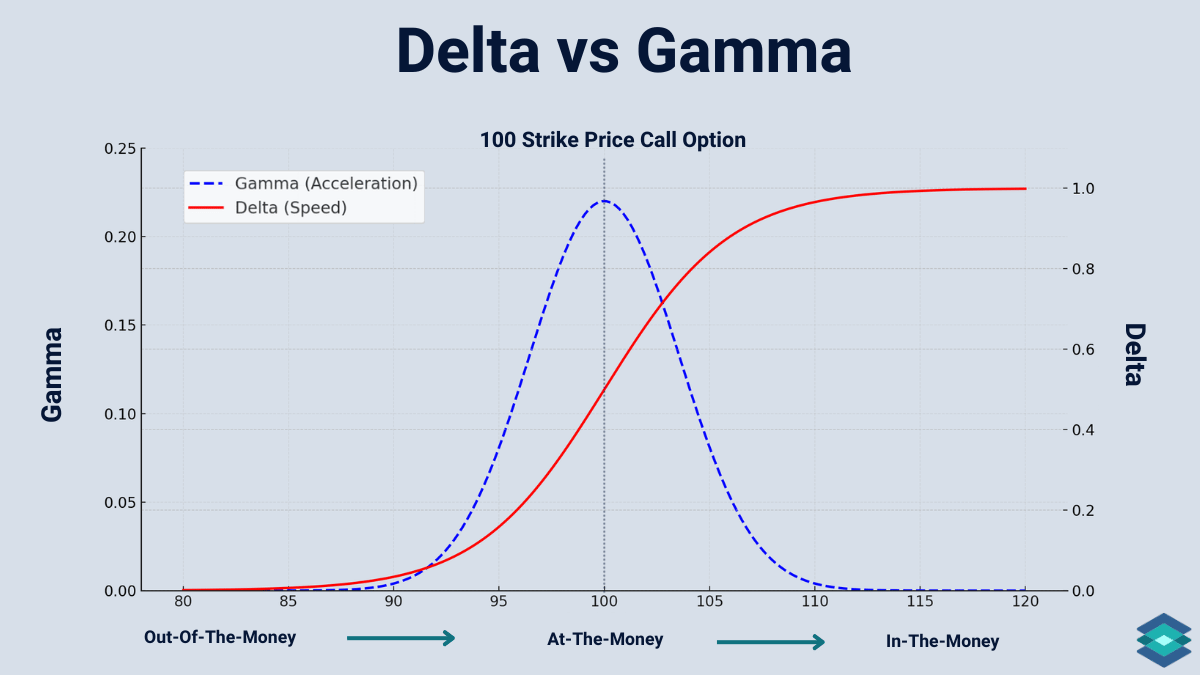
From the graph, you can see two crucial properties:
- Gamma is highest for ATM options. This is the point of maximum uncertainty, where the option's delta is most sensitive to price changes.
- Gamma is lowest for deep ITM and far OTM options. Here, the option's fate is more certain, so its delta is stable.
Long options (both calls and puts) have positive gamma. This is a huge advantage for the buyer. It means that as the stock moves in your favor, your delta increases, automatically giving you more exposure. As the stock moves against you, your delta decreases, reducing your exposure. You get "longer" as you are proven right, and "shorter" as you are proven wrong.
Short options have negative gamma, which is extremely dangerous. As the stock moves against the seller, their delta exposure worsens, accelerating their losses. This is the risk that option sellers (including market makers) take on, and it explains why they must constantly hedge.
Gamma isn't constant; it changes dramatically with time.

This phenomenon is known as a "gamma explosion." As an option gets closer to expiration, its gamma skyrockets, especially for ATM strikes. A small move in the stock can cause a massive swing in delta, forcing those with negative gamma (like market makers) to buy or sell large amounts of stock to re-hedge. This forced activity is a key driver of the heightened volatility often seen on expiration days. Understanding this gives you an operator's insight into why prices can move so violently.
Theta (Θ): The Unrelenting Cost of Time
Theta measures the rate of change of an option's price with respect to the passage of time. It is almost always negative for long options, representing the value an option loses each day due to time decay. If an option has a theta of -0.05, it will lose $0.05 of its value overnight, all else being equal.
Delta, Gamma, Theta, Vega, and How They Affect Your Trades
This next section from the TradeAlgo guide explains the non-linear nature of time decay.
Read the section titled What is Theta, paying close attention to: The Theta Acceleration Curve: Time decay is not a straight line. It accelerates dramatically as expiration approaches, especially in the last 30 days. The 0DTE Phenomenon: Understand why theta is the defining force for options expiring the same day.
For an option buyer, theta is a constant headwind. Your thesis on direction or volatility must overcome this daily erosion of value. For an option seller, theta is their primary source of profit. They are selling the right to time and volatility, and theta is the mechanism by which they collect their premium.
This brings us to one of the most fundamental concepts in options trading: the Theta-Gamma Trade-off.
From the Black-Scholes model, there's a direct mathematical relationship:
For a delta-hedged position, this simplifies to show that Theta and Gamma are inversely related. In simple terms:
- High Gamma (high convexity) comes with High Theta (high time decay).
- Low Gamma (low convexity) comes with Low Theta (low time decay).
You cannot get the benefit of positive gamma—the auto-adjusting delta—for free. The price you pay for it is theta. An operator understands this trade-off implicitly. When you buy a short-dated, at-the-money option, you are buying a high-gamma, high-acceleration instrument, but you are paying a very high daily "rent" (theta) to hold it. When you buy a long-dated option, you are paying less rent, but you get a less responsive instrument.
A Quick Word on Vega (ν)
While price and time are the most immediate drivers, there's a third critical factor: volatility.
Vega measures the sensitivity of an option's price to a 1% change in implied volatility.
Implied volatility (IV) is the market's expectation of how much a stock will move in the future. Higher IV means a wider expected range of outcomes, which makes options more valuable (as they benefit from large moves). Therefore, long options have positive vega.
Understanding vega is critical to solving a common puzzle that stumps new traders: why did my option lose money even though the stock moved in the right direction? This often happens after a major event like an earnings announcement.
- Before the event: Uncertainty is high, so IV and vega are high. The option premium is inflated.
- After the event: The uncertainty is resolved. Even if the stock moves favorably, IV collapses. This "IV crush" can cause the option to lose more value from the drop in vega than it gained from the move in delta.
Conclusion
Today, you've moved from a static view of options to a dynamic one. You now have the language to describe the forces that constantly shape an option's value. These aren't just theoretical concepts; they are the levers that professional traders use to construct, manage, and understand their positions.
Key Takeaways:
- The Greeks are the derivatives of the option pricing model, quantifying sensitivity to different market factors.
- Delta (Δ) is the speed: it measures an option's price change relative to the stock and serves as a probability proxy.
- Gamma (Γ) is the acceleration: it measures the rate of change of delta, capturing the non-linearity that is the essence of options. Positive gamma is the buyer's friend; negative gamma is the seller's risk.
- Theta (Θ) is time decay: the daily cost of holding a long option. Its decay is non-linear and accelerates near expiration.
- The Theta-Gamma Trade-off is a core principle: the benefits of high gamma (convexity) are paid for with high theta (time decay).
- Vega (ν) measures sensitivity to implied volatility and explains phenomena like post-earnings "IV crush."
In our previous lesson, you learned what an option is. Now, you can begin to think about what an option does. You have the tools to look at a position and assess its risks not just in terms of direction, but also in terms of convexity, time, and volatility.
In our next lesson, we will explore Hedging With Derivatives. Now that you can measure risk using the Greeks, we will see how professionals use this knowledge to manage that risk—not just to reduce it, but to shape it into a specific bet, such as creating a delta-neutral position to speculate on volatility alone.