Introduction
In our recent lessons, we've systematically dismantled price charts into their core components. You've learned to identify trends, gauge momentum with indicators like RSI and MACD, and, most recently, to spot the "coiled spring" of volatility contractions that often precede explosive moves. We have been learning the physics of the market. Now, it's time to build the machine.
This lesson marks a critical transition from analysis to action. We will assemble these concepts into a coherent, rules-based framework for a trend-following trade. Your objective is to define and document explicit rules for entry, exit, and stop-loss. This isn't about finding a "perfect" system; it's about building your first system—a repeatable, non-negotiable process that forms the bedrock of a professional operator's edge. Think of it as writing an algorithm for engaging with the market: if X and Y are true, then execute Z. This removes emotion and guesswork, replacing them with cold, calculated logic.
The Anatomy of a Trade Plan
Before writing the specific rules, we must understand the blueprint. A professional trading plan isn't a loose idea; it's a documented strategy with several key components.
The Complete Guide to Trend Following Strategies
Rayner Teo's guide provides a clear, high-level overview of the essential elements of any trading strategy. This sets the stage for the detailed rules we will build.
In the section "The Trendy Secrets," focus on the four elements he outlines. Read from the four points. While all are important, today our entire focus is on mastering point #4: knowing your setup, trade management, and exits. This is where the abstract idea of "trading" becomes a concrete set of instructions.
As Teo emphasizes, many traders obsess over entry signals but have no plan for what to do next. An operator knows their invalidation point (stop-loss) and their exit strategy (profit-taking) before ever committing capital.
Prerequisite: An Unambiguous Definition of Trend
To follow a trend, you must first define it with zero ambiguity. Relying on "eyeballing" a chart leads to inconsistency. We need a strict, binary rule for determining trend direction. An uptrend is a series of higher highs and higher lows. A downtrend is a series of lower highs and lower lows. The key is in defining what constitutes a valid high or low.
The Only Trading Strategy You'll Ever Need
The video "The Only Trading Strategy You'll Ever Need" provides an excellent, rule-based method for identifying valid market structure. This algorithmic approach is crucial for consistency.
Watch the segment from Step 1: Market Structure. Pay close attention to the core rule explained around this timestamp: A low is only validated if it breaks the previous high. Similarly, a high is only validated if it breaks the previous low. Internalize this logic. It prevents you from misinterpreting a minor pullback as a change in the primary trend.
This rule is your first line of code. Until the valid low of an uptrend is broken, the trend is considered intact, and you should only be looking for long opportunities.
Rule 1: The Entry Trigger
With a trend defined, you need a precise trigger for entry. Trend followers typically enter in one of two ways:
- Breakouts: Buying the instrument as it makes a new high, betting on momentum continuation.
- Pullbacks: Buying the instrument after it has temporarily dipped within an established uptrend, getting in at a better price.
Breakout Entry: Buying Strength
A breakout entry is an aggressive bet that the force driving the trend will persist. This often follows the volatility contractions we discussed previously. However, not all breakouts are created equal. We must filter for high-quality signals.
[Blueprint] Create a Simple Trend Following System · Nick Radge
In this interview, veteran trader Nick Radge explains how to build a robust trend-following system from scratch. He details how to move beyond overly simplistic rules.
Watch these two segments to understand how to construct a powerful entry signal: The Basic Entry: Watch this explanation of using a long-term breakout, like a 20-week high, as the initial trigger. The Filters: This is the critical part. Watch how Radge adds a confirmation filter (e.g., rate of change > 30%) to ensure the breakout has velocity. Then, watch his explanation of the regime filter, which ensures you're only buying stocks when the broader market is also in an uptrend.
These filters—Regime and Confirmation—are what separate a professional system from an amateur one. You are ensuring you have both the market's tide and the individual stock's momentum in your favor.
Pullback Entry: Buying the Dip
A pullback entry is a more conservative approach, aiming to join the trend at a discount. The key is identifying a logical area where buying pressure is likely to resume.
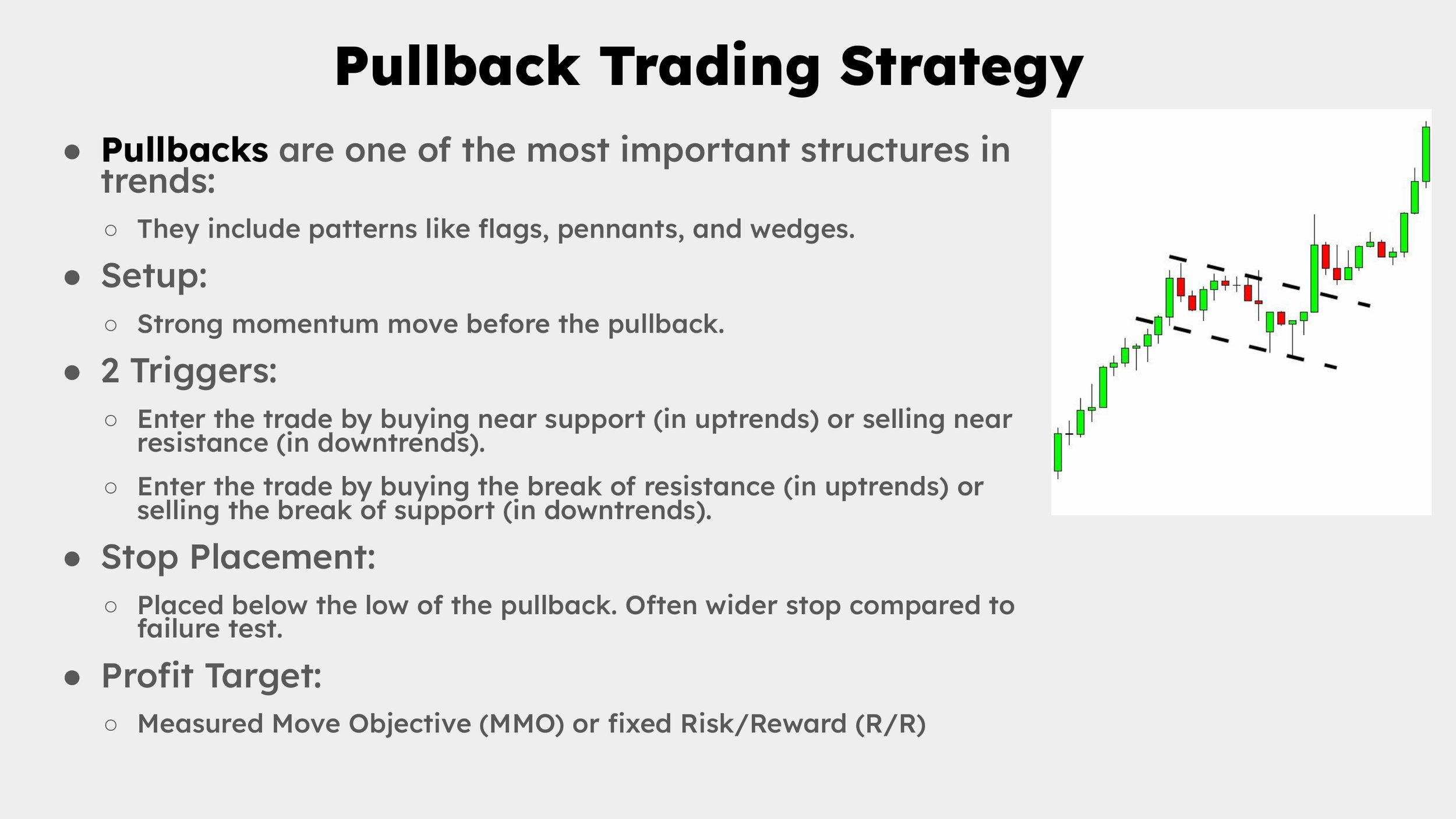
To make this more systematic, we can use the concept of "demand zones" from the TradingLab video. A demand zone is the area of consolidation just before the last strong upward move. A retest of this zone is a high-probability entry point.
The Only Trading Strategy You'll Ever Need
This video again provides a clear, visual rule for a pullback entry.
Watch the section on identifying supply and demand. In an uptrend, you are looking for demand zones. Then, see how this is applied in the chart example from this segment. The entry is triggered when the price returns to the demand zone created before the last impulse move.
Rule 2: The Invalidation Point (Stop-Loss)
The stop-loss is not an admission of failure; it is the pre-defined point at which your trade thesis is proven wrong. For trend followers, this concept is paramount, but it's applied differently than in other strategies. Trend following requires giving the trade room to breathe.
[Blueprint] Create a Simple Trend Following System · Nick Radge
Nick Radge's take on stop-losses is counter-intuitive for beginners but essential for trend followers. He explains why tight stops are a fatal flaw in this type of system.
Watch his detailed discussion on trailing stops, starting from this point. He argues for wide stops (around 20% or based on volatility like ATR) to avoid being shaken out by market noise. He puts this into a portfolio context, explaining that a 20% loss on one position is only a 1% loss on the total portfolio.
The key takeaway is that to catch big trends, you must endure normal pullbacks. A stop that is too tight guarantees you'll be knocked out before the real move happens.
Concrete Stop-Loss Rules:
- For a Breakout Trade: Place your stop based on volatility. A multiple of the Average True Range (ATR) is standard. For example, a 3x or 6x ATR "chandelier stop" as mentioned in the resources from Rayner Teo (LINK) and the deep dive article (LINK).
- For a Pullback Trade: Place your stop just below the pullback structure. As shown in the Pullback Trading Strategy image, this would be below the low of the flag/pennant. If using demand zones, the stop goes just below the zone, as shown in the TradingLab video.
Rule 3: The Exit Strategy (Taking Profit)
How do you know when the trend is over? A trend follower's answer is: you don't. You simply follow it until it bends. This means you don't use fixed price targets. Instead, you use a trailing stop-loss that moves up as the trend progresses, locking in profits until the trend finally reverses and stops you out.
The Complete Guide to Trend Following Strategies
This guide provides two excellent, concrete examples of trend-following exit rules.
First, look at the "discretionary" crypto strategy. In the section on exits, notice the exit rule: "wait for the price to close below the 20-period moving average." This is a classic moving average trail. Next, examine the "systematic" strategy. In the execution steps, the rule is to exit only if the price closes above/below the 6 ATR chandelier stop. This is a volatility-based trail.
The goal is to stay in the trade for as long as the trend is intact. Your biggest winners will come from the few trades that run for months or even years. A trailing stop is the mechanism that allows you to ride them.
As a final filter, especially for shorter-term trades, you can implement a minimum risk-to-reward ratio. This ensures the potential profit justifies the initial risk.

Assembling Your First Playbook
Let's now document a complete, explicit trend-following system based on these rules. This is your "Momentum Breakout" playbook.
- Trade Universe: Nifty 500 stocks.
- Timeframe: Daily chart for entries and exits.
- Regime Filter (System Prerequisite):
- Rule: No new long trades are initiated unless the Nifty 50 index is trading above its 200-day simple moving average.
- Entry Rules:
- Trigger: Buy when a stock's price closes at a new 52-week (252-day) high.
- Filter: At the time of the breakout, the 20-week (100-day) rate of change must be greater than 25%.
- Execution: Enter at the market open on the day following the signal.
- Stop-Loss Rule (Invalidation):
- Initial Stop: Place an initial stop-loss at 3 times the 20-day Average True Range (ATR) below the entry price. This is your maximum acceptable loss.
- Exit Rule (Profit Taking):
- Trailing Stop: After entry, trail the stop-loss daily. Exit the trade if the price closes below the 20-day exponential moving average (EMA). Using the close prevents being stopped out by intraday volatility spikes.
This is a complete, mechanical system. There is no room for debate or feeling. You run your scan, check the rules, and execute.
Conclusion
Today you've transitioned from being a market observer to a system architect. You've learned that a professional trading approach is not based on hunches, but on a well-defined and rigorously documented set of rules. This process, when followed with discipline, is the source of a true trading edge.
Key Takeaways:
- A Plan is Non-Negotiable: A trade plan must have explicit, documented rules for entry, stop-loss (invalidation), and profit-taking (exit).
- Define Your Conditions: You must have an unambiguous rule for identifying the market state (e.g., trend direction, market regime) before you can even consider a trade.
- Entry is a Trigger, Not a Guess: Use filtered signals like breakouts with momentum confirmation or pullbacks to defined demand zones.
- Stops are for Invalidation, Not Fear: Trend following requires wide, volatility-based stops (like an ATR multiple) to survive market noise and capture the majority of a trend.
- Exit by Trailing, Not Predicting: The most profitable trends are unpredictable in length. Use a trailing stop (like a moving average or chandelier stop) to ride them as long as possible.
In our next lesson, we will build a playbook for the opposite market condition: range-bound, or mean-reverting, markets. You will learn the rules for trading when there is no clear trend, further expanding your operational toolkit.