Introduction
In the last lesson, we navigated the critical space between a company's calculated intrinsic value and its current market price. You learned that a gap between the two isn't an automatic buy signal; it's an invitation to investigate whether you've found a true bargain or a value trap. We established that the quality of the business, particularly its ability to generate returns on invested capital, is the deciding factor.
This lesson builds directly on that foundation. Knowing a company's intrinsic value is an intellectual exercise; deciding to buy it is an act of capital allocation. Today, we will formalize the single most important principle that bridges that gap: the Margin of Safety. This isn't just a formula; it's a core tenet of the professional operator's mindset, designed to ensure survival and profitability in a world where forecasts are always wrong. By the end of this lesson, you will be able to apply this principle systematically to determine a disciplined buy price for any investment.
The Philosophy of Error: Why a Margin of Safety is Non-Negotiable
Valuation is an attempt to pin a precise number on an uncertain future. Every DCF model is a collection of assumptions about growth, profitability, and risk. No matter how rigorous your analysis, these assumptions will be, at best, a well-informed guess. The market is a complex, chaotic system, and unforeseen events—a new competitor, a regulatory change, a shift in consumer taste—can render your forecasts obsolete overnight.
The Margin of Safety is the explicit acknowledgment of this fallibility. It is the buffer you build between your estimate of a company's worth and the price you are willing to pay. Benjamin Graham, the father of value investing, viewed this as the central concept of investment. His most famous student, Warren Buffett, uses a powerful analogy to explain it.
4 WAYS TO DETERMINE AN INVESTING MARGIN OF SAFETY
In this video, Sven Carlin explains several ways to think about the margin of safety. We'll start with the classic analogy that captures the entire philosophy.
Watch the final segment where he presents Buffett's bridge analogy. This mental model is the bedrock of the entire concept.
The idea is simple but profound: if you build a bridge to hold 30,000 pounds, you only drive 10,000-pound trucks across it. In investing, if you calculate a stock's intrinsic value to be ₹100, you don't buy it at ₹95. You buy it at a price low enough—say, ₹60 or ₹70—that you have an enormous cushion for error, bad luck, or the simple fact that you missed something.
This buffer protects you from two primary dangers:
- Valuation Errors: Your assumptions might be too optimistic.
- Business Deterioration: The company's fortunes may decline in ways you didn't foresee.
The following article explains this philosophy and includes quotes from some of the world's most successful investors who live by this rule.
Why the Margin of Safety is Important When Performing Stock ...
This article from StableBread provides a fantastic overview of the Margin of Safety principle, its benefits, and its philosophical underpinnings.
Start by reading the introduction. Then, read the section Understanding Margin of Safety, paying close attention to the quotes from Graham, Klarman, and Buffett. Finally, review the Key Benefits section to solidify why this isn't just an academic concept, but a practical tool for risk management and enhanced returns.
Applying the Principle: From Intrinsic Value to Buy Price
Applying the margin of safety is a straightforward mechanical process. Once you have determined your estimate for a company's intrinsic value per share (from your DCF model), you subtract a percentage buffer to arrive at your "Buy Price."
The formula is:
For example, if your DCF model suggests a company is worth ₹250 per share and you decide to apply a 30% margin of safety, your calculation would be:
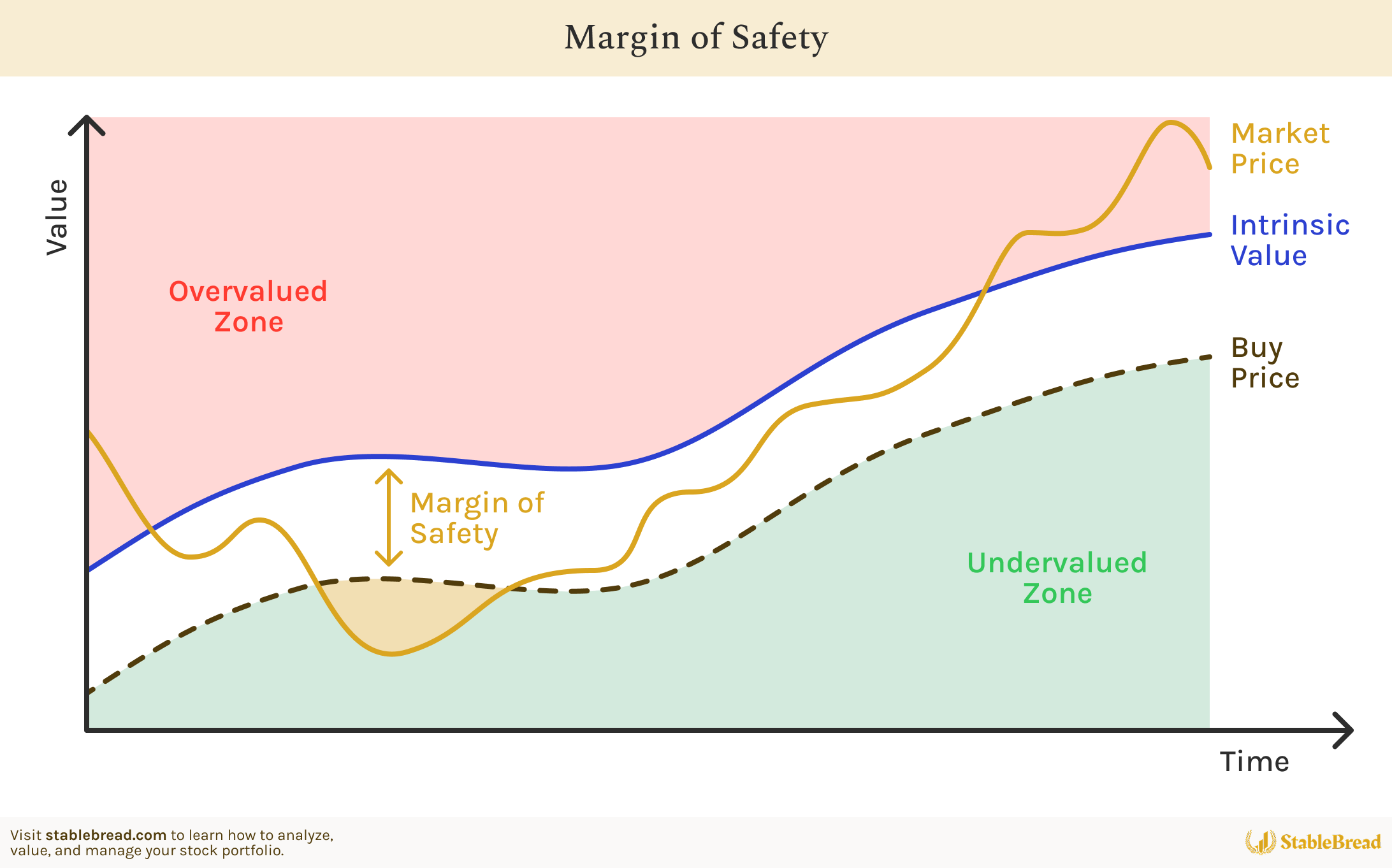
This means ₹175 is the maximum price you are willing to pay. If the stock is trading at or below this price, it enters your "Undervalued Zone" and becomes a candidate for investment. If it trades above this price, you do nothing, no matter how much you like the business. This discipline is what separates professional operators from speculators.
The graph below provides a clear visual representation of this concept.
How Much Margin is "Safe"?
This is where the art of valuation meets the science. A fixed margin for all companies is a sign of an amateur. The size of your margin of safety should be dynamic, reflecting the level of uncertainty in your valuation. Your IT background provides a perfect analogy: you wouldn't use the same error-handling budget for a simple script as you would for a complex, multi-threaded application operating on a distributed system.
Professor Aswath Damodaran provides a clear framework for thinking about this.
Margin of Safety: An alternative risk assessment tool?
In this blog post, Professor Damodaran critiques the simplistic application of MOS and offers a more sophisticated framework.
Read the following sections to understand how a professional thinks about this: First, see how a savvy investor uses MOS in a three-step process. Notice that MOS is the last step. Next, read the propositions that MOS augments, not substitutes, other risk assessments and is only as good as your intrinsic value estimate. Critically, read Proposition 3, which argues that the MOS should not be a fixed number. He explains why you'd require a larger MOS for a volatile tech stock like Google than for a stable utility.
The key takeaway is this: the more uncertain your valuation, the larger your margin of safety should be.
- Stable, predictable business (e.g., an FMCG company like Nestlé): You can have high confidence in your cash flow forecasts. A smaller margin of safety (e.g., 20-25%) might be appropriate.
- Cyclical business (e.g., an auto manufacturer): Earnings are volatile and harder to predict. A moderate margin of safety (e.g., 30-40%) is more prudent.
- High-growth, high-uncertainty business (e.g., a young tech company): The range of potential outcomes is enormous. You need a very large margin of safety (e.g., 50% or more) to compensate for the high risk of being wrong.
A Practical Example: The Coca-Cola DCF
Let's look at a complete analysis. The image below is a full DCF valuation for The Coca-Cola Company. It combines everything we've discussed: forecasting cash flows, discounting them to the present, calculating an intrinsic value, and then applying a margin of safety to determine a buy price.

Take a moment to dissect this image:
- DCF Inputs (Top Left): The analyst has set a forecast period (5 years), a discount rate (9.0%), and a terminal growth rate (2.0%). They also have different cases for FCF growth (Conservative, Base, Optimistic).
- DCF Calculation (Middle Left): The model projects future FCFs and discounts them back to their present value. This leads to an "Intrinsic Share Price" for each case (e.g., ₹29.95 for the Optimistic Case).
- Margin of Safety (Bottom Left): The analyst applies a 15.0% margin of safety. For the Optimistic Case, this results in a "Buy Price" of ₹25.46 (which is ₹29.95 * (1 - 0.15)).
- Valuation (Bottom Left): The model compares the Buy Price to the "Current Stock Price" (₹59.39) and concludes the stock is "Overvalued."
- Sensitivity Analysis (Right Side): This is the professional's tool. The tables show how the Buy Price changes as you vary the key assumptions (Terminal Growth Rate, Discount Rate, Margin of Safety). For example, even with a tiny 10% Margin of Safety and an aggressive 11.0% Discount Rate, the buy price is only ₹19.0.
This single image encapsulates the entire process: calculate, apply a buffer, and then stress-test your assumptions. The StableBread article you read earlier also provides an excellent step-by-step guide on how to perform this sensitivity analysis in Excel.
Why the Margin of Safety is Important When Performing Stock ...
This section of the StableBread article gives a practical guide to implementation.
Read the entire section on How to Apply the Margin of Safety. Focus on the "Margin of Safety Sensitivity Analysis" part and the examples of using data tables in Excel. This directly leverages your quantitative background.
The Investor's Mindset
Finally, it's crucial to understand where the margin of safety fits into the overall thought process. It's not about being conservative on every single input in your DCF. That leads to "diworsification" of your analysis and can cause you to miss every opportunity. Charlie Munger and Warren Buffett explain the correct mindset.
Warren Buffett Explains How He Calculates a Margin of Safety
Listen to Munger and Buffett discuss their practical application of the margin of safety.
First, listen to Munger's explanation. The key insight is that you try to be realistic and slightly conservative with your variables, but the real margin of safety is a buffer applied at the very end. Next, hear Buffett's insurance analogy. They make realistic assumptions about earthquakes and then add a premium (the margin of safety) to the final price. Finally, listen to Munger's closing point on staying within your circle of competence. The need for a huge margin of safety diminishes when you are analyzing a business you understand deeply.
Conclusion
The Margin of Safety is more than a calculation; it is a philosophy of intellectual humility and risk management. It is the disciplined practice of buying an asset for significantly less than you believe it's worth, providing a cushion against a future that is inherently unpredictable.
Key Takeaways:
- Valuation is an Estimate: The margin of safety is the necessary buffer between your imperfect estimate of value and the price you pay.
- A Tool for Survival: Its primary purpose is to protect your capital from your own errors and from unforeseen negative events.
- Application is Simple: Calculate intrinsic value, then subtract a percentage to determine your maximum buy price.
- The Size is Dynamic: Your margin of safety should be larger for more uncertain businesses and smaller for predictable ones. It reflects your confidence in your own analysis.
- Stress-Test with Sensitivity Analysis: Use tools like data tables to understand how your buy price changes under different assumptions, creating a robust valuation range rather than a single point estimate.
In our next lesson, we will expand on this last point. We will conduct a full sensitivity analysis on a valuation model, systematically stress-testing not just the margin of safety but all the critical drivers—growth rates, margins, and the discount rate—to understand what truly drives a company's value and where the biggest risks in your forecast lie.