Introduction
In our last lesson, we confronted the brutal, non-linear math of drawdowns. You now understand that a 50% loss of capital is not just a setback—it's a catastrophic event that requires a 100% gain merely to break even. This mathematical reality dictates the primary directive for any serious market operator: survival first, returns second.
Today, we transition from the why of risk management to the how. This lesson is about forging your armor. We will design the explicit, non-negotiable rules for managing every trade you take. The objective is to design and pre-commit to hard stop-loss and take-profit rules, ensuring that your decisions are governed by a cold, repeatable process, not by fear or greed in the heat of the moment. This is where you build the system that protects you from the market, and more importantly, from yourself.
The Operator's Contract: Rules Before Action
For an amateur, a trade begins with the "buy" button. For a professional, the trade is practically over before it's even placed. The entry is a minor detail; the exit strategy is everything. Your profit or loss on any single trade is determined not when you enter, but when and how you exit.
This mandates a sequence that is non-negotiable: you must define your invalidation point—your stop-loss—before you ever risk a single rupee. Once your capital is at risk, your objectivity is compromised. The time for thinking is before the trade; the time for trading is pure execution of the plan.
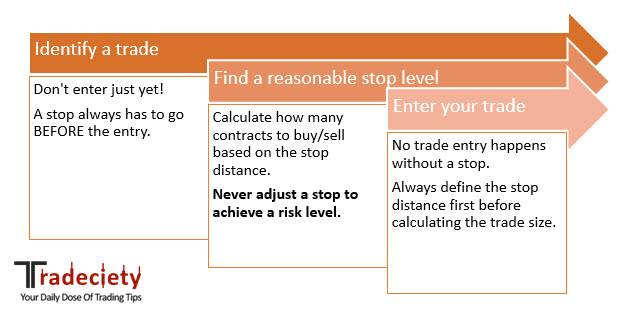
The logic is simple:
- Identify the Trade Idea: Your analysis suggests a potential opportunity.
- Define the Invalidation Point (Stop-Loss): At what price is the trade idea definitively wrong? This is your stop-loss level.
- Calculate Position Size: Based on your predetermined risk per trade (e.g., 1% of your account) and the distance from your entry to your stop, you calculate how many shares to buy.
- Enter the Trade: Only now do you execute the entry.
This sequence transforms trading from a gamble into a calculated business risk.
Part 1: Designing the Stop-Loss (Capital Preservation)
A stop-loss is not a penalty for being wrong. It is the calculated price you pay for information. If the market hits your stop, it has given you a definitive answer: your thesis was incorrect. The amateur hopes the thesis will become correct again; the professional accepts the information and moves on.
The most common mistake is using arbitrary rules. A "10% stop-loss" is meaningless because it ignores the unique character of the asset. A 10% move in a volatile stock like Tesla is just noise; a 10% move in a low-volatility utility stock is a major event. Your stop must be based on the market's structure and volatility, not your feelings.
When to Cut Losses and When to Let Profits Run | For Traders
This article from For Traders provides a clear framework for different types of stop-loss placements. It moves beyond arbitrary percentages and into logic-based methods.
In the section "Setting Clear Exit Rules," find the table under "Stop Loss Methods." Study the four types of stops presented: Technical Level, ATR-Based, Time-Based, and Break-Even. Note how each is suited for a different market context.
Let's dissect the two most robust methods:
- Technical (Structural) Stops: You place your stop just beyond a significant technical level. For a long trade, this could be below a recent swing low or a key support level. The logic is powerful: if that level breaks, the structural integrity of your trade idea is compromised.
- Volatility-Based (ATR) Stops: This is a more dynamic and quantitative approach. The Average True Range (ATR) indicator measures an asset's recent volatility. Instead of a fixed percentage, you can set your stop at a multiple of ATR (e.g., 2x ATR) below your entry price. This ensures your stop is wide enough to absorb the normal "noise" of the market but tight enough to get you out if the character of the price action changes.
How to Set Stop Loss and Take Profit in Trading for Max Gains
This resource from Goat Funded Trader explains why a volatility-based approach is superior.
Read the subsection "How should I size and place a stop...". The key insight is that by using volatility to define the stop distance, you can then adjust your position size to keep your dollar risk per trade constant. This is the core of professional risk management.
For every trade, you risk a fixed percentage of your account (e.g., 1%). Let's call this your "1R" risk. The stop-loss price defines the distance that equals 1R. If a stock is more volatile, the stop distance will be wider, so you must trade a smaller position size to maintain your 1R dollar risk. This is the opposite of the amateur, who gambles with the same number of shares regardless of the setup.
Part 2: Designing the Take-Profit (Realizing Gains)
While a stop-loss is about defense, a take-profit is about offense. It's the pre-planned exit that turns paper gains into real money. The famous saying is to "cut your losses short and let your winners run," but "letting them run" doesn't mean letting them run back to zero. You need a systematic way to get paid.

The Foundation: Risk-Reward Ratio
The simplest and most effective starting point is a fixed risk-reward ratio. If you risk 1R on a trade, you should aim to make at least 2R or 3R. This builds a positive expectancy into your system.
Risk Management & Position Sizing Strategy for Trading
Humbled Trader provides an excellent spreadsheet demonstration on the power of risk-reward ratios. This illustrates how you can be profitable even if you are wrong more often than you are right.
Watch the segment from the spreadsheet analysis. Pay close attention to the scenarios. With a 1:1 risk-reward, a 50% win rate is break-even. But with a 1:2 or 1:3 ratio, you can be profitable even with a 40% or 30% win rate. This is the mathematical engine of a sustainable trading career.
Advanced Exits: Adapting to the Market
A fixed R:R target is excellent for discipline. However, sometimes the market offers you more than you planned for. A trade that starts as a 2R opportunity might evolve into a powerful trend that could run for 10R or more. In these cases, you can switch from a fixed target to a dynamic trailing stop. This allows you to "let the winner run" while systematically protecting your gains.
The Ultimate Guide to Exit Strategies (Prop Trading Firm Secrets Revealed)
This video from SMB Capital, a professional trading firm, reveals several advanced, rule-based exit techniques that allow traders to maximize gains when a stock is performing exceptionally well.
Watch these three examples of dynamic exit strategies: For pure momentum: Watch the First Green/Red Bar strategy. You stay in a strong move until the first candle closes against the momentum, signaling a potential pause or reversal. For a developing trend: Watch the 21 EMA Close strategy. You use the 21-period exponential moving average as your guide, staying in the trade as long as the price remains above it (for a long) and only exiting on a definitive close below it. This gives the trade more room to breathe than a tighter momentum-based exit. For a classic trend: Watch the First Higher High/Lower Low strategy. In a downtrend, you stay short as long as the stock keeps making lower lows. The first time it fails to make a new low and instead prints a higher low, the trend's character has changed, and it's your signal to exit.
These are not discretionary, "gut feel" decisions. They are alternative, pre-defined rule sets you apply when the market context changes.
Part 3: Codifying Your Rules and The Discipline to Follow Them
Ideas are worthless. A plan on a napkin is worthless. The only thing that matters is a concrete, testable, and enforceable set of rules. For every trade, you must write down your plan before execution.
How to Set Stop Loss and Take Profit in Trading for Max Gains
This article provides an excellent template for formalizing your trade plan. This is the "pre-commitment" that enforces discipline.
Read the section "How do I write a stop-and-take-profit rule...". This gives you a 7-point template to define every parameter of your trade, from entry to exit, including position size and order types. This is your contract with yourself.
Once the contract is written, your job is to execute it without deviation. The two cardinal sins of trade management are:
- Moving your stop further away because the trade is going against you. This is like removing your helmet in a firefight. You are not "giving the trade more room to work"; you are unilaterally increasing your risk out of an emotional inability to accept a loss.
- Cancelling a take-profit order because the trade is screaming in your favor. This is pure greed (or FOMO) and often results in watching a massive winner reverse and turn into a small gain or even a loss.
When to Cut Losses and When to Let Profits Run | For Traders
Finally, let's revisit the psychology. Understanding the rules is easy; following them under pressure is what makes you a professional.
Read the section on "Mental Blocks in Trading" and "Developing Mental Discipline." Pay special attention to the concept of mental rehearsal, where you visualize accepting a loss calmly. This is how you prepare emotionally for the realities of execution.
Conclusion
In this lesson, we have constructed the core of your operational playbook. You've moved from the abstract fear of drawdowns to a concrete system for managing risk and profit on every single trade.
Key Takeaways:
- Rules First, Trade Second: Your stop-loss and take-profit levels must be defined before you enter a trade. The stop-loss determines your position size.
- Stops are Structural, Not Arbitrary: Base your stop-loss on market structure (support/resistance) and volatility (ATR), not on fixed percentages or random dollar amounts.
- Targets are Systematic: Use fixed risk-reward ratios (e.g., 2:1, 3:1) as your baseline for taking profits.
- Let Winners Run (With Rules): For trades that are working exceptionally well, switch to a pre-defined trailing stop strategy (e.g., EMA, ATR, or structural trail) to maximize gains without giving back all your profit.
- Discipline is the Edge: A mediocre plan followed with perfect discipline will always outperform a brilliant plan followed sporadically. Your written trade plan is an unbreakable contract.
You now have the tools to manage a trade from start to finish. In our next lesson, "Risk-Adjusted Returns," we will zoom out. We'll learn how to analyze the performance of your entire portfolio, not just on raw return, but on the quality of those returns relative to the risks you took. This will allow you to objectively measure whether your system is truly effective.