Introduction
We've previously established the principle of "survival first" by learning how to construct a protective put, a tool for managing risk on a single position. Now, we move from protecting one asset to managing the risk of the entire portfolio. This brings us to what is arguably the single most critical decision you will make as an investor or trader: position sizing.
Getting the stock right is important. Getting the entry right is helpful. But determining how much capital to allocate to an idea is what separates fleeting wins from enduring wealth. It's the lever that magnifies your edge or your mistakes. In this lesson, we will dissect how to determine the appropriate size for any given investment based on your conviction, your risk tolerance, and the broader context of your portfolio. You will learn why "being right" is secondary to how you bet.
Why Sizing Is More Important Than Your Entry
Most market participants are obsessed with their "batting average"—the percentage of time they are correct. Professionals, however, are obsessed with their "slugging percentage"—how much they make when they are right versus how much they lose when they are wrong. This distinction is fundamental to market success.
Let's begin by listening to a segment from Mawer Investment Management's podcast, which breaks down this very concept.
Why Position Size Matters in Investing | EP151
This podcast transcript introduces the core philosophy behind position sizing.
Read the first part of the transcript, from the introduction to the baseball analogy. Pay close attention to these three concepts: The Behavioral Impact: Note the idea of the "uncle point," where an oversized position causes so much psychological pain that you are forced to sell at the worst possible moment, squandering a potentially good idea. The Structure of Markets: The market follows a power-law distribution. A tiny fraction of stocks (the "fat tail") generate the vast majority of all wealth. Your job is to make sure you have meaningful capital in these rare, big winners. Batting vs. Slugging: Internalize the difference between winning often (batting average) and winning big (slugging percentage).
The key takeaway is that you can be wrong more often than you are right and still be wildly profitable, if your winners are significantly larger than your losers. This is only possible through intelligent position sizing. Many great investors have a hit rate below 50%, but their wealth is built on a few monumental wins that were sized correctly.
This brings us to a grading system used by elite traders. Not all ideas are created equal, and they shouldn't be sized equally.
The Trade Sizing Strategy that Made Me Millions
In this video, top trader Lance Breitstein explains his aggressive, yet systematic, approach to sizing.
Watch from the beginning up to the end of the poker analogy. He introduces two powerful ideas: A-B-C-D Grading: A framework for categorizing trade quality. An "A" trade is a rare, month-making opportunity, while a "C" trade is an everyday scalp. Exponential Bet Sizing: The practice of betting exponentially more on your "A" trades. He uses the poker analogy of getting dealt pocket aces: it's a rare event with a high probability of success, and you must capitalize on it by betting big.
This mindset is crucial. The goal isn't to make a little money on every trade. The goal is to deploy small, exploratory "scout" positions on B and C-grade ideas, while reserving significant firepower for the rare, high-conviction A-grade setups.
The Kelly Criterion: A Mental Model for Optimal Sizing
If we're going to bet more on better ideas, the logical next question is: "How much more, exactly?" The theoretical answer to this comes from information theory and gambling, and it's called the Kelly Criterion.
Given your background in IT, the logic behind this formula should be quite intuitive. It's a mathematical approach to maximize the long-run growth rate of capital.
Let's watch a clear, step-by-step explanation of the formula.
Kelly Criterion Trading Strategy : Used by Buffett, Munger, Pabrai
This video by Andrew Brown breaks down the Kelly formula with a simple gambling example.
Watch the section from the coin flip game explanation. The basic formula is: Kelly % = W - [(1 - W) / R] Where: W = Probability of winning R = Your win/loss ratio (e.g., if you risk $1 to make $2, R = 2) Focus on understanding the inputs and how they combine to suggest an optimal bet size.
The Kelly Criterion is powerful, but applying it mechanically to investing is a recipe for disaster. The formula's output is only as good as its inputs, and in markets, these inputs are never known with certainty.
The key fragilities of using "Full Kelly" are:
- Unknown Probabilities: Unlike a deck of cards, we can never know the true probability of a stock going up or down. Our "W" is always an estimate.
- Volatile Outcomes: The Kelly formula is optimized for the long run, but in the short run, it produces brutal drawdowns that can wipe you out psychologically (hitting your "uncle point") or financially if your estimates are wrong.
- Insufficient Sample Size: The formula's math works over thousands of bets. An investor might only make a few dozen significant bets in a decade.
Look at this chart, which compares the performance of different sizing strategies over 200 trades.
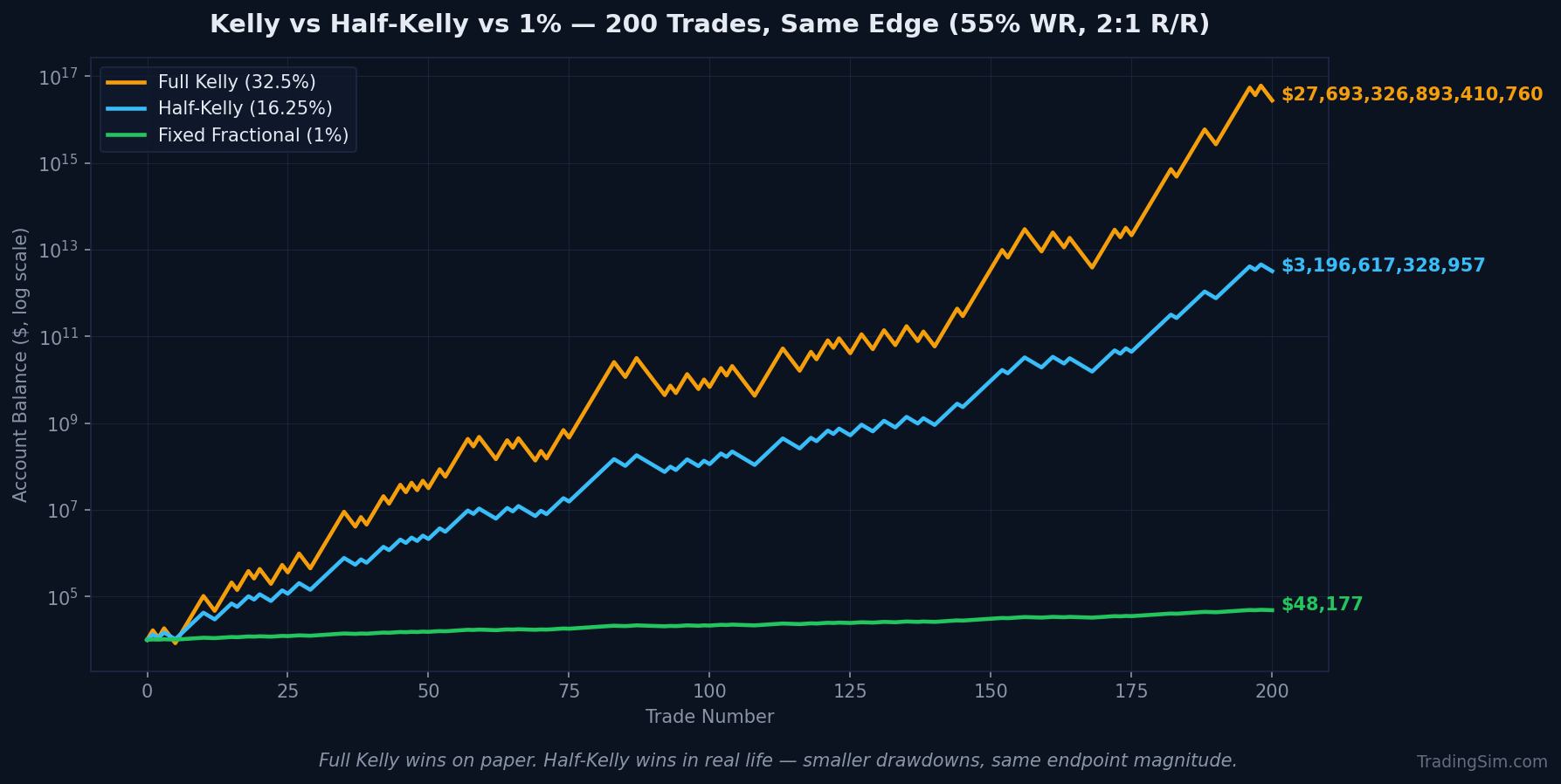
Because of this volatility, no serious professional uses Full Kelly. Instead, they use it as a mental model and apply a Fractional Kelly approach (e.g., Half-Kelly, Quarter-Kelly) as a practical guardrail.
From Theory to Practice: A Sizing Framework
Let's translate these concepts into an actionable framework.
1. Grade the Opportunity & Assess Your Conviction
First, you need a process to determine if an idea is A-grade, B-grade, or C-grade. This is where you assess your conviction. A useful model for this is the BAIT framework, which helps you identify the source of your perceived edge.
Why Position Size Matters in Investing | EP151
Returning to the Mawer podcast transcript, let's look at their decision-making checklist.
Read the section describing the BAIT framework. For any investment, ask yourself: Behavioral Edge: Is the market being irrational (too pessimistic/optimistic), and I can be more rational? Analytical Edge: Have I done deeper research or analysis than the average market participant? Informational Edge: Do I have access to unique information? (This is rare and often illegal). Technical Edge: Does the price action/market structure suggest a favorable setup? The more checks you have, and the stronger they are, the higher your conviction. An A+ trade often involves a strong analytical and behavioral edge.
2. Estimate the Probabilities and Payoffs
With your conviction assessed, you can make some rough, conservative estimates for the Kelly inputs. The goal is not precision, but to be "mostly right and not horribly wrong."
Kelly Criterion Trading Strategy : Used by Buffett, Munger, Pabrai
Let's revisit the Kelly video to see a practical application.
Watch how the presenter applies the formula to a real stock, from the real-world example. Notice his process: he's not looking for a perfect number. He's: Estimating the probability of total loss (fraud, government intervention). Estimating a conservative "win" scenario (takeover offer price). Plugging these into the formula to get a ballpark number (8%). Applying a margin of safety by halving the Kelly output to arrive at a 4% position size.
This process—Estimate, Calculate, and then apply Conservatism—is a robust way to move from abstract idea to a concrete allocation.
3. Use a Sizing Matrix
Finally, you can use a simple matrix to guide your actions. This combines your conviction level with your current portfolio allocation.

Let's analyze this framework:
- High Conviction: If allocation is small, you increase significantly. If it's already large, you maintain or trim slightly to manage risk.
- Low Conviction: If allocation is small, you exit. If it's large (a previous high-conviction bet that has soured), you reduce significantly.
Now, consider the middle row. What actions would you place in the "Medium Conviction" boxes?
- < 4% Allocation: This is likely a "scout" position. If conviction is medium, you might maintain it or add slightly, but you wouldn't increase significantly.
- 4%-8% Allocation: This is a standard position size. With medium conviction, the default action is to maintain.
- > 8% Allocation: The position has grown. If your conviction hasn't risen with it and remains "medium," the prudent action is to trim it back into your target range.
This matrix provides a simple, repeatable process for managing your portfolio.
Dynamic Sizing: Managing Winners and Losers
Position sizing is not a one-time decision. You must actively manage your positions as prices move and new information comes to light.
Why Position Size Matters in Investing | EP151
The final part of the Mawer podcast discusses strategies for managing positions after the initial investment.
Read the section starting from the discussion on winners and losers. The key approaches are: For Winners (The Connoisseur): Let them run. The biggest mistake is being a "raider" who takes profits too early on a potential multi-bagger. You can trim periodically to manage risk, but avoid exiting a great company just because the position gets large. For Losers (Assassin vs. Hunter): You must have a plan. The assassin cuts losses quickly. The hunter patiently averages down on a high-conviction idea. The one strategy that consistently fails is the rabbit—doing nothing and hoping for a turnaround.
Your style—whether you are an assassin or a hunter—depends on your temperament. But you cannot be a rabbit. You must have a process for dealing with losing positions.
Conclusion
This lesson introduced the paramount importance of position sizing in achieving superior returns. It's the engine that converts a small analytical edge into a dominant portfolio advantage.
Key Takeaways:
- Sizing > Entry: Your long-term results will be driven more by how much you invest in your best ideas than by the precise price you pay.
- Grade Your Setups: Not all opportunities are equal. Use a grading system (e.g., A/B/C/D) to differentiate high-conviction plays from everyday trades.
- Kelly as a Mental Model: Use the Kelly Criterion not as a rigid formula, but as a framework for thinking about probability (W) and payoff (R). Always use a fractional approach (e.g., Half-Kelly) to avoid ruinous volatility.
- Build a Framework: Combine conviction assessment (BAIT), payoff estimation, and practical rules (hard limits, sizing matrix) to create a repeatable sizing process.
- Manage Dynamically: Let your winners run. Have a pre-defined plan for your losers, whether it's cutting them quickly (assassin) or adding to them with discipline (hunter).
We have now established how to size a single position. However, a portfolio's risk is not simply the sum of its parts. In our next lesson, we will explore Diversification vs. 'Diworsification'. You will learn how ten different stocks can secretly be the same trade due to hidden Correlation, a critical concept for true portfolio-level risk management.