Introduction
In our last lesson, we sharpened our defenses, learning to decode the subtle signals embedded in sell-side analyst reports and insider trading data. You now know how to filter the noise from the opportunistic signals and why the consensus narrative is often the last thing you should rely on for an edge. This ability to see past the public story is a prerequisite for what comes next.
Today, we move from analysis to synthesis. This lesson is the culmination of our entire module on fundamental analysis. We will take all the pieces you've learned—dissecting financial statements, evaluating business moats, judging management quality, and decoding external signals—and forge them into a single, powerful weapon: the investment thesis. Your objective is to learn how to build a structured argument for why a stock is mispriced, what will force the market to correct that mispricing, and when you'll know you're wrong. This is not an academic exercise; it's the core operational skill of every serious market participant.
What is an Investment Thesis?
An investment thesis is not a feeling, a tip, or a vague story about a company being "good." It is a rigorous, evidence-backed argument that answers three fundamental questions:
- Why is this security mispriced?
- What will cause the market to recognize this mispricing?
- What could go wrong, and how would I know?
A professional thesis is built on a variant perception: a view that is different from the market consensus, and, critically, is also correct. Being different isn't enough; you have to be different and right.
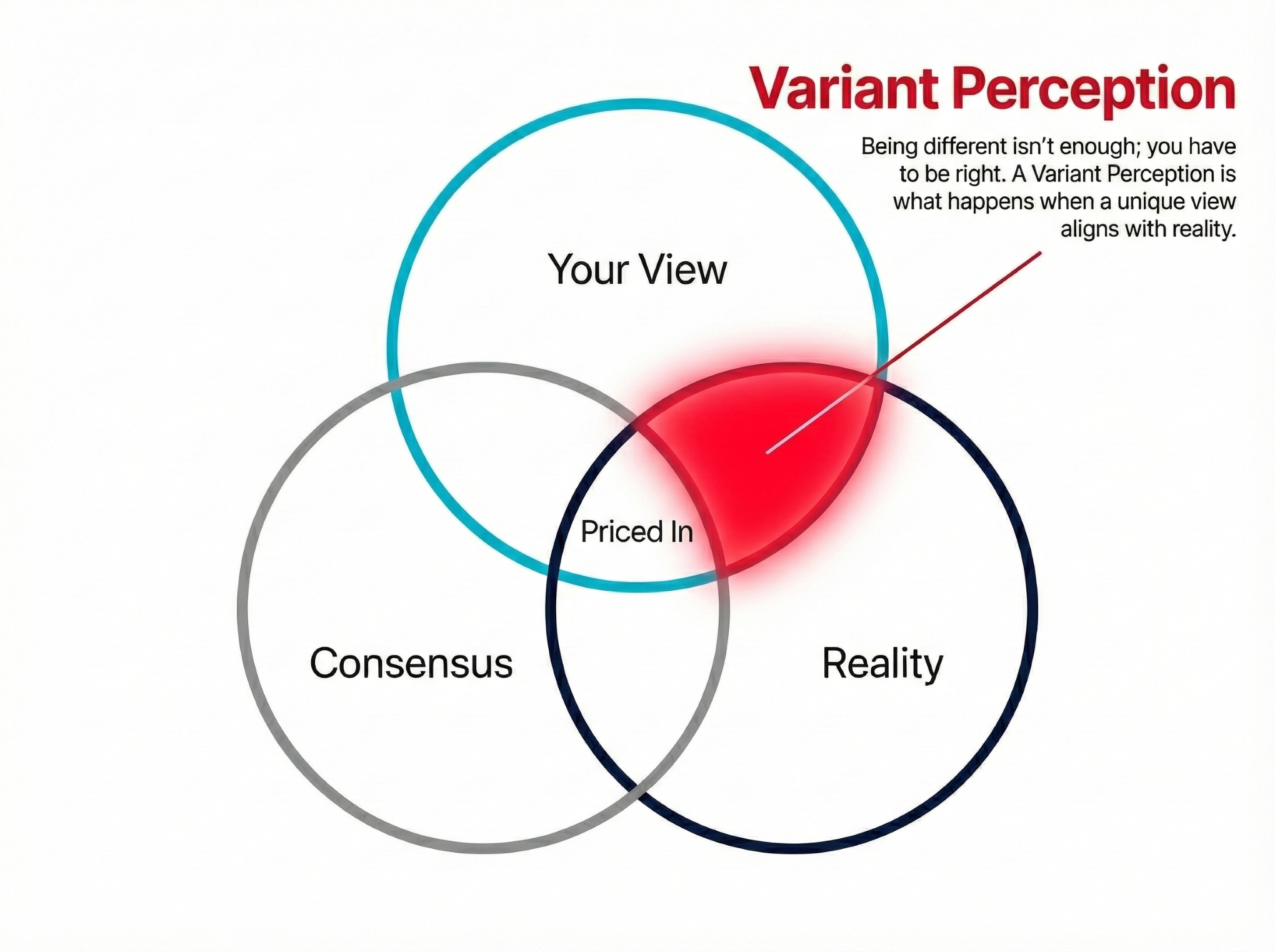
In a professional investment process, the thesis is the central output of the analytical and debate phase, bridging the gap between raw data and a final trade decision.

The Anatomy of a Professional Thesis
A robust thesis has several non-negotiable components. Think of it as a logical structure with clearly defined inputs and outputs, much like a well-designed software program.
Stock research report template: Professional equity analysis guide
This guide breaks down the structure of a professional equity research report, which is the formal document that contains an investment thesis. We will use its structure to define the key components.
Focus on the formula and structure provided. First, read the section on the executive summary. Pay close attention to the formula for a compelling thesis: it must identify something the market is missing. Next, review the section on the investment recommendation. This outlines the key outputs of a thesis: a price target, the catalysts, and disciplined exit criteria. Finally, absorb the distinction between professional and amateur analysis in the final paragraphs of the article. Focus on the sentence starting with "A professional report answers..." and the list of questions. This is the acid test for any thesis.
Based on this professional standard, we can break a thesis down into five key elements:
-
The Core Argument (Variant Perception): This is your unique insight. It's the answer to "What do I know that the market doesn't appreciate?" It's never "This is a good company." It's "The market is pricing this as a simple hardware company, but I have evidence it's transitioning to a high-margin software-as-a-service model."
-
Supporting Evidence (The "Why"): This is where you bring your analytical work to bear. It's the body of proof for your core argument, drawing from:
- Micro Analysis: Financials (Is revenue accelerating? Are margins expanding?), business model (Is the moat widening?), management quality (Have they executed in the past?).
- Macro Analysis: Industry trends, regulatory changes, competitive landscape.
- External Signals: Are insiders making opportunistic buys? Is a quiet but smart hedge fund building a position?
-
Valuation (The "How Much"): A thesis must be quantifiable. What is the stock worth if you are right? This involves projecting earnings and assigning a multiple, as we'll explore in-depth in later modules. For now, understand that you must translate your qualitative story into a concrete price target. A 40% potential return changes your position size and risk tolerance compared to a 10% return.
-
Catalysts (The "When"): A mispriced stock can stay mispriced for years. A catalyst is a specific, foreseeable event that will force the market to re-evaluate the stock and close the price-to-value gap. Examples include an upcoming earnings release, a product launch, a regulatory decision, or an investor day. Without a catalyst, you don't have a trade; you have a hope.
-
Risks & Invalidation (The "What If"): What could go wrong? More importantly, what specific data point would prove your thesis incorrect? This is not a generic list of risks; it's a pre-mortem. "If the company loses the 'X' contract, my growth assumption is invalid, and I will exit the position." This pre-commitment is your defense against emotional decision-making.
A Practical Framework: The 10-Step Hedge Fund Pitch
Knowing the components is one thing; assembling them under pressure is another. Professional analysts use a structured framework to ensure their thinking is complete and logical. The following video breaks down a 10-step process that is standard at many top hedge funds. This is your operational playbook.
Pitch a Stock Like a Hedge Fund Pro - Step By Step Guide
This video provides a direct, step-by-step guide to pitching a stock like a professional analyst. It's a masterclass in structuring your investment thesis for clarity and impact.
Watch the full video. The presenter first lists the 10 steps from the beginning, then applies them to a real-world short thesis on Chewy. Pay attention to how each step logically builds on the last.
Let's consolidate that 10-step framework into our core structure. This is how you build your argument:
- Step 1: The Conclusion First (Variant View). Lead with your qualitative conclusion. "I am bullish/bearish on Stock X because the market is wrong about Y."
- Step 2: Quantify the View. Translate your view into numbers. "I am modeling 15% revenue growth vs. consensus of 8%, leading to a price target of $120 vs. the current $80."
- Step 3: Provide Evidence. This is the "why." Use data, channel checks, expert calls, and your own analysis to support your variant view.
- Step 4 & 5: Analyze Sentiment & Positioning. Is the market bullish or bearish? Is the stock heavily owned by hedge funds (a crowded trade) or forgotten? This tells you how much of the good/bad news is already priced in.
- Step 6 & 7: Identify the Catalyst & Setup. What event will prove you right, and why is now the time to act? The setup combines sentiment, positioning, and the catalyst. An attractive setup might be a forgotten stock with low expectations heading into an earnings call where you expect a positive surprise.
- Step 8: Acknowledge the Biggest Risk. What is the single strongest counter-argument to your thesis? Articulate it clearly and explain why you believe it's unlikely to materialize. This shows intellectual honesty.
- Step 9: Outline the Risk/Reward. This is a formal analysis of your Bull (what if you're very right?), Base (what you expect), and Bear (what if you're wrong?) cases. Assign probabilities and price targets to each to calculate an expected value. This is the ultimate quantitative expression of your thesis.
- Step 10: Define Next Steps. What key metric will you track to see if your thesis is playing out? This creates a feedback loop for continuous analysis.
From Thesis to Memo
The final output of this process is often a written document, typically a 1-2 page investment memo. The act of writing forces clarity of thought. If you can't write it down simply, you don't understand it well enough.
This memo is not just for others; it's for you. When the market gets volatile and your emotions are running high, this document is your anchor. It's the rational, pre-committed plan you made when you were thinking clearly.
Communicating Your Thesis
Finally, a thesis is only useful if it can be communicated. In a professional environment, you need to deliver your idea with conviction and clarity, often in just a few minutes.
How to pitch a stock (equity research)
This video provides excellent tips on how to pitch a stock effectively. The core message is about structuring your communication for maximum impact.
Watch the key sections that demonstrate the structure and language of a powerful pitch. Structure: Observe how the pitch starts with a clear recommendation and then provides the thesis, not the other way around. This is covered from the MSCI example. Quantification: See how the pitch for AMN Healthcare uses specific EPS estimates and valuation multiples to frame the upside from this example. The Variant View: The most advanced part of a pitch is explaining why your view is different from the market's. Watch the Paylocity example from this advanced pitch to see this in action.
The key is to state your conclusion first, then provide the reasons, backing them up with numbers. You must be able to articulate the story, the numbers, the catalysts, and the risks in a concise package.
Conclusion
You now have the complete blueprint for building a professional-grade investment thesis. This is the central skill that separates an analyst from a data collector. It is the engine of any repeatable investment process.
Key Takeaways:
- A Thesis is an Argument: It's a structured argument explaining why a stock is mispriced, what will fix it, and what could go wrong.
- It Must Be Variant: Your edge comes from having a view that is both different from the consensus and correct.
- Structure is Everything: Use a framework (like the 10-step pitch) to ensure your thinking is logical and complete, covering the core argument, evidence, valuation, catalysts, and risks.
- Write It Down: Formalizing your thesis in a memo enforces clarity and provides an anchor during market volatility.
- Pre-commit to Invalidation: The most important part of a thesis is knowing what will prove it wrong. This is your primary risk management tool.
In this module, you've learned the universal principles of analyzing a company. However, the game is played differently across different sectors. In our next module, Sector Playbooks, we will start applying these tools to the unique business models and key metrics of specific industries like banking, technology, and consumer goods, building the specialized "scary accuracy" you're looking for.