Introduction
Welcome to today's lesson. So far, we have dissected options risk into its fundamental components: directional risk (Delta, Gamma), time decay (Theta), and volatility exposure (Vega). You now have the tools to understand why an option's price changes. With this power comes a critical question: when you deploy these leveraged instruments, what separates a professional operator from a simple gambler?
The answer has nothing to do with being "right" on any single trade and everything to do with the process you follow. This lesson is designed to draw a sharp, clear line in the sand between disciplined derivative strategies and pure gambling. We will move beyond the superficial idea of "risk management" and anchor our distinction in a core mathematical principle: positive expected value. By the end of this session, you will understand the framework that allows professionals to treat trading as a business, not a casino trip, by systematically putting the odds in their favor over the long run.
The Defining Line: Expected Value
The single most important distinction between a disciplined strategist and a gambler is that the strategist only plays games where they have a statistical edge, repeated over time. This edge is quantified by a concept you may be familiar with from your quantitative background: Expected Value (EV).
In trading, the formula for expected value defines the average amount you can expect to win or lose per trade over a large number of trials:
Where:
- is the probability of a winning trade.
- is the probability of a losing trade ().
- Average Win and Average Loss are the respective average amounts for your strategy.
A gambler knowingly or unknowingly engages in activities with a negative expected value (-EV). A professional trader, like a casino owner, systematically constructs their business around activities with a positive expected value (+EV).
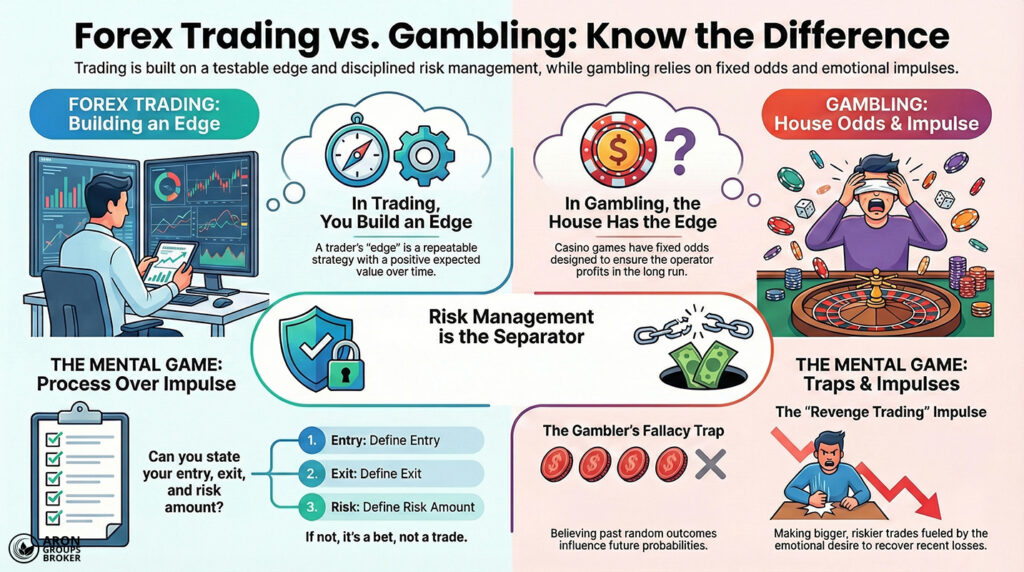
Let's ground this concept with the casino analogy, but from the correct perspective—that of the house.
Expected Value Trading: The Mentality of a Profitable Trader - Predicting Alpha
This article from Predicting Alpha provides a concise and powerful explanation of Expected Value as the core of a profitable trading operation. It uses the casino example to drive the point home.
Read the sections from the beginning down to the end of the "Casino Roulette Example". Pay close attention to how the article frames the casino's perspective. It's not winning or losing on one spin; it's the statistical certainty of profit over thousands of spins. This is the mindset of an operator. Focus on the equation: EV = (Probability of Winning × Amount Won) – (Probability of Losing × Amount Lost).
The key takeaway is that a casino doesn't gamble. It runs a business with a small but persistent positive EV. It doesn't know the outcome of the next spin, but it knows that over 10,000 spins, it will make money. Your goal as a trader is to become the house.
Building Your Edge: The Babe Ruth Effect
If you're not playing a rigged game like a casino, how do you build a +EV strategy in markets? The common misconception is that you need a high win rate. This is false.
The EV equation has two parts: probability () and magnitude (Win/Loss size). You can have a +EV with a low win rate if your average wins are much larger than your average losses. This is known as having an "asymmetric payoff" profile. In investing, this is often called the "Babe Ruth effect." Babe Ruth struck out a lot, but his home runs were so valuable they more than compensated for the outs.
This is where derivatives, especially options, become powerful tools for disciplined speculation. Their non-linear payoffs allow you to construct strategies with massively asymmetric risk/reward profiles.
This Morgan Stanley paper is a masterclass in professional investment thinking. It's dense, but the concepts are crucial. We will focus on a few key ideas.
First, read the introduction. Pay special attention to the paragraph starting with this sentence, which introduces the "Babe Ruth effect." Next, find the "Payoffs" section and read the subsection on Asymmetric payoffs. This explains the concept of seeking opportunities where potential gains are larger than potential losses, the hallmark of many professional option strategies. Finally, jump to the section "Investing in Various Asset Classes" and read about the batting average and slugging ratio. This gives you a professional framework: Batting Average: Your win rate (P_{win}). Slugging Ratio: Your (Average Win / Average Loss). A disciplined strategy is about ensuring the combination of these two things results in a positive EV, not about maximizing one of them in isolation.
Operationalizing Positive EV: "Expectancy Hacking"
So, how do you translate this theory into a repeatable, mechanical process? This is where we move from finance theory to an operator's playbook. You have an IT background, so think of this as an algorithm for trading.
A brilliant method for this is a concept called "Expectancy Hacking," popularized by trader David Sun. Instead of letting your wins and losses be random, you use rules to fix the ratio between your average win and average loss.
The system is simple and powerful:
- Define your win size: You will exit a winning trade when it reaches a specific profit target (e.g., you collect 60% of the maximum possible profit from a short option).
- Define your loss size: You will exit a losing trade when it hits a pre-defined stop loss, which is a multiple of the premium you collected (e.g., a 200% stop means you lose 2x the premium you took in).
By doing this, you have hard-coded your Slugging Ratio. The only variable left in the EV equation is your Batting Average (win rate). Your entire job now is to find and backtest strategies that, when subjected to these fixed rules, produce a win rate high enough to generate a positive EV over hundreds of trades.
Systematic Options Trading - Minimizing Risk Exposure & Optimizing Edge · David Sun
In this "Chat With Traders" interview, hedge fund manager David Sun explains his systematic approach. His engineering background comes through in the process-driven way he trades. This is the "market combat training" you're looking for.
First, watch the detailed explanation of "expectancy hacking" from here. Pay close attention to how he uses a profit-take (60% of premium) and a stop-loss (200% of premium) to fix his win/loss ratio. This transforms trading from guesswork into a statistical process. Then, listen to how he addresses the real-world problems of slippage and gaps from this segment. His answer is pure operator logic: you don't pretend these issues don't exist; you bake them into your model and ensure your strategy remains +EV even with these costs.
This systematic approach is the absolute opposite of gambling. A gambler's wins and losses are uncontrolled. An operator defines them in advance and executes a system.
The Mindset: Playing an Infinite Game
The mechanical process of expectancy hacking must be paired with the correct psychological framework. Why do most people fail to follow such a system? Because they are playing the wrong game.
Philosopher James P. Carse distinguished between two types of games:
- Finite Games: Played for the purpose of winning. They have a clear beginning and end, and a winner is declared (e.g., a football game).
- Infinite Games: Played for the purpose of continuing the play. The goal is not to win, but to stay in the game (e.g., a business, a marriage).
Gamblers treat trading as a finite game. They are obsessed with winning this trade. They refuse to take a small loss because a loss feels like losing the game. In their desperate attempt to turn a small loser into a winner, they break their rules, take on massive risk, and end up with a catastrophic loss that takes them out of the game entirely.
Professionals treat trading as an infinite game. Their primary goal is survival and capital preservation. They accept small, defined losses as a necessary business expense. They know that as long as they can stay in the game, their +EV strategy will work out over time.
The Most Important Rule of Trading - Risk Management
This video from OptionsPlay brilliantly applies the finite/infinite game concept to trading.
Watch the segment from here where the host introduces the concept of finite and infinite games and applies it to trading. Then, watch the critical follow-up from this section, which explains exactly how the finite-game mindset leads traders to blow up their accounts by refusing to accept small losses.
The Difference in Practice
Let's crystallize this with examples:
- Gambling: Buying far out-of-the-money weekly options on a meme stock. This is buying a lottery ticket. The focus is on the massive potential payout of a single event, with no regard for the astronomical premium paid (due to IV) that makes the trade deeply -EV.
- Disciplined Speculation: A strategy like David Sun's: systematically selling 15-delta puts on the SPX every day with a 2x stop-loss and a 60% profit target. This is a +EV process repeated over time, where each trade is a statistical event, not an emotional one.
- Hedging (The Ultimate Infinite Game Play): Buying puts to protect a stock portfolio. On its own, the hedge is a -EV trade; it's an expense that will likely lose money. But for the portfolio, it acts as insurance. It dramatically cuts down the "Average Loss" in the portfolio's EV equation during a crash. This prevents a catastrophic drawdown that would take you out of the game, ensuring you can continue compounding your capital. This is a hallmark of professional risk management.
The lessons from the Kelly Criterion, a formula for optimal position sizing, are paramount here: 1) Never bet if you don't have an edge (a +EV), and 2) Never bet too much. Even a +EV strategy leads to ruin if you oversize your positions. The discipline is in the process and the sizing.
Conclusion
The line between disciplined strategy and gambling is not blurry; it is a razor's edge defined by process and mathematics.
Key Takeaways:
- Expected Value is the Divider: Disciplined strategies are built on a statistical, positive expected value (+EV). Gambling is engaging in a -EV activity.
- Become the House, Not the Player: Your goal is to design a system where you have a small, repeatable edge that plays out over hundreds of trades.
- It's Not Win Rate, It's Asymmetry: Success comes from the interplay of your win rate (Batting Average) and the size of your wins versus losses (Slugging Ratio).
- Systematize Your Edge: Use methods like "Expectancy Hacking" to define your risk and reward before you enter a trade, turning trading into a process, not a prediction.
- Play the Infinite Game: Your primary goal is to manage risk to ensure you can stay in the game. Small losses are business expenses; large, uncontrolled losses are bankruptcy.
You now have the framework to distinguish a strategy from a gamble. In our next lesson, we will dive deep into Hedging With Derivatives, focusing on the practical application of using these tools not for speculation, but for the explicit professional purpose of risk reduction and survival.