Welcome to the first lesson of your course on Indian HR & Labour Laws. To build a strong and compliant HR practice, it's essential to understand not just the 'what' of labour laws, but also the 'why'. This foundational lesson will explore precisely that: the ultimate source of authority and purpose for all labour legislation in India—the Constitution.
By the end of this lesson, you will be able to explain the constitutional basis of labour laws in India, including the guiding principles and fundamental rights that shape every act you will study in this course. This understanding will provide the framework for everything that follows, from wage laws to social security.
The Philosophical Roots of Labour Law
Before we dive into the Indian context, it's helpful to briefly consider why labour laws exist at all. Modern labour legislation is a response to the societal shifts brought about by the Industrial Revolution. The traditional legal relationship was one of 'master and servant', a dynamic that often led to the exploitation of workers in the pursuit of profit.
Over time, a new philosophy emerged, best captured by the International Labour Organisation's (ILO) 1944 Declaration of Philadelphia, which proclaimed that "labour is not a commodity." This principle asserts that workers are human beings with inherent dignity, not just cogs in an economic machine. This shift in thinking—from protecting capital to protecting people—is the philosophical core of all labour laws.
The Constitution: India's Legal Bedrock
In India, this philosophy is embedded in our nation's most sacred legal document: the Constitution of India. The architects of the Constitution envisioned India as a welfare state, committed to securing social, economic, and political justice for all its citizens. This promise, enshrined in the Preamble, is the guiding star for all subsequent legislation, especially laws concerning labour.
The Constitution provides this guidance through two key components: the Directive Principles of State Policy and the Fundamental Rights. Let's explore each.
1. The Goals: Directive Principles of State Policy (DPSP)
Part IV of the Constitution contains the Directive Principles of State Policy (DPSP). Think of these as the 'conscience' of the Constitution—a set of instructions and long-term goals for the government. They direct the state to create policies and laws that promote a just and equitable society.
To understand the unique role of DPSPs, it's crucial to grasp two points: their purpose and their enforceability. The following video from BYJU'S IAS offers an excellent explanation.
Directive Principles of State Policy (Explained) | Indian Polity for UPSC Prelims & Mains 2022-2023
This video provides a clear and detailed explanation of the role and nature of Directive Principles.
First, watch the introduction to understand how DPSPs aim to establish social and economic democracy, giving life to the ideals in the Preamble. Next, focus on the key difference between Fundamental Rights and DPSPs. This segment explains that Rights are negative obligations (telling the state what it cannot do), while Directives are positive obligations (telling the state what it should do). Finally, watch the explanation of why DPSPs are not enforceable in court but are still considered "fundamental in the governance of the country."
As you saw in the video, while you cannot sue the government for failing to implement a DPSP, these principles are the moral and political compass for lawmakers. They are the objectives that labour laws are designed to achieve. Several articles are particularly relevant for labour and employment:
- Article 38: Obligates the state to promote the welfare of the people by securing a social order based on justice (social, economic, and political).
- Article 39: Directs the state to ensure that citizens have an adequate means of livelihood, that there is equal pay for equal work for both men and women, and that the health and strength of workers are not abused.
- Article 41: Aims to secure the right to work, to education, and to public assistance in cases of unemployment, old age, sickness, and disability.
- Article 42: Mandates the state to make provisions for securing just and humane conditions of work and for maternity relief. This is the direct constitutional source for the Maternity Benefit Act.
- Article 43: Directs the state to secure a living wage and conditions of work ensuring a decent standard of life for all workers.
These directives form the blueprint for a welfare-oriented labour policy.
2. The Guarantees: Fundamental Rights (FR)
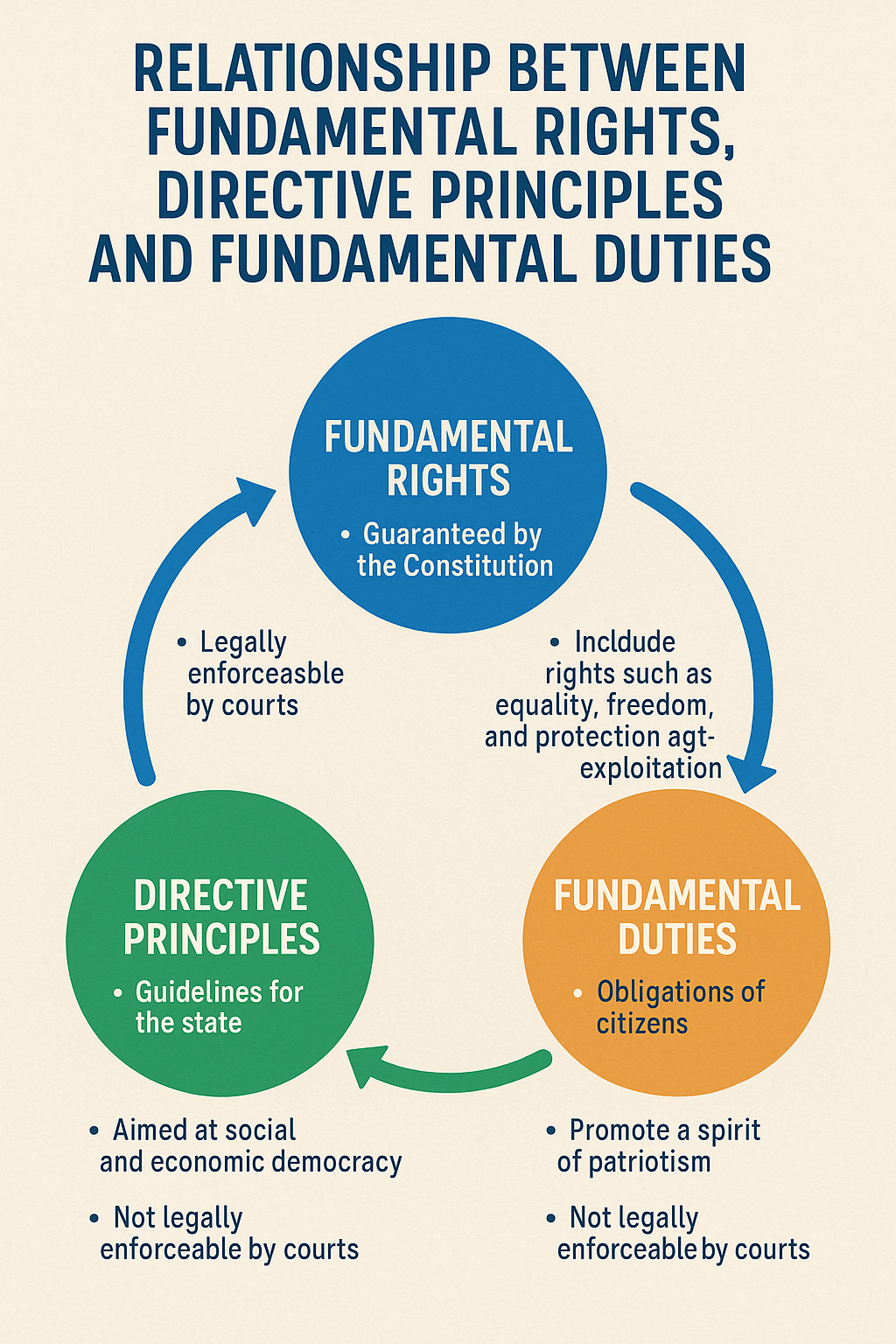
If DPSPs are the state's goals, Fundamental Rights (Part III of the Constitution) are the citizen's guarantees. These are rights so fundamental to a life of dignity that they are legally enforceable by the courts. An individual can directly approach the Supreme Court or a High Court if their Fundamental Rights are violated.
The infographic below illustrates the core relationship between Fundamental Rights, Directive Principles, and Fundamental Duties. Notice that only Fundamental Rights are legally enforceable.
Let's examine the specific Fundamental Rights that form the bedrock of labour law.
Labour laws in India - iPleaders
This section from an article by iPleaders provides a solid overview of the key constitutional articles.
Please read the part of the section titled Fundamental Rights. As you read, focus on how each article—14, 16, 19, 21, 23, and 24—creates a specific protection for workers.
To summarize and frame this from an HR perspective, these rights are the source of many key compliance obligations:
- Article 14 (Equality before Law): Ensures that laws are applied equally and prohibits arbitrary actions by the state. This is a foundational principle for fair treatment in the workplace.
- Article 19(1)(c) (Freedom of Association): This is the constitutional source of the right to form trade unions and associations.
- Article 21 (Right to Life and Personal Liberty): The Supreme Court has interpreted this right expansively to include the right to livelihood and the right to live with human dignity. This interpretation implies that fair wages and safe working conditions are essential for a life of dignity.
- Article 23 (Prohibition of Forced Labour): This bans all forms of forced labour ('begar'). The judiciary has held that paying a worker less than the statutory minimum wage amounts to a form of forced labour, directly linking this right to wage laws.
- Article 24 (Prohibition of Child Labour): This explicitly prohibits the employment of children in factories, mines, or other hazardous occupations, forming the direct basis for all child labour legislation.
The Interplay and Legislative Authority
You might wonder what happens when a law made to achieve a DPSP (like land reform for social good) appears to violate an FR (like the right to property). This has been a central debate in Indian constitutional law. While the initial stance was that FRs would prevail, the Supreme Court now advocates for a harmonious construction, viewing FRs and DPSPs as two wheels of the same chariot, both essential for justice. The state's duty is to balance them.
Finally, where does the government get the power to create these laws? The Constitution's Seventh Schedule divides law-making powers between the Centre and the States into three lists:
- The Union List (only Centre can legislate)
- The State List (only States can legislate)
- The Concurrent List (both Centre and States can legislate)
Most subjects related to labour fall under the Concurrent List.
Labour Law Introduction: Meaning, Types, Nature, Need & Constitutional Provisions of Labour Law
This short clip explains the concept of the Concurrent List and identifies the specific entries related to labour.
Please watch the segment from the video that details the entries in the Concurrent List. This is crucial for understanding why you'll often encounter both central acts and state-specific rules for the same subject.
This dual authority means that as an HR professional, you must be aware of both the main central Act (e.g., The Factories Act) and the specific rules framed by the state in which your establishment operates.
Conclusion
Let's summarize the key takeaways from our first lesson:
- The Indian Constitution is the ultimate source of all labour laws, driven by the vision of a welfare state.
- Directive Principles of State Policy (DPSP) in Part IV are the non-enforceable goals and guiding principles for the state, such as ensuring a living wage, humane working conditions, and equal pay.
- Fundamental Rights (FR) in Part III are the legally enforceable guarantees for citizens, forming the basis for rights like forming unions, equality, and protection from forced and child labour.
- The power to legislate on labour is derived from the Concurrent List in the Seventh Schedule, giving both the Central and State governments the authority to make laws.
You now have a solid understanding of the 'why' behind India's labour laws. This constitutional framework provides the rationale for the legal obligations you manage daily as an HR professional.
In the next lesson, we will build on this foundation to classify the vast landscape of Indian labour laws into practical categories and further explore the distinct roles of the central and state governments in their administration.