In our last lesson, we focused on expressing your likes and dislikes with more nuance, using phrases like "I'm into" and "I can't stand." This was an important step in making your conversations more expressive and personal.
Today, we will build on that by tackling one of the most common social challenges: making small talk. This lesson focuses on asking and answering five common "getting to know you" questions in a way that feels natural, not robotic. Mastering this skill is the final piece of our foundational module and is essential for building the confidence you need for both casual chats and professional interactions. We will focus on a simple but powerful strategy to help you move past short, conversation-ending replies and into smooth, flowing dialogues.
Part 1: The Goal of Small Talk (and Why It's Not a Test)
Before we dive into questions and answers, it's crucial to understand the purpose of small talk. Many learners feel immense pressure to be brilliant or perfectly grammatical. The reality is much simpler. Small talk is not about having a deep, complex conversation; it's a way to be polite, acknowledge the other person, and find a small, initial connection.
The video below explains this concept perfectly. Understanding this will help reduce the fear of making mistakes and allow you to relax into the conversation.
The 5 Most Common Small Talk Questions in English with Answers
This video from Speak Confident English clarifies the true purpose of small talk, framing it as a low-pressure, polite form of connection.
Watch the section from this timestamp. The speaker explains what small talk is (polite, quick, a way to make an initial connection) and what it isn't (profound, lengthy, or complicated). This should help ease any anxiety you have about these conversations.
The biggest challenge in small talk is not knowing the right vocabulary, but avoiding answers that stop the conversation. A one-word answer like "Good" or "Yes" forces the other person to do all the work. The secret to avoiding this is a simple strategy: Answer + 1 Detail.
Part 2: The "Answer + 1 Detail" Strategy
Let's break down this strategy with the most common question of all: "How are you?" Your answer to this question completely depends on the context.
Sometimes, it's just a long way of saying "hello," and a simple "Fine, thanks, and you?" is all that's needed. But in other situations, like waiting for a meeting to start, a one-word answer creates an awkward silence. This is where adding one small detail makes all the difference.
The 5 Most Common Small Talk Questions in English with Answers
The same video provides an excellent breakdown of how to answer "How are you?" in different situations using the "Answer + 1 Detail" strategy.
Watch the segment from this point. Notice the difference between answering a neighbor you're passing on the street versus a colleague in a meeting. The key is adding a small piece of information (e.g., "It's been a bit of a busy week") to give the other person something to respond to.
Adding a detail might seem hard when you feel nervous. A simple trick is to use conjunctions like because, but, so, or and. These words naturally force you to add more information.
- "My weekend was good, because I finally had time to read my new book."
- "I'm a bit tired, so I'm looking forward to a quiet evening."
Part 3: Common Questions and Natural Answers
Let's apply this strategy to five common "getting to know you" questions. You can find many of these questions in the image below, which is a great reference for different social situations.

Here are five key questions and how to answer them naturally.
1. "How was your weekend?" (Usually asked on a Monday)
- Closed Answer: "It was good." (Conversation ends)
- Natural Answer (Answer + 1 Detail): "It was really relaxing. I mostly stayed home and caught up on some reading."
2. "Any plans for the weekend?" (Usually asked on a Friday)
- Closed Answer: "Not really."
- Natural Answer: "Not much, I'm hoping to catch up on some sleep because it's been a hectic week at work. How about you?"
3. "What do you like to do in your free time?"
- Closed Answer: "I like reading."
- Natural Answer: "I'm really into photography right now. I love walking around the city and taking pictures on the weekends." (This also uses a phrase from our last lesson!)
The video below gives excellent examples for these exact questions.
The 5 Most Common Small Talk Questions in English with Answers
This video provides many natural phrases and model answers for talking about your weekend and hobbies.
Watch these three short segments to gather more phrases: For talking about your past weekend, watch from this timestamp. Note expressions like "I took it easy" or "It was a blast." For talking about hobbies, watch from this section. Pay attention to "I recently took up..." and "I'm really into..." For discussing future weekend plans, watch from this part. Notice how conjunctions like 'because' and 'so' are used to add details.
4. "Where are you from?"
- Closed Answer: "I'm from Delhi."
- Natural Answer: "I'm originally from Delhi, but I've been living in Mumbai for about three years now for my job."
5. "What do you do?" (Asking about your job)
- Closed Answer: "I am an HR Executive."
- Natural Answer: "I work in HR. Right now, I'm focused on employee onboarding, so I spend a lot of time helping new hires get settled in."
Part 4: Keeping the Conversation Going
A conversation is a two-way street. After you answer, it's your turn to ask a question or show you're interested in what the other person is saying. This is how you build a connection.
The worksheet below shows a simple conversation flow. Notice how it includes steps for both starting the conversation and "showing interest."
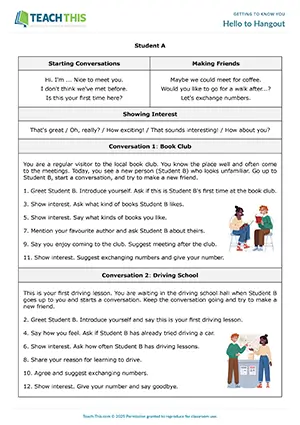
How do you "show interest" naturally? You can use simple phrases like "Oh, really?", "That sounds interesting!", or "Good to hear." You can also ask follow-up questions.
Another great technique is to add a small question at the end of your statement.
- "New York is an amazing place, don't you think?"
- "Onboarding is always a challenge, isn't it?"
This invites the other person to share their opinion. The next video demonstrates these exact phrases in a business context.
Improve Your Small Talk Skills | Business English Conversation
This video from Maria Sheeran demonstrates natural small talk in a professional setting and breaks down the vocabulary used.
Please watch from this section. It covers: More interesting ways to ask "How are you?" (e.g., "What's keeping you busy these days?"). Varied answers (e.g., "All good here," "Can't complain"). Phrases to show interest ("Oh really?", "Good to hear") and using tag questions ("...don't you think?").
Part 5: Your Turn to Speak
Now it's time to put it all into practice. Record yourself answering the prompts below. The goal is to use the Answer + 1 Detail strategy and sound natural and conversational. Don't worry about perfection; focus on the flow.
Scenario 1: Social Setting
Imagine you are at a networking event for HR professionals. Someone you don't know walks up to you, shakes your hand, and starts a conversation.
- Them: "Hi, I'm Alex. I don't think we've met before."
- You: (Introduce yourself)
- Them: "Nice to meet you. So, what do you do?"
- You: (Answer using the Answer + 1 Detail strategy. For example, mention your company or a specific project you're into.)
- Them: "That sounds interesting. My company is struggling with that right now. How was your journey here today?"
- You: (Answer about your journey and add a detail. Then, ask a question back, like "How about you? Are you based here in the city?")
Scenario 2: Professional Setting (Before a Meeting)
You've joined a Zoom call a few minutes early for a weekly team update. A senior manager from another department, whom you respect but don't know well, is also there waiting.
- Manager: "Good morning. How's your week been so far?"
- You: (Answer using a phrase other than "Good." For example: "It's been pretty hectic, but productive..." and add a one-sentence detail about a task you finished. Then ask, "How about your week?").
- Manager: "Busy as always! We're preparing for the quarterly review. Are you all set for the holidays?"
- You: (Answer about your holiday plans using a detail, and then ask them a question back.)
After recording, listen to yourself. Did you add a detail? Did you ask a question back? This practice is the most effective way to build these skills.
Key Takeaways
- Small talk is low-pressure: Its goal is simple connection, not a deep discussion.
- The Golden Rule: Always try to use the Answer + 1 Detail formula. This is the key to keeping conversations alive.
- Use Conjunctions: Words like because, but, and so are easy triggers to help you add that detail.
- Be an active listener: Show interest with phrases like "That's interesting" and ask follow-up questions.
This lesson completes our first module on the foundations of speaking. You now have the basic tools to introduce yourself, express your opinions, and handle simple 'getting to know you' conversations.
In our next lesson, we will begin a new, exciting module: Thinking in English. We will start with a powerful technique called "self-talk," where you'll practice narrating your own daily actions in English. This is the first major step to breaking the mental habit of translating from Hindi and starting to think directly in English.