Welcome to the second module of our course, "Thinking in English: Breaking the Translation Habit." In our first module, we built a solid foundation for conversation, covering everything from introducing yourself to making small talk. You learned how to express your thoughts and engage in simple dialogues using key phrases and strategies.
Now, we're going to take a major step forward. This module is dedicated to one of the most important shifts you can make as a language learner: moving from translating in your head to thinking directly in English. This is the secret to unlocking true fluency and confidence. Our first lesson in this new module will introduce a powerful, practical technique: narrating your own actions in English as you perform daily tasks. This practice, often called "self-talk," is the single best way to start building the habit of thinking in English.
Part 1: Why Translating from Hindi Slows You Down
Before we learn the technique, let's understand the problem we're trying to solve. When you're in a conversation and you mentally translate every thought from Hindi to English, you're doing twice the work. This process is slow, creates pauses, and often results in sentences that sound unnatural or "textbook-like."
The article below explains why breaking this habit is a crucial barrier to overcome for fluency.
Linguistic Tricks to Sound Fluent and Natural in English
This article from PlanetSpark directly addresses the challenge of mental translation.
Please read the section titled "Think in English, Not Translate." Focus on the core idea that translation slows you down and makes your speech sound unnatural. The goal we are aiming for is to make English a part of your thinking, and this lesson is the first step.
By practicing thinking directly in English, you train your brain to access English words and structures automatically, without the intermediate step of translation. This is what allows for smooth, spontaneous, and confident speech.
Part 2: The Power of Self-Talk: Narrating Your Life
So, how do we start thinking in English? The most effective method is self-talk, or narrating your actions out loud. Imagine you are the commentator of your own life, describing everything you do as you do it.
The podcast-style video below introduces this idea perfectly and explains why it's such a powerful tool for learning.
How to Talk to Yourself All Day in English | Improve Fluency Fast | Easy English Podcast
This video from the Everyday English Academy, titled "How to Talk to Yourself All Day in English," breaks down the concept of narrating your life.
First, watch the introduction from the beginning, where the hosts establish that talking to yourself is a normal and highly effective learning technique. Then, watch the section from this timestamp, which explains what it means to narrate your life. Pay close attention to the analogy of a sports commentator and the key benefit: you are practicing real-time English production with authentic, original sentences.
As you heard, this isn't about memorizing. It's about creating spontaneous sentences about what is happening right now. This builds the mental pathways you need for real conversations.
While you can do this in your head ("inner speech"), it is far more effective to speak the words aloud ("private speech"). Speaking out loud engages the physical muscles of your mouth and tongue, building the muscle memory needed for pronunciation and fluent delivery.
Part 3: A Live Demonstration of Daily Narration
To see what this looks like in practice, we'll watch a fantastic video from Bob the Canadian. He literally walks through his daily routine and narrates his actions in simple, natural English. This will give you the vocabulary and sentence structures you need to start your own practice.
Below is a visual guide of common daily activities to keep in mind as you watch.
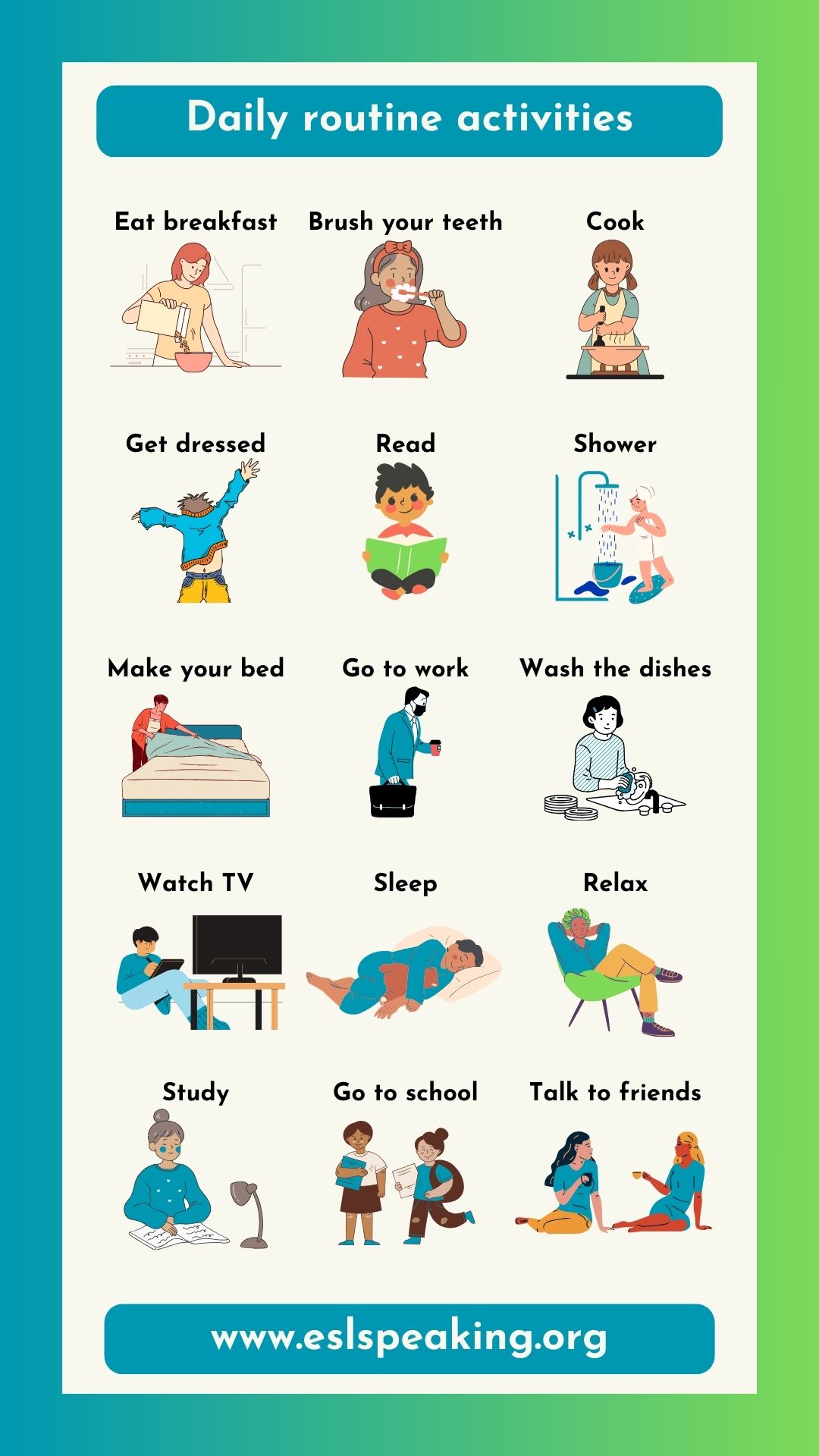
Now, let's watch the demonstration.
Learn How To Talk About Your Daily Routine in English by Watching Me Act Out Mine
In "Learn How To Talk About Your Daily Routine," Bob the Canadian provides a perfect model for our self-talk exercise.
Watch the video from the beginning up to this point. As you watch, pay close attention to the simple present and present continuous tenses he uses. Morning Routine (00:44-01:51): Notice the phrases: "I wake up," "I press the snooze button," "I get up," "I make the bed," "I use the bathroom." Breakfast and Computer (01:57-03:03): Listen for action verbs like "I make breakfast," "I fry two eggs," "I eat breakfast" (or "I have breakfast"), "I check my email." Getting Ready (03:06-03:55): He says "I take a shower" (or "I have a shower"), "I get dressed," "I shave," "I brush my teeth." Leaving the House (03:57-04:46): Note the phrases "I make a lunch," "I pack a lunch," and "I grab my things" (keys, phone, wallet). The key here is the simplicity. He is just saying what he is doing. This is exactly what you are going to practice.
Part 4: Your Turn to Practice
Now it's time to become the commentator of your own life. Remember the advice from the podcast: start small. Don't try to narrate your entire day at first. Pick one simple, 5-minute activity and describe it out loud.
Your First Self-Talk Exercise:
Choose ONE of the following activities and narrate your actions for the next 5-10 minutes. Speak out loud. Don't worry about perfection; focus on just speaking.
Scenario 1: Making a cup of tea or coffee.
- Example Narration: "Okay, I'm walking to the kitchen now. I'm going to make some coffee. I'm opening the cupboard to get a mug. This one is my favorite. Now, I'm getting the coffee. I'm putting one spoonful in the mug. I need to boil some water. I'm filling the kettle now and switching it on."
Scenario 2: Getting ready to leave the house.
- Example Narration: "It's time to go. Where are my keys? Ah, they are on the table. I'm picking up my keys. I'm also grabbing my wallet and my phone. I need to put on my shoes. I'm wearing the black ones today. Okay, I think I have everything. I'm opening the door and leaving the apartment now."
Scenario 3: Cleaning your desk or a small area.
- Example Narration: "This desk is a bit messy. I'm going to organize it. First, I'm picking up these old papers. I'm putting them in the bin. Now I'm wiping the surface with a cloth. It's looking much better. I'm putting my laptop back in the center."
Tips for Your Practice:
- Use Present Continuous: The "-ing" form is your best friend here (I am walking, I am opening, I am thinking).
- Describe Your Thoughts: Don't just narrate actions. Narrate your thoughts and decisions too. ("Hmm, what should I wear today? It's cold outside, so I need a sweater.")
- Don't Stop If You Don't Know a Word: If you can't think of a word, describe it instead (e.g., "I'm using the... thing you use to boil water") or just say the word in Hindi and continue in English. The goal is to maintain the flow.
Part 5: Improving Your Self-Talk
Self-talk is a private practice, which is great for building confidence. However, it has one potential downside: you might be practicing mistakes without realizing it.
Talking To Yourself: Is It An Effective Way To Improve Your English Speaking?
This article provides a balanced view by highlighting the potential challenges of self-talk.
Read the section "Disadvantages of self-talk." The key point to understand is that self-talk can reinforce mistakes because there is no one to correct you.
So, how do we solve this? A simple and effective way is to record yourself. Once a week, use your phone to record a 5-minute self-talk session. When you listen back, you will be surprised at how many small errors you can identify yourself. This also serves as a fantastic way to track your progress and see how much more natural you sound over time.
Key Takeaways
- Break the Translation Habit: Thinking directly in English is the key to fluency. Translating from Hindi is a major barrier.
- Narrate Your Life: The best way to start is by practicing self-talk—describing your actions, thoughts, and surroundings out loud as they happen.
- Start Small and Be Consistent: Begin with short, 5-minute activities like making breakfast or getting dressed. The goal is to build a daily habit.
- Record Yourself to Improve: Listening back to your own voice is a powerful way to catch mistakes and track your progress.
You have now learned the foundational technique for our "Thinking in English" module. This is a skill you can practice anytime, anywhere, and it will have a massive impact on your confidence and fluency.
In our next lesson, we will expand on this skill. Instead of just narrating your own actions, you will learn to describe what you see around you in English, further strengthening your ability to think and react spontaneously in the language.