Welcome to your next lesson! In our previous session, we focused on talking about the future using 'will', 'going to', and natural-sounding contractions like 'I'll' and 'gonna'. This was a key step in making your spoken English flow more smoothly.
Today, we'll continue this journey by dramatically expanding your vocabulary for expressing opinions. Instead of relying on the simple "I like" or "I don't like," you will learn to discuss your preferences on a spectrum—from strong passion to complete indifference to intense dislike. Mastering natural expressions like 'I'm into' and 'I can't stand' will make your conversations far more engaging and help you express your personality more clearly.
Part 1: Moving Beyond "I Like"
When you want to express a positive feeling about something, using a variety of phrases shows confidence and a richer vocabulary. Let's explore some common ways to do this, ranging from mild interest to strong passion.
The video below from Oxford Online English provides excellent, clear examples of how native speakers express strong likes. Pay attention not just to the words, but also to the enthusiastic intonation they use.
Talking About Likes and Dislikes in English - Spoken English Lesson
This video provides clear, contextual examples of how to express strong preferences in a natural way.
Watch the first section of the video, from the beginning until the first practice prompt. Focus on phrases like "I really love...", "I'm a big fan of...", and "What I really like is...". Notice how they are used with both nouns (e.g., "blues music") and activities (e.g., "swimming in the sea").
To build on this, let's explore a few more essential phrases. The expressions "I'm keen on" and "I'm into" are particularly useful for talking about hobbies and interests in a natural, conversational way.
The next video explains these phrases very clearly.
Stop Saying "I like" in English (Speaking lesson)
This lesson from POC English breaks down intermediate-level phrases for expressing likes, including the exact ones we want to master.
Please watch the section on intermediate expressions for liking things, from this timestamp. Pay close attention to the explanations for "I'm fond of...", "I'm keen on...", and especially "I'm into...".
So, to summarize your new toolkit for liking something:
- For strong passion: "I love...", "I adore...", "I'm crazy/mad about..."
- For hobbies and interests: "I'm into...", "I'm a big fan of..."
- For general preference: "I'm keen on...", "I'm fond of..."
Part 2: The Spectrum of Dislike and Indifference
Just as important as expressing what you like is expressing what you don't, and doing so with the right level of intensity. Shouting "I hate it!" about a colleague's suggestion might be too strong, while saying "I don't like it" about something you truly detest might not be strong enough.
Let's start with mild dislike and complete indifference. These are very common in daily conversation, especially for being polite.
Talking About Likes and Dislikes in English - Spoken English Lesson
Continuing with the Oxford Online English video, these next two parts cover the more nuanced areas of mild preference and neutrality.
First, watch the section on low-level likes and dislikes from this timestamp. Focus on polite or mild ways to show you don't like something, such as "I'm not keen on..." and "...isn't my thing." Next, watch the part about expressing neutrality from this timestamp. This is crucial. Phrases like "I don't mind" and "I can take it or leave it" are very useful when you don't have a strong opinion.
Now, let's look at how to express strong dislike. This is where a phrase like "I can't stand" comes in. It's powerful, common, and very natural.
Stop Saying "I like" in English (Speaking lesson)
Let's return to the POC English video for a focused look at strong negative expressions.
Watch the section on intermediate expressions for disliking things, from this timestamp. The video gives a great explanation of "I can't stand..." and "I can't bear...", clarifying that they mean you cannot tolerate something.
Here is a visual summary of the different phrases you've learned for likes, dislikes, and neutrality. It's a handy reference chart.
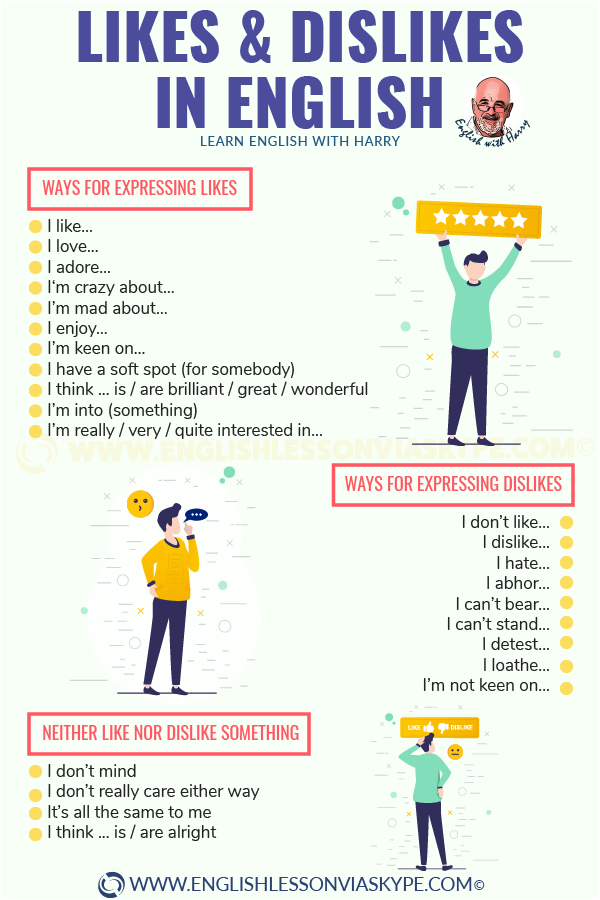
Part 3: Your Turn to Speak
Time to practice! Record yourself speaking your answers. The goal is to use a variety of the new phrases, not just "I like" or "I don't like." Try to match your tone of voice to the strength of the phrase.
Warm-up Practice
Answer these questions out loud, using a different expression for each.
- What kind of movies are you into?
- Example Answer: "I'm a big fan of psychological thrillers. But, to be honest, I can't stand horror movies with too much gore."
- What are your thoughts on spicy food?
- Example Answer: "I absolutely love it. I can't get enough of it. My friends think I'm crazy."
- How do you feel about reading non-fiction books?
- Example Answer: "It depends. I'm keen on books about psychology and business, but history isn't really my thing."
- Someone offers you coffee or tea. You have no preference.
- Example Answer: "Honestly, I don't mind. Either is fine, thank you."
HR-Focused Speaking Task
Now, let's place these phrases in a professional context. Imagine you are in these HR-related situations. Speak your responses aloud.
- Situation 1: During a meeting to plan the annual company offsite, a colleague suggests, "How about a multi-day trekking trip?"
- Your goal: Politely express that you don't think it's a good idea for everyone.
- Possible phrases: "I'm not so keen on that idea..." or "Trekking isn't everyone's cup of tea..."
- Situation 2: Your team is testing a new performance management software. Your manager asks for your initial thoughts on its user interface.
- Your goal: Express a strong positive opinion about one feature and a strong negative opinion about another.
- Possible phrases: "I'm really into the clean dashboard... but I can't stand the way the reports are generated. It's so confusing."
- Situation 3: A new hire asks you for your opinion on the office cafeteria food during their onboarding.
- Your goal: Give a neutral, diplomatic answer.
- Possible phrases: "It's alright. I can take it or leave it, to be honest." or "I don't mind it for a quick lunch."
- Situation 4: In a discussion about employee engagement activities, someone suggests starting a company book club.
- Your goal: Show genuine enthusiasm for the idea.
- Possible phrases: "I love that idea! I'm really into reading, so I'd definitely join."
Reviewing your recordings will help you hear how natural and varied you sound. This practice is the fastest way to build these phrases into your active vocabulary.
Key Takeaways
- Go beyond the basics: Replace "I like" with phrases like "I'm into," "I'm a big fan of," or "I'm keen on."
- Express dislike appropriately: Use milder phrases like "I'm not keen on" or "...isn't my thing" for politeness. Use strong phrases like "I can't stand" or "I can't bear" for things you genuinely hate.
- Master neutrality: Phrases like "I don't mind" and "I can take it or leave it" are essential for everyday, flexible conversations.
You've added a powerful set of tools to your speaking toolkit today. Being able to express your tastes and opinions with nuance is a hallmark of a confident and fluent speaker.
This lesson concludes our first module on the foundations of confident speaking. In our next lesson, we will begin Module 2, "Thinking in English." Our first activity will be to practice narrating your own actions in English. This "self-talk" technique is a fantastic way to break the mental habit of translating from Hindi before you speak.