Hello. The previous lesson separated resting energy use from the full daily total: digestion, planned exercise, and everyday movement also matter. This lesson turns that framework into a rough maintenance-calorie range for a hypothetical adult. The aim is to understand what a calculation can tell you—and why its output is not a precise eating prescription.
The safety boundary from the first lesson still applies. An adult maintenance equation is not a basis for recommending restriction during adolescence, pregnancy or breastfeeding, undernutrition, or circumstances that call for medical or eating-disorder support.
Start with an estimate of energy used at rest
One commonly used method begins with the Mifflin–St Jeor equation. It uses weight, height, and age to estimate resting energy expenditure. The equation has different constants in its male and female versions; those are features of a population-derived formula, not direct measurements of an individual’s metabolism.
Watch the opening and the worked resting-expenditure example in Vivo Phys – Evan Matthews’s Basal and Total Metabolic Rate – Mifflin St. Jeor Equations. Focus on the input units and on the point at which the calculation stops being about resting expenditure and starts being about the whole day.
Basal and Total Metabolic Rate - Mifflin St. Jeor Equations
Vivo Phys – Evan Matthews’s worked calculation makes the equation’s inputs and units concrete before we use it for a different hypothetical adult.
Watch the equation for the weight, height, age, and constant terms. Then watch the worked example, where weight and height are converted to metric units before calculating resting expenditure. The many decimal places shown in the arithmetic do not imply that the result is known to that precision.
Written with metric inputs, the equation is:
The constant is in the male version and in the female version. Kilograms and centimetres are essential here: putting pounds or inches into this version of the equation would produce a misleading result.
Consider a hypothetical 35-year-old adult, weighing 70 kg and standing 165 cm, for whom we use the equation’s female version. Substitution gives:
About 1,395 kcal/day is the equation’s resting estimate. It is not the amount required for maintenance across an ordinary day, and it is not a suggested intake. A different person with the same listed inputs could have a different measured resting expenditure.
Account for the whole day without adding the same activity twice
A convenient shortcut multiplies the resting estimate by an activity factor:
The factor is an approximate way to move from resting expenditure toward a daily total. In this shortcut, do not separately add a workout estimate or another allowance for digestion to the resulting total. That would risk counting expenditure the shortcut is already intended to represent.
Return to the video for its activity-factor table and its complete maintenance calculation.
Basal and Total Metabolic Rate - Mifflin St. Jeor Equations
The same video shows how a resting estimate becomes a total-expenditure estimate and supplies the factors used in this lesson’s worked range.
Watch activity factors for the sedentary and light-activity values, and notice that the descriptions are approximate categories. Then watch the daily total to see the resting result multiplied by one selected factor. We will use two plausible factors instead of treating a single category as certain.
For this hypothetical adult, suppose most work is seated, there is some ordinary walking, and there is no regular vigorous training. The exact amount of movement is unspecified. Using 1.2 as a low-activity assumption and 1.375 as a light-activity assumption from the video lets us see how much that choice matters:
| Assumed activity | Calculation | Estimated daily total |
|---|---|---|
| Lower activity | about 1,674 kcal/day | |
| Light activity | about 1,918 kcal/day |
Rounded to avoid false precision, the result is roughly 1,700–1,900 kcal/day under those two activity assumptions. That is an illustrative maintenance range, not a pair of cutoffs or a recommendation to eat at either endpoint. A routine involving substantially more movement would call for different assumptions; a change to the adult’s circumstances would call for a fresh estimate.
The factor is often the less obvious input. A planned walk or training session matters, but so does movement during the rest of the day. Describing someone only as “a person who exercises” is therefore not enough to select a factor confidently.
Read the result as a model, not a measurement
The arithmetic can be correct while the estimate is off. The resting equation predicts from a few inputs rather than measuring energy use directly. Activity labels compress varied days into categories, and expenditure itself can vary from day to day. The 1,700–1,900 range above shows the effect of two selected activity factors; it is not a guaranteed interval containing this person’s true maintenance needs.
Maintenance also refers to a pattern over time. In the energy-balance sense, it means intake and expenditure are approximately balanced without a sustained change in stored body energy. It does not require identical intake, expenditure, or scale readings every day. Later in the course, you will examine why short-term scale changes cannot, by themselves, settle whether an estimate was right.
The formula’s male and female constants deserve the same caution as its activity categories: neither is an identity test nor an individual metabolic measurement. In situations where a standard equation’s assumptions may not fit—particularly where health conditions, medications, or hormone-related circumstances affect energy needs—professional guidance can be more useful than selecting whichever calculator output appears most appealing.
Compare another estimator carefully
The National Institute of Diabetes and Digestive and Kidney Diseases’ Body Weight Planner provides another example of an estimator. Read its input and results guidance without entering personal information. Its purpose here is to show how an estimate depends on supplied activity information, not to produce a second prescription.
Read the National Institute of Diabetes and Digestive and Kidney Diseases’ Body Weight Planner guidance to see which inputs a model asks for and how its results depend on activity assumptions.
Under “Starting Information,” begin with the input guidance; pay particular attention to the “Physical Activity Level” subsection and its description of the default. Then move past “Physical Activity Changes” to “Results.” Read the results guidance, focusing on the dependence on entered activity changes and the warning that results can be too high in some circumstances.
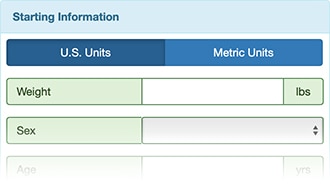
Notice that the Body Weight Planner describes typical physical-activity-level numbers beginning at 1.4 for sedentary activity, whereas the video’s shortcut uses 1.2 for its sedentary category. Do not swap numbers between the two methods just because both are called activity factors. Use each estimator’s inputs and definitions together. Their differing categories are another reason to regard outputs as model-dependent estimates rather than facts about an individual’s exact needs.
For the worked adult, the defensible conclusion is therefore modest: using the specified equation and a low-to-light activity assumption yields an initial maintenance estimate of roughly 1,700–1,900 kcal/day. It does not establish what that adult must eat, whether a deficit is appropriate, or how their weight will respond to a particular intake.
Key takeaway
To estimate maintenance needs, first calculate resting expenditure with the correct units, then apply an activity assumption to approximate the daily total. Using more than one plausible assumption makes uncertainty visible; rounding the result keeps the arithmetic from masquerading as precision. The estimate is a starting model, not a target or a substitute for safety and health context.
The next module moves from estimating maintenance to deciding, when restriction is appropriate, what makes a starting deficit conservative and sustainable.