Hello. Last lesson separated two ideas: a sustained energy deficit reduces stored body energy, while a scale reading measures total mass and cannot tell you how much fat changed. We now turn to the expenditure side of that comparison. To understand an energy-needs estimate later, you need to know what it is trying to include: energy used at rest, energy used to process food, deliberate exercise, and movement throughout an ordinary day.
This is an explanation of how expenditure works, not a reason to restrict food. The safety considerations from the first lesson still apply.
One daily total, several kinds of expenditure
Total daily energy expenditure, often shortened to TDEE, is the energy the body uses over a day. A useful breakdown is:
The last two terms are often grouped together as physical activity. Separating them here makes an important distinction visible: a workout is only one kind of movement.
Watch these two short portions of Lecturio Medical’s Energy Considerations in Nutrition: BMR, RMR & Physical Activity. The first introduces energy use at rest; the second lays out the daily components. There is no need to follow the calculations mentioned at the end—that belongs to the next lesson.
Energy Considerations in Nutrition: BMR, RMR & Physical Activity – Nutrition | Lecturio
Lecturio Medical’s “Energy Considerations in Nutrition: BMR, RMR & Physical Activity” provides a compact overview of what belongs in total expenditure.
Watch resting energy for the distinction between basal and resting metabolic rates. Then skip ahead to daily expenditure; notice that processing food and everyday movement appear alongside basic bodily needs and workouts.
The following schematic shows the same broad categories. Its level balance scale illustrates the balanced case; intake and expenditure are not necessarily equal on any particular day.
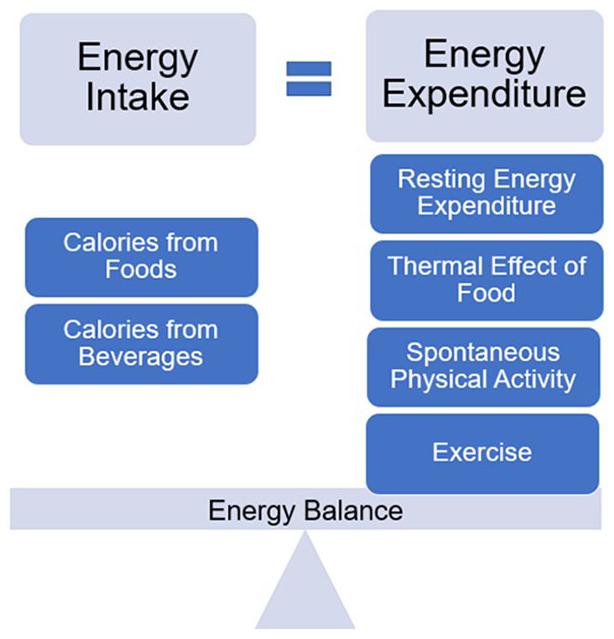
The diagram labels one movement category “spontaneous physical activity.” In practice, non-exercise activity also includes routine movement that is not a workout, such as walking between rooms or doing household tasks. These are useful accounting categories, not four separate engines that switch on and off. Your body continues using energy at rest while you are walking, eating, or exercising.
Resting expenditure: the energy of keeping the body running
Resting metabolic rate, or RMR, describes energy use when you are resting quietly. Breathing, circulating blood, regulating temperature, and maintaining the activity of organs and the nervous system all require energy. “Resting” does not mean “doing nothing” in an energy sense.
Read the three consecutive subsections of the National Academy of Sports Medicine article below. They clarify what RMR covers, how it fits into TDEE, and why you may also encounter the term basal metabolic rate (BMR).
Resting Metabolic Rate: How to Calculate and Understand Yours
The National Academy of Sports Medicine’s article gives the resting component a concrete meaning and places it alongside food processing and activity.
Begin in “What Is Resting Metabolic Rate?” at its opening definition. Read the three subsections through the final paragraph of “What’s the Difference Between RMR and BMR?” Stop before “How Is Resting Metabolic Rate Estimated?” Focus on why resting expenditure is not the same as the whole day’s expenditure.
BMR and RMR both describe energy used to sustain basic functions, but BMR is measured under more restrictive conditions. RMR is the more practical resting measure. For the purposes of this lesson, the crucial distinction is not between those two measurements; it is between resting expenditure and total expenditure.
Resting expenditure is often the largest part of TDEE. The reading gives approximately 60–75% for many relatively sedentary people, not a percentage that applies to everyone. A person’s size and body composition affect their resting needs, as do other biological circumstances. Someone who spends much more energy in physical activity could have a smaller percentage of their daily total coming from rest, even though their resting functions still require substantial energy.
A common mistake is to treat an RMR figure as a complete “maintenance-calorie” figure. It is not: a whole day also includes processing food and moving. Another mistake is to think that building muscle makes resting expenditure soar. Lean tissues do contribute to resting energy use, but neither the reading nor this breakdown supports treating any one tissue as an automatic solution to energy balance.
The thermic effect of food: processing what you eat
Eating supplies energy, but digesting, absorbing, and processing food also uses energy. This expenditure is called the thermic effect of food, or TEF. It is generally a smaller part of TDEE than resting expenditure; the video describes it as roughly a tenth of the daily total.
TEF changes with how much food is eaten and with the mix of nutrients. That does not make eating more a way to create a deficit. A larger meal can raise the energy spent processing it while also supplying more energy than that processing costs. Nor does TEF make a particular food “free” of calories.
This category helps explain why an energy budget is more than “resting calories plus workout calories.” It also shows why the components are not perfectly fixed. Unlike a hypothetical daily allowance assigned in advance, the energy spent processing food depends partly on what is consumed that day. For now, it is enough to recognize TEF as a real component without trying to calculate it meal by meal.
Movement includes much more than workouts
Exercise is purposeful activity undertaken as exercise: for example, a planned resistance-training session, cycle ride, or brisk walk. Non-exercise activity thermogenesis, usually called NEAT, covers movement outside those sessions. It includes walking as part of a daily routine, household tasks, standing and shifting position, and small movements such as fidgeting.
The distinction is about the activity’s role in a person’s day, not whether it uses the same muscles. A walk taken as a planned workout can be classified as exercise; walking around while carrying out ordinary tasks belongs with non-exercise activity. Both use energy. The labels simply help us avoid overlooking movement because it was not logged as a workout.
NEAT is easy to underestimate. Someone could complete a short exercise session yet spend the rest of the day moving very little. Another person might do no formal workout but move frequently through daily tasks. Neither description alone gives a precise TDEE: the amount, duration, and intensity of movement, as well as resting needs, still matter. Work routines, physical ability, transport, caregiving, and surroundings can all shape opportunities to move. NEAT is not a measure of virtue or discipline, and there is no requirement to manufacture fidgeting.
When adding components, avoid double-counting. A resting estimate represents a baseline level of energy use; the movement terms represent activity-related expenditure in addition to that baseline. Likewise, a device or calculator reporting total daily calories may already include resting and activity energy. Adding a workout estimate to that total without knowing what it includes could count the same activity twice.
Putting the categories together
Consider two illustrative, not prescriptive, days for the same hypothetical adult. The numbers are chosen to show how the categories relate, not to describe anyone’s energy needs.
| Component | Day without a workout | Day with a workout |
|---|---|---|
| Resting expenditure | 1,450 kcal | 1,450 kcal |
| Thermic effect of food | 150 kcal | 150 kcal |
| Everyday, non-exercise movement | 350 kcal | 200 kcal |
| Planned exercise | 0 kcal | 250 kcal |
| Total | 1,950 kcal | 2,050 kcal |
The workout day includes 250 kcal of planned exercise, but its hypothetical total is only 100 kcal higher because everyday movement is 150 kcal lower. That is one possible pattern, not a claim that exercise always reduces other movement by that amount. The example holds resting expenditure and TEF constant to isolate the distinction; real days need not do so.
The point is that “I exercised today” does not, by itself, specify total expenditure. Equally, “I did not exercise today” does not mean expenditure was limited to resting needs. Each day’s total reflects all the components together, and actual component values are difficult to know precisely outside specialized measurement.
TDEE describes expenditure over a day, whereas maintenance is better understood over time: intake and expenditure are approximately balanced across a longer period, without a sustained change in stored body energy. A single day can differ from that longer-term pattern. The breakdown helps identify what an estimate must account for; it does not turn the estimate into an exact measurement.
Key takeaway
Total daily energy expenditure includes energy used at rest, energy used to process food, and energy used in movement. Movement includes both deliberate exercise and non-exercise activity throughout daily life. Resting expenditure is usually substantial, but it is not the whole daily total; a workout is part of the total, but it is not all of physical activity.
Next, you will use this framework to estimate a range of maintenance energy needs for a hypothetical adult, while keeping the uncertainty of any calculation in view.