Hello! Welcome back to your course on Oncology Immunotherapy.
Introduction
In our last lesson, we distinguished between the innate and adaptive immune systems, identifying their key cellular players. We concluded by highlighting the dendritic cell (DC) as the critical messenger that bridges these two arms, activating the specific, powerful response of the adaptive system.
Today's lesson focuses on this crucial role. Our learning outcome is to describe the function of antigen-presenting cells (APCs), with a focus on dendritic cells. We will explore what APCs are, why dendritic cells are considered the most important ones for initiating an immune response, and the step-by-step process they undertake to sound the alarm against threats like cancer cells.
Understanding this process is fundamental. It's the very first step in the chain of events that allows the immune system to recognize and attack a tumor, and it's a process that many immunotherapies aim to enhance.
What Are Antigen-Presenting Cells (APCs)?
An Antigen-Presenting Cell is a specialized immune cell that captures invaders or abnormal cells (like cancer cells), breaks them down into small pieces called antigens, and displays these antigens on its surface for T-cells to inspect.
However, simply showing an antigen isn't enough to activate a naive T-cell (one that has never encountered its target antigen before). To do this, a cell must be a "professional" APC. These cells are defined by two key abilities:
- They present antigens on special molecules called Major Histocompatibility Complex (MHC) class II molecules.
- They provide a crucial second signal through co-stimulatory molecules on their surface.
This "two-signal" activation process is a safety mechanism to prevent T-cells from being activated inappropriately.
To see a clear explanation of this concept, please watch the beginning of the following video.
Antigen Presenting Cells (B-cells, Macrophage, Dendritic Cell) - Immunology
This video from Taim Talks Med provides an excellent introduction to what an APC is and the 'three signals' required to activate a T-cell (we will focus on the first two for now).
Please watch from the beginning to 2:56. Focus on the definition of an APC, the role of MHC molecules, and the importance of the second signal (B7 and CD28 interaction).
The Three Professional APCs
The immune system has three main types of professional APCs:
- Macrophages: As we learned, these are phagocytic cells of the innate system. They are excellent at engulfing debris and pathogens within tissues and can present antigens, but they are not the primary activators of naive T-cells.
- B-cells: These adaptive immune cells can internalize specific antigens that bind to their surface antibodies. They are very efficient at presenting that specific antigen to T-cells, but this role is more about getting help for their own activation rather than initiating a broad primary response.
- Dendritic Cells (DCs): These are the undisputed champions of activating naive T-cells and are therefore considered the most potent and important APCs for initiating an adaptive immune response.
To understand what makes DCs unique, especially in the context of cancer, please read the introduction to the following research article.
Dendritic Cells and Their Role in Immunotherapy
This article, 'Dendritic Cells and Their Role in Immunotherapy' from the journal Frontiers in Immunology, clearly explains the roles of different APCs within a tumor and highlights the unique and critical function of dendritic cells.
Read the 'Introduction' section. Pay close attention to the comparison between macrophages and dendritic cells and why the authors state that DCs 'have a unique ability to transport tumor antigen to the draining lymph nodes to initiate T cell activation'.
As the article emphasizes, the key difference is migration. While macrophages and B-cells generally present antigens where they are, dendritic cells have the unique job of capturing an antigen in a peripheral tissue (like a tumor) and traveling to a lymph node to present it to the vast armies of naive T-cells residing there.
The Dendritic Cell Journey: From Sentinel to Activator
The function of a dendritic cell is best understood as a three-step journey.
Step 1: The Sentinel (Antigen Capture)
In their default state, immature DCs are scattered throughout the body's tissues (e.g., in the skin, lungs, and gut lining), where they act as sentinels. Their primary job is to constantly sample their surroundings for signs of danger.
Given your biochemistry background, you might find the mechanisms of this sampling process interesting. It's not just random engulfing; DCs use a variety of surface receptors to recognize and internalize material.
Dendritic cell biology and its role in tumor immunotherapy
This review article, 'Dendritic cell biology and its role in tumor immunotherapy' from the Journal of Hematology & Oncology, details the molecular mechanisms DCs use to find and capture antigens.
Please read the section 'Antigen recognition and internalization'. You don't need to memorize every receptor, but focus on understanding the different strategies DCs use, such as recognizing patterns on pathogens (via C-type lectin receptors and Toll-like receptors) and engulfing larger amounts of fluid (macropinocytosis).
In an oncology context, DCs capture antigens from dying tumor cells. These dying cells release "danger signals" that alert the DCs.
Step 2: Maturation and Migration
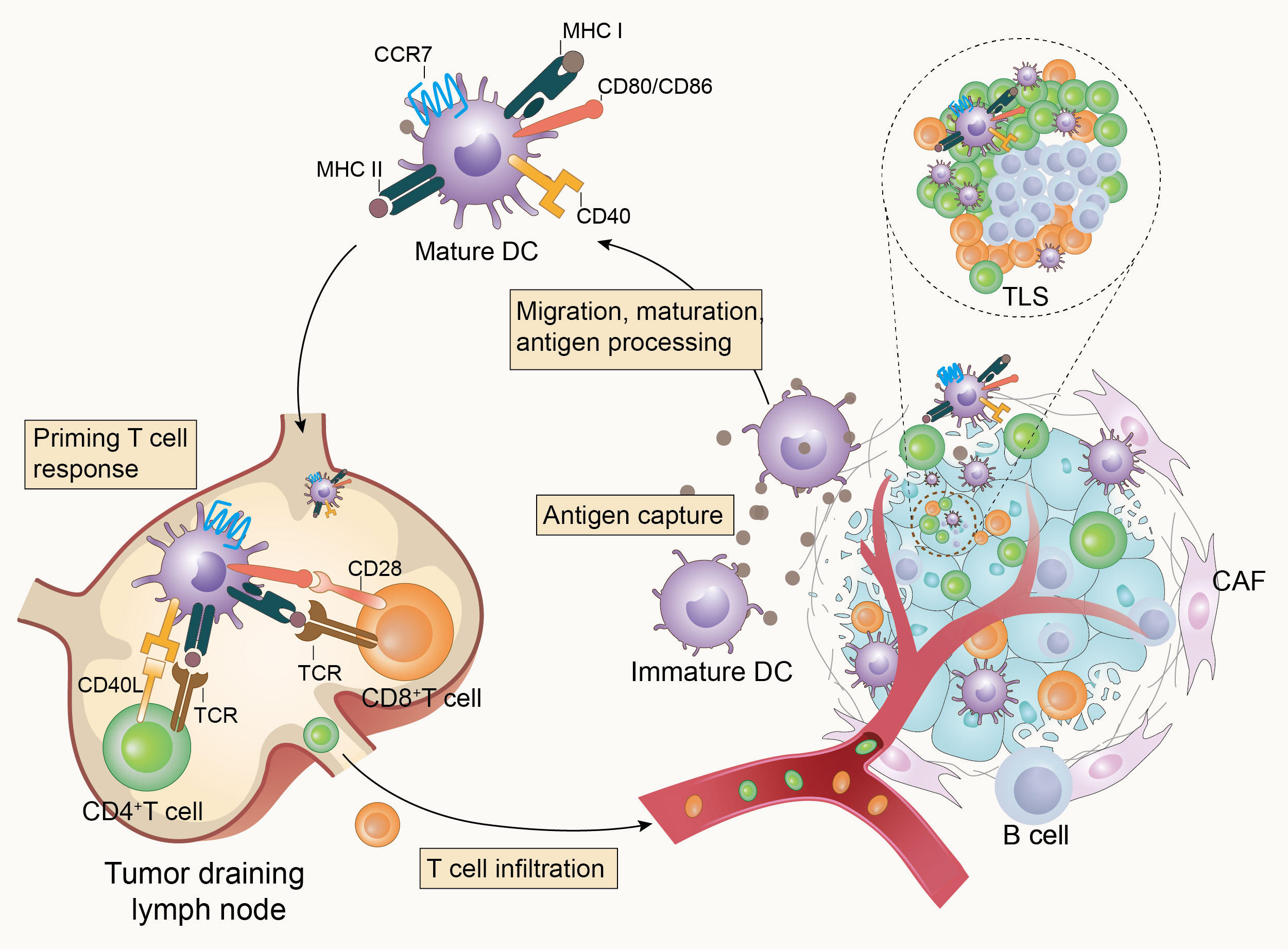
Upon capturing an antigen and receiving danger signals, the immature DC undergoes a profound transformation known as maturation. This process essentially reprograms the DC from an "antigen-capturing" cell into an "antigen-presenting" cell.
Key changes during maturation include:
- Decreased phagocytosis: It stops capturing new antigens to focus on what it has already found.
- Increased surface molecules: It dramatically increases the expression of MHC molecules (to present the antigen) and co-stimulatory molecules (like B7, also known as CD80/CD86) needed for the "second signal."
- Expression of CCR7: This is a chemokine receptor that acts like a GPS, directing the DC to leave the tissue and migrate via the lymphatic vessels to the nearest lymph node.
This video provides a great visual summary of this activation and presentation process.
Dendritic Cells: The Regulators
Let's watch a segment from the 'Dendritic Cells: The Regulators' video by Professor Dave Explains. It neatly summarizes the transition from antigen capture to presentation.
Watch the clip from 3:32 to 4:29. Notice how it describes the maturation process and the migration to lymph nodes to interact with lymphocytes.
This journey from the tissue to the lymph node is a defining feature of the dendritic cell's function.

Step 3: The Activator (T-cell Priming)
Once the now mature DC arrives in the lymph node, it is perfectly equipped for its final task: screening passing T-cells. It presents its captured antigen on MHC molecules. When a naive T-cell with a matching T-cell receptor (TCR) comes along, it binds to the MHC-antigen complex (Signal 1). The DC then provides the co-stimulatory signal via its CD80/86 molecules binding to the T-cell's CD28 (Signal 2).
This successful two-signal handshake activates the T-cell, causing it to proliferate and differentiate into an effector cell that can now travel throughout the body to find and destroy any cells bearing that specific antigen—including the cancer cells in the original tumor.
Putting It All Together: DCs in Cancer Immunology
This entire process is the foundation of anti-tumor immunity. Without DCs to perform this capture-migrate-present function, the adaptive immune system would remain largely unaware of the tumor's existence.
The image below provides a comprehensive overview of the DC's role specifically within the tumor microenvironment, linking it to the T-cell response you're aiming to understand.
Conclusion
In this lesson, we've unpacked the critical function of antigen-presenting cells, placing a special focus on the unique and indispensable role of dendritic cells.
Key Takeaways:
- Professional APCs (DCs, Macrophages, B-cells) are the bridge between innate detection and adaptive response. They are defined by their ability to present antigens on MHC class II and provide co-stimulation.
- Dendritic Cells are the most potent activators of naive T-cells due to their unique ability to capture antigens in tissues, migrate to lymph nodes, and mature into powerful activators.
- The DC life cycle is a journey: immature sentinel in the tissue -> maturation upon antigen capture -> migration to the lymph node -> mature activator of T-cells.
- This process is the critical first step in initiating a T-cell-mediated immune response against cancer.
Preview of the Next Lesson:
We've now established who presents antigens (APCs, primarily DCs) and where this leads to T-cell activation (the lymph node). In the next lesson, we will zoom in on the molecular details of this interaction. We will answer the question: How exactly do cells present antigens? This will lead us to explore the two different pathways of antigen presentation: MHC class I and MHC class II molecules. Understanding this distinction is essential for the next step, which is to contrast the roles of CD8+ and CD4+ T-cells.