Hello! Welcome to the first lesson in your course on Oncology Immunotherapy.
Given your background in biochemistry and your work in health economics for an oncology drug, this course is designed to build a deep biological understanding of the mechanisms that underpin the immunotherapies you encounter professionally.
Introduction
This first lesson serves as the bedrock for everything that follows. Our goal is to address the first learning outcome of the course: to distinguish between the innate and adaptive immune systems and list the key cell types involved in each.
Think of the immune system as the body's military. To understand how a new weapon (an immunotherapy) works, you first need to know the different branches of the military (innate vs. adaptive), who the soldiers are (the cell types), and their fundamental rules of engagement. Mastering this foundational knowledge is essential for appreciating the sophisticated ways we can now direct the immune system to fight cancer.
We will start with a high-level overview of these two systems, then explore the specific components of each, and conclude by summarizing their key differences.
The Two Arms of the Immune System: An Overview
At its core, the immune system's primary job is to distinguish "self" (your own healthy cells) from "non-self" (pathogens like bacteria and viruses, or altered-self, like cancer cells) and to eliminate the latter. This defense is organized into two distinct but interconnected arms: the innate immune system and the adaptive immune system.
- Innate Immunity: This is the body's immediate, non-specific first line of defense. It's like a group of sentries on constant patrol. They recognize general danger signals and react within minutes to hours. They fight all intruders in the same way and do not form a "memory" of the encounter.
- Adaptive Immunity: This is a more sophisticated, specialized defense. It is slower to respond initially (taking days), but its attack is highly specific to the particular intruder. Crucially, it creates a long-lasting "immunological memory," allowing for a much faster and stronger response if the same intruder is encountered again.
To get a dynamic introduction to these concepts, please watch the following short video.
Immune System: Innate and Adaptive Immunity Explained
This video from Science ABC provides a clear and concise overview of the two divisions of the immune system. Focus on how it introduces the core concepts and the main differences in their response.
Please watch the introduction (0:00-0:47) and the final comparison (6:25-6:57). These clips will frame our discussion by providing a high-level summary of innate versus adaptive immunity.
The Innate Immune System: The First Responders
As you just saw, the innate system is our rapid-response force. Its components are always ready and are the first to engage an invader or a damaged cell.
To understand its components and characteristics in more detail, please read the following section from an article by Technology Networks.
Innate vs Adaptive Immunity: Key Differences
This article, 'Innate vs Adaptive Immunity: Key Differences', clearly outlines the components of the innate system. It provides a structured overview that we will build upon.
Please read the section titled 'What is innate immunity?'. Pay close attention to the different types of barriers and the list of cellular defenses.
As the reading highlights, the innate system has several key components:
1. Physical and Chemical Barriers:
- Physical: The skin and mucous membranes that line our respiratory and digestive tracts.
- Chemical: Substances like stomach acid, enzymes in tears (lysozyme), and antimicrobial peptides.
2. Cellular Players:
These are the "soldiers" of the innate system. Based on the reading and your existing knowledge, let's list the most important ones for our course:
- Phagocytes ("cell eaters"):
- Neutrophils: The most abundant white blood cells. They are true first responders, quickly migrating to sites of infection to engulf and destroy pathogens.
- Macrophages: Large, long-lived cells that not only engulf pathogens and cellular debris but also play a crucial role in signaling to the adaptive immune system.
- Natural Killer (NK) Cells: These cells are of particular interest in oncology. They are lymphocytes that can recognize and kill stressed cells, such as virus-infected cells and, importantly, tumor cells. They do this without needing prior activation or "training," making them a vital part of immune surveillance against cancer.
- Dendritic Cells (DCs): These are the most important messengers between the innate and adaptive immune systems. After engulfing a pathogen or a cancer cell, they process it and present fragments of it (antigens) to the adaptive immune cells, thereby activating the specific, targeted response. We will dedicate the next lesson to their function.
- Mast Cells: Located in tissues, they release histamine during inflammation and allergic reactions, which helps recruit other immune cells to the area.
The process of inflammation, driven by cells like macrophages and mast cells, is a hallmark of the innate response. To see how these cells coordinate at a site of injury, watch the following segment.
The Immune System: Innate Defenses and Adaptive Defenses
This video from Professor Dave Explains provides an excellent animation of the inflammatory response, showing how phagocytes are recruited to a site of injury.
Watch the section on the 'Innate Defense System' from 1:28 to 5:42. Focus on the descriptions of phagocytes, NK cells, and the step-by-step process of inflammation (vasodilation, margination, diapedesis, chemotaxis).
The Adaptive Immune System: The Elite Specialists
When the innate response is not enough to clear an infection, the adaptive immune system is called into action. This system is defined by two key properties: specificity and memory.
- Specificity: An adaptive response is custom-tailored to a specific molecular target, known as an antigen. For example, it can distinguish between two different strains of the flu virus.
- Memory: After encountering an antigen for the first time, the adaptive system "remembers" it. A second encounter leads to a much faster, stronger, and more effective response. This is the principle behind vaccination.
Now, please read the next section of the Technology Networks article to learn about the adaptive system.
Innate vs Adaptive Immunity: Key Differences
We'll now turn to the section on adaptive immunity in the same article from Technology Networks.
Please read the section titled 'What is adaptive immunity?'. Focus on the concepts of specificity and memory, and identify the two main cell types involved.
The main players of the adaptive immune system are a class of white blood cells called lymphocytes:
- B-cells (B-lymphocytes): These cells are responsible for the humoral immune response. When activated, they differentiate into plasma cells, which are factories for producing antibodies. Antibodies are proteins that can bind specifically to antigens, neutralizing them or "tagging" them for destruction by other cells like macrophages.
- T-cells (T-lymphocytes): These cells are responsible for the cell-mediated immune response. There are two main types crucial for our course:
- Helper T-cells (CD4+ T-cells): These are the "generals" of the adaptive response. They don't kill invaders directly but coordinate the immune response by releasing signaling molecules (cytokines) that activate other cells, including B-cells and cytotoxic T-cells.
- Cytotoxic T-cells (CD8+ T-cells): These are the "assassins." They directly recognize and kill host cells that are infected with viruses or have become cancerous. Many immunotherapies, such as checkpoint inhibitors, are designed to enhance the function of these cells.
Summary: Innate vs. Adaptive Immunity
Let's consolidate the key distinctions. The core differences lie in their speed, specificity, and ability to form memory.
The table below, adapted from the Technology Networks article, provides a clear summary.
| Feature | Innate Immune Response | Adaptive Immune Response |
|---|---|---|
| Response Time | Immediate (minutes to hours) | Delayed (days) |
| Specificity | Non-specific (recognizes general patterns) | Highly specific (recognizes specific antigens) |
| Memory | None | Yes (long-term memory) |
| Key Cells | Phagocytes (Macrophages, Neutrophils), NK Cells, Dendritic Cells, Mast Cells | Lymphocytes (T-cells, B-cells) |
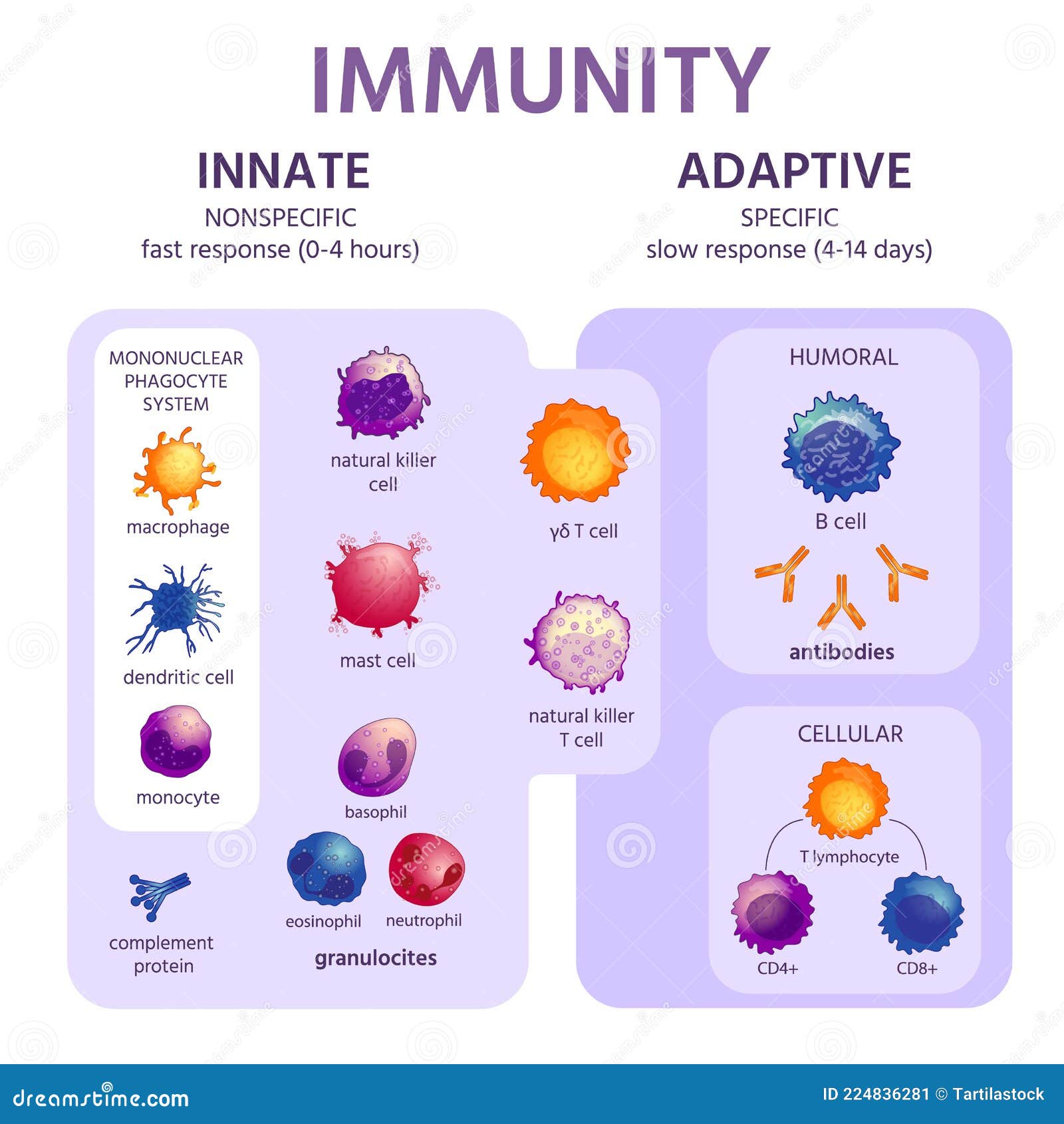
This image provides a helpful visual map of the two systems and their cellular components.
Conclusion
In this lesson, we have established the fundamental division of the immune system into its innate and adaptive arms. You should now be able to distinguish between them based on their speed, specificity, and memory, and list their principal cellular players.
Key Takeaways:
- Innate Immunity is the rapid, non-specific first line of defense. Its key cells include macrophages, neutrophils, NK cells, and dendritic cells.
- Adaptive Immunity is the slower, highly specific second line of defense that provides long-term memory. Its key cells are lymphocytes: B-cells (which produce antibodies) and T-cells (including Helper and Cytotoxic T-cells).
- The two systems are interconnected. The innate system, particularly through dendritic cells, is crucial for activating the adaptive system.
Preview of the Next Lesson:
We've identified dendritic cells as the critical bridge between the innate and adaptive responses. In our next lesson, we will delve into their function as Antigen-Presenting Cells (APCs), exploring exactly how they process and present information to activate the highly specific T-cell response—a process that is central to how the immune system targets cancer.