Hello! Welcome back to our course on Oncology Immunotherapy.
Introduction
In our last lesson, we established the critical distinction between the MHC class I and MHC class II antigen presentation pathways. You learned that MHC class I molecules, present on all nucleated cells, display internal peptides to CD8+ T-cells, while MHC class II molecules, found only on professional APCs, present external peptides to CD4+ T-cells.
Today, we will explore the consequences of these interactions. The learning outcome for this lesson is to contrast the roles of CD8+ cytotoxic T-cells and CD4+ helper T-cells in an anti-tumor immune response. We will move from how these cells are activated to what they do once they recognize a tumor antigen. We'll start with their classic, distinct roles—the "killer" and the "helper"—and then explore the more complex and synergistic ways they collaborate to fight cancer.
The Two Major T-Cell Subsets
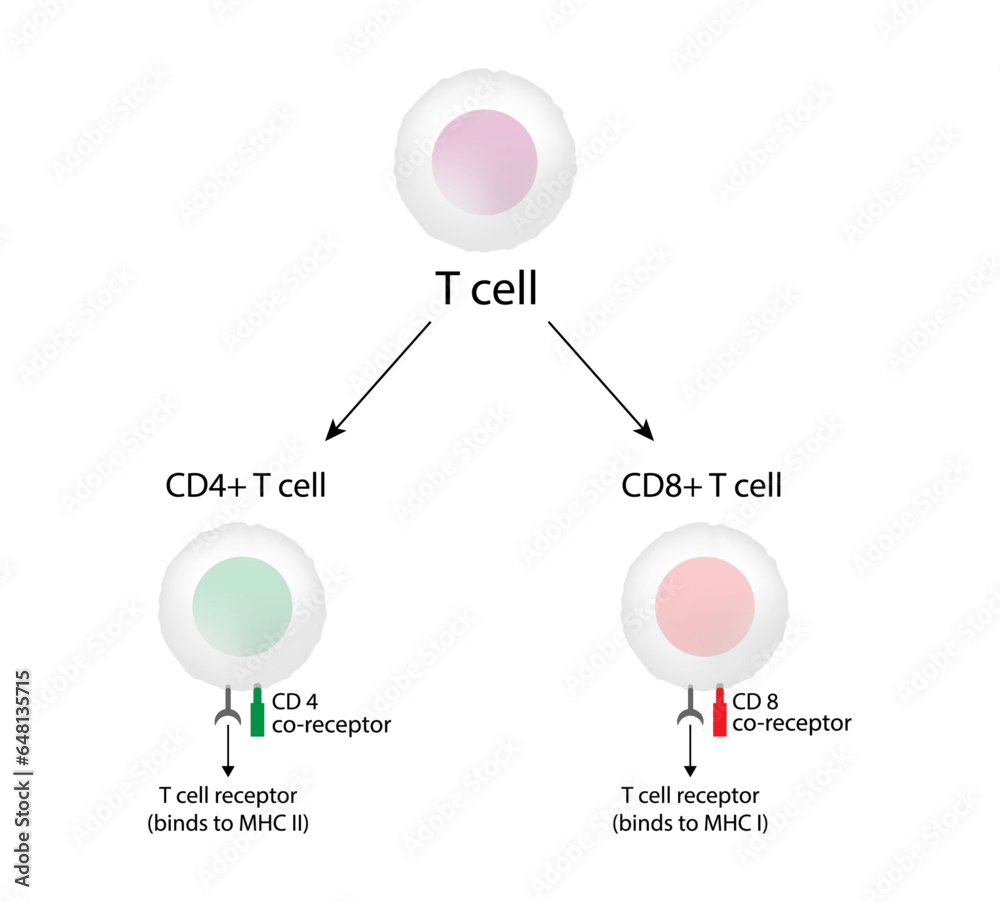
T-cells are distinguished by co-receptor proteins on their surface that work alongside the T-cell receptor (TCR). These co-receptors determine which class of MHC molecule the T-cell can interact with.
- CD8+ T-cells have the CD8 co-receptor, which binds to MHC Class I.
- CD4+ T-cells have the CD4 co-receptor, which binds to MHC Class II.
This fundamental difference dictates their distinct functions in the immune system.
CD8+ T-cells: The Cytotoxic "Killers"
CD8+ T-cells, often called Cytotoxic T-Lymphocytes (CTLs), are the primary executioners of the adaptive immune system. Their main job is to identify and eliminate cells that have been compromised, such as those infected with a virus or, crucially for us, cancer cells.
Mechanism of Action:
- Recognition: A CD8+ T-cell patrols the body. Its T-cell receptor (TCR) scans the MHC class I molecules on the surface of all cells.
- Binding: If it finds a cell (e.g., a tumor cell) presenting a non-self or abnormal peptide (a neoantigen), its TCR and CD8 co-receptor bind to the peptide-MHC-I complex.
- Activation & Killing: This binding, along with other co-stimulatory signals, activates the CD8+ T-cell. It then releases a lethal payload of cytotoxic granules directly onto the target cell.
To understand what's in this payload, let's watch a short video segment.
Immune Response Explained: T-Cell Activation
This video from Demystifying Medicine McMaster provides a clear explanation of how cytotoxic T-cells function.
Please watch from 1:46 to 2:30. Focus on the description of the two key proteins released by cytotoxic T-cells: perforin and granzymes.
As the video explains, the two key effector molecules are:
- Perforin: This protein creates pores in the target cell's membrane.
- Granzymes: These are enzymes that enter the target cell through the pores created by perforin and initiate a process called apoptosis, or programmed cell death.
This is a highly specific and efficient mechanism. The CD8+ T-cell delivers its lethal hit directly to the recognized target, minimizing damage to surrounding healthy tissue.
CD4+ T-cells: The "Helper" and Orchestrator
While CD8+ T-cells are the frontline soldiers, CD4+ T-cells, or Helper T-cells, act as the command and control center. Their primary role is not to kill target cells directly, but to orchestrate and amplify the overall immune response.
Mechanism of Action:
- Recognition: A CD4+ T-cell interacts with a professional Antigen-Presenting Cell (APC), such as a dendritic cell, in a lymph node.
- Binding: Its TCR and CD4 co-receptor bind to a peptide-MHC-II complex on the APC. This peptide would have come from a tumor antigen that the APC engulfed and processed.
- Activation & "Helping": This activation causes the CD4+ T-cell to proliferate and release signaling molecules called cytokines. These cytokines are the instructions that coordinate other immune cells.
This brief video clip highlights the supportive role of helper T-cells.
Tumour immunology and immunotherapy
This clip from nature video succinctly describes the key functions of helper T-cells in an anti-tumor response.
Please watch from 1:26 to 1:38. Note the two key helping functions mentioned: helping dendritic cells activate cytotoxic T-cells and producing cytokines.
The "help" provided by CD4+ T-cells includes several critical actions:
- Promoting CD8+ T-cell responses: They produce cytokines like Interleukin-2 (IL-2), which is a potent growth factor for T-cells, driving the proliferation of activated CD8+ "killer" cells.
- Enhancing APC function: They can "license" dendritic cells, making them more effective at activating CD8+ T-cells. This creates a positive feedback loop for a stronger response.
- Activating other immune cells: They release cytokines like Interferon-gamma (IFN-γ), which can boost the killing capacity of other cells like macrophages and Natural Killer (NK) cells, and also make tumor cells more visible by increasing their MHC-I expression.
- Helping B-cells: They provide signals that help B-cells mature and produce antibodies against tumor antigens.
The diagram below provides an excellent visual summary, contrasting the activation and function of both T-cell types.

A Deeper Dive: Synergy and Evolving Roles
The "killer" vs. "helper" distinction is a powerful model, but your background in biosciences will appreciate that the reality is more nuanced. A successful anti-tumor response almost always depends on the synergistic collaboration between these two cell types. Furthermore, the roles themselves are not as rigid as once thought.
Let's start with a short reading that frames the classic roles and the challenge of harnessing CD4+ T-cells in therapy.
Differences between anti-viral and anti-tumor T-cell responses could impact immunotherapy
This article from the NIH's Center for Cancer Research summarizes the conventional understanding of CD8+ and CD4+ T-cell functions in cancer.
Please read the first two paragraphs of this short article. It reinforces the idea of CD8+ cells as killers and CD4+ cells as helpers, while also alluding to the complexity of CD4+ T-cell functions.
Recent research has significantly evolved our understanding of the CD4+ T-cell's contribution. They are not just "helpers"; they are indispensable for a durable response and can even possess direct killing abilities.
The following reading from a recent scientific commentary explores this evolving view, particularly in the context of CAR-T cell therapy (which we will cover later in the course). The principles, however, apply broadly to cancer immunology.
The role of CD4+ CAR T cells in cancer immunotherapy
This article, 'The role of CD4+ CAR T cells in cancer immunotherapy', provides an excellent overview of the modern understanding of CD4+ T-cell function, moving beyond the simple 'helper' model.
Please read the following sections from this article: The final paragraph of the Introduction (starting 'One fundamental question...'). This sets up the traditional vs. evolving view. The section titled 'Evolving understanding of CD4+ CAR T cell contributions'. Focus on the evidence that CD4+ T-cells can have direct killing activity and that combining CD4+ and CD8+ cells often yields the best results. The section titled 'Dissection of in vivo cross-talk...'. This part is particularly interesting as it contrasts the mechanisms of killing: localized, direct killing by CD8+ cells versus long-range, indirect killing by CD4+ cells mediated by IFN-γ.
From this reading, we can extract some advanced points of contrast:
- Direct vs. Indirect Killing: While CD8+ T-cells specialize in direct, cell-to-cell contact killing via perforin/granzymes, CD4+ T-cells can also induce tumor cell death indirectly, from a distance, by secreting high levels of IFN-γ.
- Synergy: The anti-tumor response is often strongest when both subsets are present. CD4+ T-cells provide the necessary support (e.g., IL-2) for CD8+ T-cells to expand and persist. In some models, the combination is superior to either cell type alone.
- Cytotoxicity: The ability to kill is not exclusive to CD8+ T-cells. Certain activated CD4+ T-cells can also directly kill tumor cells, particularly those that have been induced to express MHC-II molecules.
Summary of Contrasting Roles
This table summarizes the key differences between the two T-cell workhorses of anti-tumor immunity.
| Feature | CD8+ Cytotoxic T-cells | CD4+ Helper T-cells |
|---|---|---|
| Co-receptor | CD8 | CD4 |
| MHC Recognition | MHC Class I | MHC Class II |
| Antigen Source | Endogenous (intracellular) | Exogenous (extracellular) |
| Presenting Cell | Any nucleated cell (e.g., tumor cell) | Professional APCs (e.g., dendritic cell) |
| Primary Function | Directly kill target cells | Orchestrate the immune response |
| Key Effector Molecules | Perforin, Granzymes | Cytokines (e.g., IL-2, IFN-γ) |
| Mode of Killing | Contact-dependent, induces apoptosis | Primarily indirect via cytokines (e.g., IFN-γ), but can also be direct |
| Analogy | The "Executioner" or "Soldier" | The "General" or "Commander" |
Conclusion
Today we have contrasted the crucial and complementary roles of CD8+ and CD4+ T-cells in the fight against cancer.
Key Takeaways:
- CD8+ Cytotoxic T-cells are the primary killers. They recognize tumor antigens on MHC-I and eliminate those cells directly using perforin and granzymes.
- CD4+ Helper T-cells are the orchestrators. They recognize tumor antigens on MHC-II presented by APCs and release cytokines to amplify and sustain the immune attack, primarily by "helping" CD8+ T-cells.
- The classic "killer" vs. "helper" roles are a useful simplification, but the functions are more complex. CD4+ T-cells are essential for a robust response and can also contribute to tumor killing through different mechanisms.
- A successful and durable anti-tumor immune response relies on the synergistic collaboration between both CD4+ and CD8+ T-cells.
Preview of the Next Lesson:
We have now covered the main players of the T-cell-mediated adaptive response. But there is another key lymphocyte: the B-cell. In our next lesson, we will describe the function of B-cells in producing antibodies and their role as APCs, completing our foundational picture of the key cells in anti-tumor immunity.