Hello! Welcome back to our course on Oncology Immunotherapy.
Introduction
In our last lesson, we contrasted the roles of CD8+ "killer" T-cells and CD4+ "helper" T-cells, establishing how they work together to fight cancer. We noted that one of the key functions of CD4+ helper T-cells is to activate other immune cells. Today, we focus on a major recipient of that help: the B-cell.
This lesson addresses the learning outcome: Describe the function of B-cells in producing antibodies and their role as APCs. We will explore the B-cell's two critical identities: first, as the body's factory for producing antibodies (the foundation of humoral immunity), and second, as a highly specialized type of antigen-presenting cell (APC) that plays a crucial role in activating the T-cell response.
For someone in the pharmaceutical industry, understanding the biology of B-cells is fundamental, as many blockbuster oncology drugs—from monoclonal antibodies like rituximab to antibody-drug conjugates (ADCs) like Enhertu—are engineered versions of the very molecules B-cells are designed to produce.
1. The Humoral Role: B-cells as Antibody Factories
The most famous role of the B-cell is to produce antibodies. This arm of the adaptive immune system is called humoral immunity, named for the "humors" or body fluids (like blood and lymph) where antibodies circulate.
A B-cell's life mission is guided by its unique B-cell receptor (BCR). The BCR is essentially a version of the antibody the cell will produce, but anchored to the cell's surface. Each B-cell has a unique BCR that can recognize a specific antigen.
When a B-cell encounters its specific antigen, it becomes activated, often with help from a CD4+ T-cell (more on this later). This activation triggers a process of differentiation, leading to two main cell types:
- Plasma Cells: These are terminally differentiated B-cells that become dedicated antibody-secreting factories. A single plasma cell can secrete thousands of antibody molecules per second, releasing them into the bloodstream to find and neutralize their targets.
- Memory B-cells: These are long-lived cells that "remember" the antigen. If the same pathogen or tumor antigen appears again, these cells can mount a much faster and stronger response. This is the principle behind vaccination.
To get a dynamic overview of this process and the different types of antibodies, let's watch a video.
B Cells and Antibodies (Humoral Immunity)
This video from the 'Professor Dave Explains' channel provides a clear introduction to B-cells, their activation, and the different classes of antibodies they produce.
Please watch the following two segments: B Cell Activation and Antibody Production (2:38 - 3:53): Focus on how B-cells differentiate into plasma cells and memory cells. Antibody Class Switching and Functions (5:15 - 8:01): Pay attention to the different antibody isotypes (IgM, IgG, etc.) and their general functions. You don't need to memorize all the details, but appreciate that different antibody structures lead to different functions.
Antibody Structure and Function
As the video discussed, antibodies (or immunoglobulins, Ig) come in different classes or isotypes. While they all share a basic Y-shape, the "stem" of the Y, known as the Fc region (Fragment, crystallizable), differs between classes. This region determines the antibody's effector function—that is, how it helps eliminate a threat once it binds to an antigen.
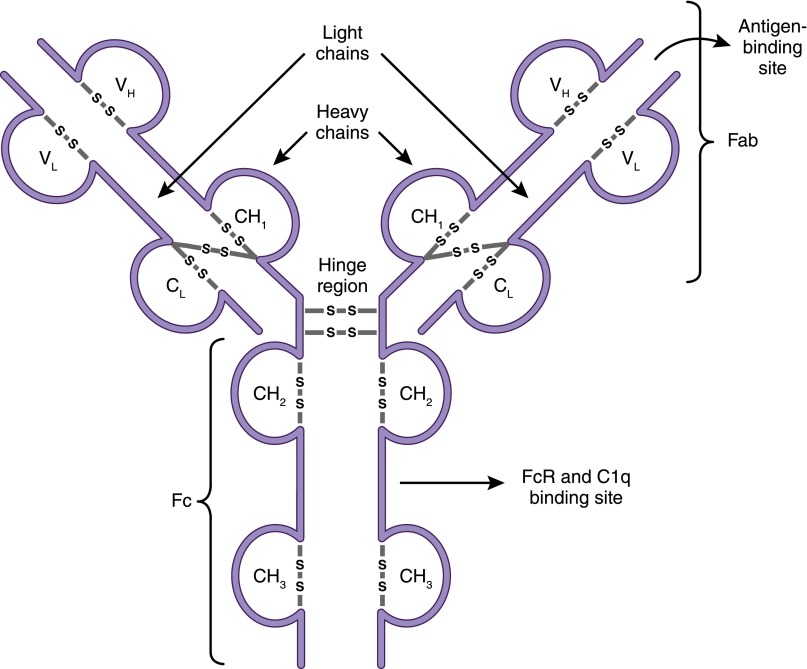
Caption: The basic structure of an antibody, composed of two heavy and two light chains. The variable region (Fab) binds the antigen, while the constant region (Fc) mediates effector functions.
The main antibody classes have distinct roles:
- IgM: The first antibody produced in an initial response. It's large and very effective at activating the complement system.
- IgG: The most abundant antibody in the blood. It's a versatile workhorse involved in many effector functions and is the only class that can cross the placenta. Most therapeutic monoclonal antibodies are based on an IgG structure.
- IgA: Found in mucosal secretions (gut, respiratory tract), acting as a first line of defense.
- IgE: Involved in allergic reactions and defense against parasites.
For a more detailed summary of antibody types and their functions, the following reading provides an excellent table and explanation.
B Cells, Antibodies, and More - PMC
This review article, 'B Cells, Antibodies, and More', published in the Clinical Journal of the American Society of Nephrology, offers a detailed look at antibody biology. The information is broadly applicable to all fields of immunology.
Please read the section titled 'Antibody Types'. Focus on the general structure and the three main ways antibodies exert their effects (neutralization, Fc receptor activation, and complement activation). The table provides a useful summary of the different isotypes.
2. The Cellular Role: B-cells as Antigen-Presenting Cells (APCs)
Beyond producing antibodies, B-cells perform a second, equally vital function: they act as professional Antigen-Presenting Cells (APCs). In a previous lesson, we introduced dendritic cells as the most potent APCs for initiating a T-cell response. B-cells are also in this exclusive club, but with a unique specialization.
While dendritic cells are generalists, sampling their environment broadly, B-cells are specialists. They use their highly specific BCR to find and capture their cognate antigen. This makes them incredibly efficient at capturing a specific antigen, even when it's present at very low concentrations.
The process works as follows:
- Antigen Capture: The B-cell's BCR binds to its specific antigen (e.g., a protein shed from a tumor cell).
- Internalization: The entire BCR-antigen complex is taken into the cell via receptor-mediated endocytosis.
- Processing: Inside the cell, the antigen is broken down into small peptide fragments.
- Presentation: These peptides are loaded onto MHC class II molecules and presented on the B-cell's surface.
This video provides a concise visual of this process.
Antigen-Presenting Cells (Macrophages, Dendritic Cells and B-Cells)
This clip from an 'Andrey K' video focuses specifically on how different immune cells, including B-lymphocytes, function as APCs.
Please watch the segment from 6:37 to 8:21. It clearly illustrates how a B-cell internalizes an antigen and presents it on MHC-II to a CD4+ T-cell, leading to the B-cell's own activation.
The T-cell-B-cell Partnership
Why does the B-cell present antigens? The primary reason is to get help from a CD4+ helper T-cell. This interaction is the cornerstone of a strong, long-lasting antibody response.

This is the "T-cell dependent activation" we alluded to earlier. The B-cell shows the T-cell the antigen it has found (via MHC-II). If the T-cell recognizes that same antigen, it confirms the threat is real and provides the B-cell with two crucial signals:
- Co-stimulation: A direct, physical interaction, most famously between the CD40 protein on the B-cell and the CD40L (ligand) on the T-cell.
- Cytokine Signals: The T-cell releases cytokines like IL-4 and IL-21, which instruct the B-cell to proliferate, undergo class switching (e.g., from IgM to IgG), and differentiate.
This elegant system ensures that the powerful weapon of antibody production is only fully unleashed when both a B-cell and a T-cell agree that a target is foreign and dangerous.
Synthesis: B-cell Functions in Anti-Tumor Immunity
Now, let's connect these two roles to our focus: oncology.
-
Antibodies Against Tumors: B-cells can recognize tumor-associated antigens (TAAs) and produce antibodies against them. These antibodies can fight cancer through several mechanisms, which are harnessed by therapeutic monoclonal antibodies:
- Neutralization: Blocking receptors on cancer cells that are essential for their growth.
- Opsonization: Coating tumor cells to mark them for destruction by phagocytes like macrophages.
- Antibody-Dependent Cell-Mediated Cytotoxicity (ADCC): Forming a bridge that allows Natural Killer (NK) cells to bind to and kill the tumor cell.
- Complement-Dependent Cytotoxicity (CDC): Activating the complement cascade, a system of proteins that can punch holes in the tumor cell membrane.
-
Antigen Presentation to Sustain the Attack: By capturing tumor antigens and presenting them to CD4+ T-cells, B-cells help initiate and sustain the entire anti-tumor immune response. This ensures that the CD4+ T-cell "commanders" remain active, continuing to help both B-cells and the CD8+ "killer" T-cells.
Conclusion
In this lesson, we've unpacked the dual identity of the B-cell as a central player in anti-tumor immunity.
Key Takeaways:
- B-cells have two primary functions: producing antibodies (humoral immunity) and presenting antigens to T-cells (cellular immunity).
- As antibody producers, they differentiate into plasma cells that secrete vast quantities of antibodies and memory B-cells that provide long-term immunity.
- Antibodies like IgG and IgM can attack tumor cells through neutralization, ADCC, and complement activation. This is the biological basis for many successful cancer therapies.
- As APCs, B-cells use their specific BCR to efficiently capture antigens, process them, and present them on MHC class II molecules to CD4+ helper T-cells.
- This T-cell interaction is critical for receiving the "help" needed for a robust and specific antibody response, creating a powerful feedback loop in the adaptive immune system.
Preview of the Next Lesson:
The interaction between the B-cell (as an APC) and the helper T-cell perfectly illustrates the need for multiple signals to activate a lymphocyte. In our next lesson, we will formalize this concept by outlining the 'two-signal' model of T-cell activation, a fundamental principle that governs when and where T-cells launch an attack.