Welcome back. In our last lesson, we explored the GRE's section-level adaptive scoring, establishing a critical principle: your performance in the first Verbal and Quant sections is the gateway to an elite score. You now understand why doing well in that first medium-difficulty section is non-negotiable for your 335+ goal.
Today, we transition from the why to the how. This lesson is dedicated to developing a precise pacing strategy for the Verbal Reasoning sections. Pacing is not just about moving fast; it's a deliberate skill of allocating your time to maximize correct answers. For the Verbal section, which you've identified as your relatively weaker area, a bulletproof pacing plan is your most powerful tool. By the end of this session, you will have a clear, actionable strategy to manage the clock, prioritize questions, and confidently navigate both Verbal sections.
The Verbal Landscape: Time and Question Types
First, let's refresh our memory on the structure of the two Verbal sections. Your first section has 12 questions to be answered in 18 minutes, and the second has 15 questions in 23 minutes.
This works out to an average of 90 seconds per question in Section 1 and about 92 seconds in Section 2. However, treating all questions equally is one of the most common mistakes test-takers make. A one-blank Text Completion question and a complex Reading Comprehension passage demand vastly different time investments.
To visualize the flow, let's watch a brief walkthrough of how the questions are presented.
(2025) Introduction to the GRE + Exam Walkthrough + Tips and Tricks
In this segment from a Greg Mat video, he walks through the user interface of a Verbal section. Notice the fixed order in which question types appear: Text Completion (TC), then a block of Reading Comprehension (RC), then Sentence Equivalence (SE), followed by another block of RC.
Watch the portion from the first verbal section. Pay attention to the different question formats—single-blank, two-blank, and three-blank TC; RC with single or multiple questions; and SE questions. This visual tour will help you mentally map the section.
Knowing this fixed order is the first step. The next is to realize you don't have to follow it. The GRE allows you to skip questions and return to them later, which is the key to our strategy.
Your Time Budget: Allocating Seconds for Maximum Points
Instead of a flat 90-second average, we will assign a specific "time budget" to each question type. This allows you to bank time on quicker questions and spend it on more time-intensive ones.
GRE Verbal Section Order Strategy: Pacing & Tips - Test Ninjas
The Test Ninjas article provides a clear breakdown of how to allocate your time. It explains the logic behind spending less time on vocabulary-based questions to create a time reserve for reading.
First, read the brief introductory sections on section structure to see the typical distribution of question types. Then, study the section on pacing. Internalize the time recommendations in the table, as these will be your targets.
Based on that reading and other expert advice, here is your consolidated time budget:
- Sentence Equivalence (SE): Aim for under 60 seconds. These are often the fastest points you can score. You are looking for a synonym pair that fits the sentence. If you know the vocabulary, it's quick; if you don't, agonizing won't help.
- Text Completion (TC): Budget 1 to 1.5 minutes.
- Single-blank questions should be closer to 60-75 seconds.
- Two- and three-blank questions will naturally require more time, up to 90-120 seconds, as you must verify that the combination of words works together.
- Reading Comprehension (RC): This is where you spend the time you've saved. Budget 3 to 5 minutes for an entire passage and its associated questions.
- Short passages (1 paragraph, 1-2 questions) should take under 3 minutes total.
- Longer passages (2-3 paragraphs, 3-4 questions) may require up to 5 minutes.
Your goal isn't to hit these times perfectly on every question, but to use them as a guide to know when you're spending too long on a single problem.
The Two-Pass Strategy: Your Master Plan for Verbal
Knowing the time budgets is one thing; executing them under pressure is another. The most effective method for managing your time is the Two-Pass Strategy. The principle is simple: since all questions are worth the same number of points, secure all the easy points first before getting bogged down in difficult questions.
Let's see a top scorer describe this exact approach.
How I Scored GRE 335 (Q168 V167) in 2.5 Weeks | My Best Strategies
In this clip, a test-taker who scored a 167 on the Verbal section explains his strategy. Listen to how he explicitly prioritizes certain question types.
Watch his explanation from his verbal testing strategy. He states he would "skip the reading comprehension" and go straight to Sentence Equivalence and Text Completion. This is a real-world application of the two-pass strategy.
His approach is the essence of this strategy. Here is how you will formalize it:
Pass 1: Collect Easy Points
Your first pass through the section is a high-speed mission to answer every question you can solve confidently and quickly.
- Action: Answer all Sentence Equivalence and Text Completion questions where you feel comfortable with the vocabulary. For Reading Comprehension, tackle only the short passages or those on topics you find easy to grasp.
- The "Flag" Button is Your Best Friend: If a TC question has totally unfamiliar vocabulary, or an RC passage seems dense and convoluted, make your best educated guess, flag it for review, and move on immediately. Do not invest more than 90 seconds on any single question in this pass.
- Goal: To answer roughly two-thirds of the questions in the section, banking guaranteed points and building momentum.
Pass 2: Tackle Flagged Questions
After you've reached the end of the section in your first pass, you will have a chunk of time remaining and a handful of flagged questions. Now, you go back to them.
- Action: Use the "Review" screen to navigate back to your flagged questions. Start with the one that seems most manageable. Perhaps a three-blank TC now seems clearer, or you're ready to tackle that long RC passage.
- The Benefit: Your brain is warmed up, and you're working with a sense of calm because you've already secured a significant number of points. Questions that seemed difficult before may now feel more approachable.
- Goal: To use your remaining time to solve the most difficult problems methodically. With one minute left on the clock, ensure every single question has an answer selected, even if it's a guess. There is no penalty for wrong answers.
This process is summarized perfectly in the Test Ninjas article you looked at earlier.
GRE Verbal Section Order Strategy: Pacing & Tips - Test Ninjas
This reading formalizes the two-pass strategy with a clear table and highlights the most common pacing errors students make.
Read the section on the two-pass strategy, paying close attention to the table that outlines the goal and actions for each pass. Then, review the section on common mistakes to understand the pitfalls you must avoid, especially the "time trap" of spending too long on one question.
Staying on Track: Time Checkpoints
To ensure your two-pass strategy is working, you need to check your progress at key moments. These are your "time gates" or checkpoints. Instead of constantly watching the clock, you'll just glance at it at predetermined points.
The following dashboard provides an excellent visualization of these checkpoints for the entire GRE. Let's focus on the Verbal sections (green and orange).
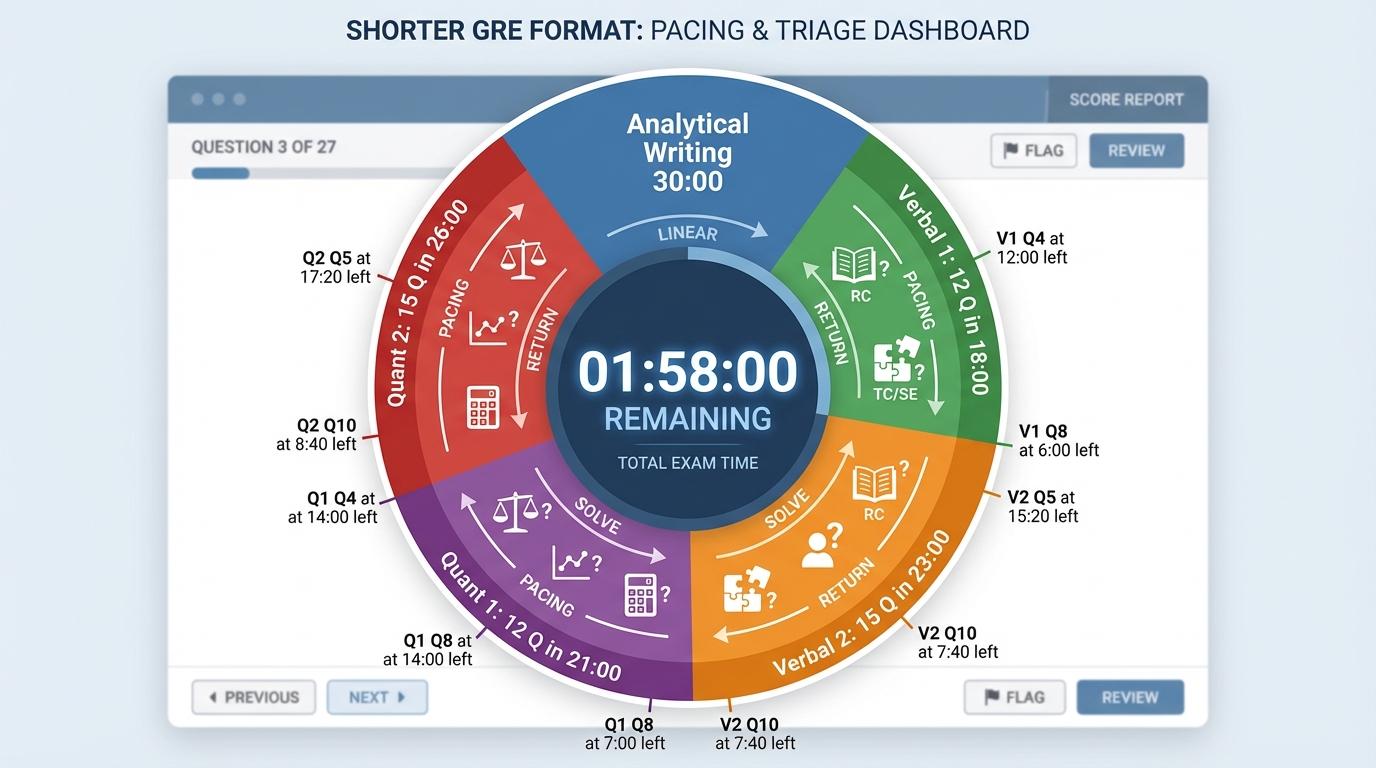
Here are your key checkpoints based on this visual guide:
Verbal Section 1 (12 Qs, 18:00)
- After 6 minutes (12:00 remaining): You should be at or have completed Question 4.
- After 12 minutes (6:00 remaining): You should be at or have completed Question 8.
Verbal Section 2 (15 Qs, 23:00)
- After about 7.5 minutes (15:20 remaining): You should be at or have completed Question 5.
- After about 15.5 minutes (7:40 remaining): You should be at or have completed Question 10.
If you find yourself behind at a checkpoint, that's your signal to be more aggressive with flagging and moving on. If you're ahead, you know you have a healthy time reserve for the difficult questions in your second pass.
Conclusion
Mastering Verbal pacing is about shifting from a reactive mindset to a proactive, strategic one. You are now in control of the clock.
Here are your key takeaways for the Verbal sections:
- Use Differentiated Time Budgets: Allocate under a minute for SE, 1-1.5 minutes for TC, and use the saved time for the 3-5 minute investment required for RC passages.
- Execute the Two-Pass Strategy: Use your first pass to quickly bank points on easy questions. Use the "mark-and-review" feature liberally. Return for a second pass to tackle the harder, flagged questions with your remaining time.
- Monitor Your Progress with Checkpoints: Use the time gates (e.g., at the 12:00 and 6:00 marks in V1) to ensure you are on track.
- Never Leave a Question Blank: Always make an educated guess before moving on or before time expires.
In our next lesson, we will apply these same strategic principles of pacing, time budgets, and the two-pass method to the Quantitative Reasoning sections. The question types are different, but the underlying philosophy of smart time management remains the same.