In our previous lesson, we established a powerful framework for managing the Verbal sections by using differentiated time budgets and a two-pass strategy. The core idea was to take control of the clock, rather than letting it control you. Today, we will carry that same philosophy forward and apply it to the Quantitative Reasoning sections.
Given your B.Com background, you have a solid foundation in the underlying mathematical concepts. This lesson is about layering a crucial skill on top of that foundation: strategic pacing. To achieve a top-tier score of 335+, a high quant score is essential, and managing the 47 minutes across 27 questions is a non-negotiable part of that equation. We will break down how to allocate your time by question type, implement the two-pass strategy for quant, and use time checkpoints to ensure you are on track to maximize your score.
The Quantitative Landscape: Timing and Question Types
First, let's review the structure of the two Quantitative Reasoning sections:
- Section 1: 12 questions in 21 minutes
- Section 2: 15 questions in 26 minutes
This gives you an average of about 1 minute and 45 seconds per question. However, just as with the Verbal section, treating all questions equally is a strategic error. The time you need for a straightforward Quantitative Comparison is vastly different from what's required for a multi-step word problem or a Data Interpretation set.
GRE Timing & Pacing for the Shorter Test: A Section-by-Section Plan
This article from Exambank provides an excellent overview of the shorter GRE's timing. It quickly establishes the structure and the critical idea that the average time-per-question is not a target for every problem.
Please read the introduction, the section on timing, and the section titled "Time per question—what it really means." This will reinforce the basic structure and the core principle of differential pacing.
The Quant sections feature four main question types:
- Quantitative Comparison (QC): These ask you to compare two quantities (Quantity A and Quantity B). They make up a significant portion of the section.
- Multiple-Choice (Select One): Standard five-choice questions.
- Multiple-Choice (Select All That Apply): Questions where you must select all correct answer choices.
- Numeric Entry: Questions where you must type your answer into a box.
A subset of these questions will be presented as Data Interpretation (DI) sets, where you'll be given graphs or tables and asked several questions about them. These are notorious time sinks if not handled correctly.
Your Quant Time Budget: Allocating Minutes for Maximum Points
To move beyond the flawed 1:45 average, you need a specific time budget for each question type. The goal is to solve the faster questions well under the average time, banking those minutes to spend on more complex problems.
How to Score 170 on GRE Quant: Proven Tips & Strategies
The Test Ninjas article offers a fantastic, detailed breakdown of how top scorers allocate their time. It provides a clear table with time recommendations that we will adopt as our core strategy.
Read the section on time management. Pay close attention to the table titled "How to distribute your 1 min 45 sec average." These time targets are your new benchmarks.
Based on that reading, here is your consolidated time budget:
- Quantitative Comparison (QC): Aim for 60–75 seconds. These questions often test logic, number properties, and estimation rather than heavy calculation. If you can't see a path forward quickly, it’s a sign to plug in numbers or to flag and move on.
- Standard Problem Solving (Multiple-Choice & Numeric Entry): Budget 1.5 to 2 minutes. Simpler problems should be closer to 90 seconds, while more involved ones may take the full 2 minutes.
- Data Interpretation (DI) & Complex Word Problems: Budget 2.5 to 3 minutes per question. DI questions require an initial investment to understand the chart or graph. It's often efficient to spend 1-2 minutes understanding the data display first, then tackle the associated questions.
Your commerce background gives you an edge in interpreting charts and data, but the key is to do it under the severe time constraints of the GRE. Banking time from QCs is what makes this possible.
The Two-Pass Strategy for Quant: Securing Easy Points First
Just like in the Verbal section, the two-pass strategy is your master plan for executing these time budgets under pressure. All questions are worth the same, so it makes no sense to get bogged down by a difficult geometry problem early on when there are easy QC points waiting for you.
Let's watch a short video that perfectly illustrates the logic behind this approach.
How to Score a 160+ in GRE Quant: Three Habits of High Scorers
This video from Magoosh vividly explains the danger of getting stuck on one question and the power of skipping strategically.
Watch the first segment, "high scorers take the easy test first." The two scenarios presented are a powerful reminder of why you must be willing to skip and return.
The Magoosh video makes a compelling case. Now, let's formalize how to apply this to the Quant sections.
Pass 1: Quick Wins (Approx. 12-15 minutes)
- Action: Go through the entire section, but only solve the low-hanging fruit. Your goal is to answer every question that you can solve confidently in under 90 seconds.
- Suggested Order: Prioritize questions in this order:
- All Quantitative Comparison questions.
- Straightforward Problem Solving questions (both multiple-choice and numeric entry) that don't look overly complex.
- The Triage Rule: As you scan each question, apply a strict 20-second rule. If you read a problem and don't have a clear idea of how to attack it within 20 seconds, make an educated guess, flag it, and move on immediately. Do not get drawn in.
Pass 2: The Deep Dive (Remaining Time)
- Action: Use the "Review" screen to return to your flagged questions. You should have a healthy chunk of time remaining to tackle these more difficult problems.
- Your Targets: These will typically be the complex, multi-step word problems, tricky geometry questions, and the Data Interpretation sets.
- The Advantage: You are now working on these challenging problems with the confidence that you've already banked a significant number of points. This reduces panic and allows you to think more clearly, investing 2, 3, or even 4 minutes into a single problem if needed, because you've budgeted for it.
Here is another perspective on this exact strategy.
GRE: How to score a perfect 170 in Quants
This video from Think and Learn discusses two "schools of thought" for tackling the test. Although it refers to the older GRE format, the strategic advice it offers is timeless.
Watch the segment from "play it fast and play it twice." Notice how the speaker describes solving the easier 15 questions in about 12-13 minutes, leaving a large time reserve for the 5 difficult ones. This is precisely the outcome of a well-executed two-pass strategy.
Staying on Track: Quant Pacing Checkpoints
To ensure your two-pass strategy is on schedule, you need clear checkpoints. You will use these "time gates" to monitor your progress without obsessively watching the clock.
This dashboard provides a great visual for these checkpoints. Focus on the purple (Quant 1) and red (Quant 2) sections.
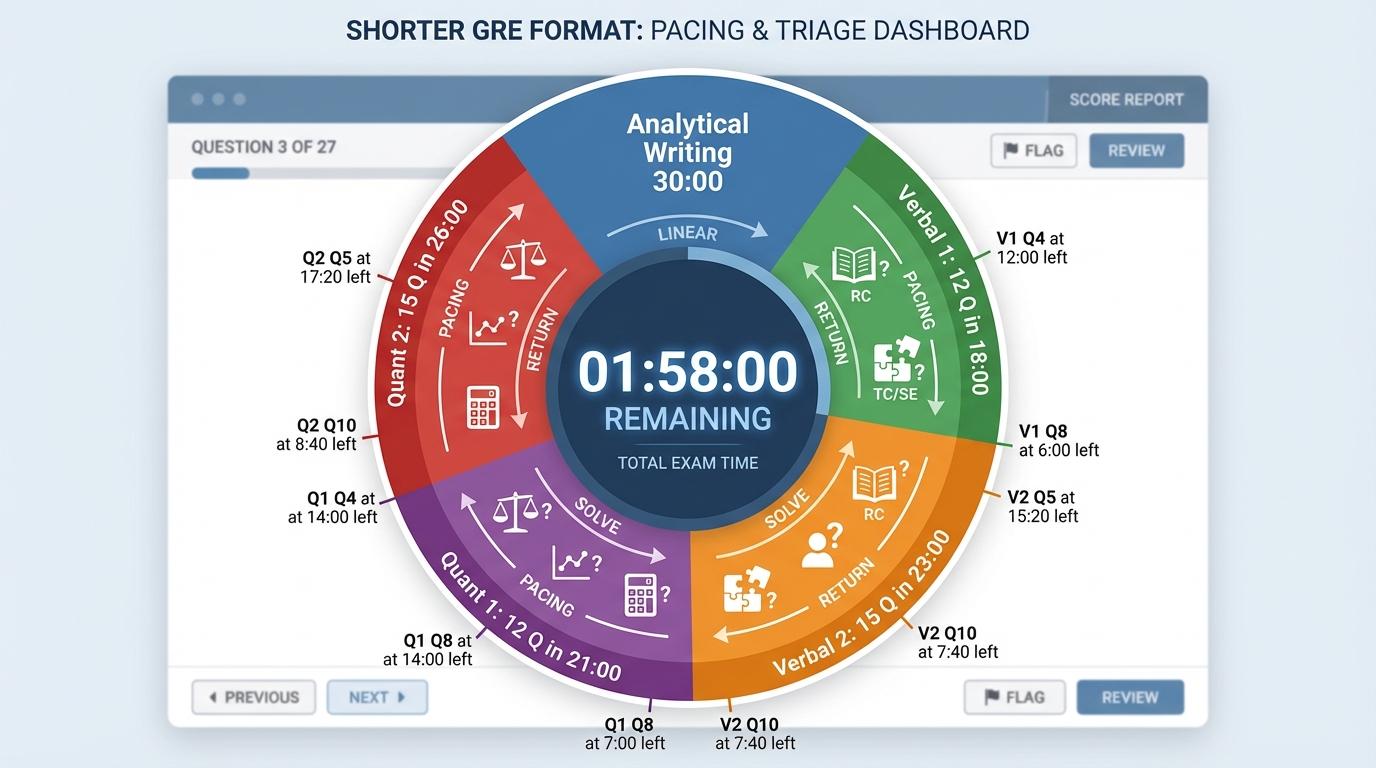
Here are your key checkpoints, taken from the dashboard and supporting resources:
Quant Section 1 (12 Qs, 21:00)
- After Question 4, you should have about 14:00 remaining.
- After Question 8, you should have about 7:00 remaining.
Quant Section 2 (15 Qs, 26:00)
- After Question 5, you should have about 17:20 remaining.
- After Question 10, you should have about 8:40 remaining.
If you are behind at a checkpoint, it's a signal to be more ruthless with your 20-second triage rule. If you're ahead, you know you have a solid time bank for the challenging problems in Pass 2.
Conclusion
You have the quantitative knowledge; this lesson provides the strategic overlay to turn that knowledge into an elite score. Pacing is an active skill, not a passive one. You must dictate the terms of engagement with the test.
Here are your key takeaways for the Quant sections:
- Use Differentiated Time Budgets: Allocate ~75 seconds for QCs, 1.5-2 minutes for standard PS, and 2.5-3 minutes for DI and complex problems.
- Execute the Two-Pass Strategy: Use Pass 1 to quickly solve all QC and simple PS questions. Flag everything else. Use Pass 2 to return to the flagged, time-intensive problems.
- Employ Strict Triage: If you don't have a clear plan within 20 seconds, flag the question and move on.
- Monitor Your Pace with Checkpoints: Use the time gates (e.g., at the 14:00 and 7:00 marks in Q1) to stay on track.
The strategies we've discussed today—especially the two-pass method—rely on being able to quickly identify which questions to skip and how to make intelligent guesses. In our next lesson, we will focus exclusively on that, building a formal framework for strategic guessing and question-skipping to optimize your score across all sections.