In our previous lessons, we built detailed pacing strategies for both the Verbal and Quantitative sections, centering on a two-pass approach. This powerful method, however, hinges on one critical skill: the willingness to strategically skip difficult questions and make educated guesses. This lesson is dedicated to mastering that very skill, which forms the final pillar of your foundational test-taking strategy.
Your goal of a 335+ score requires not just content mastery, but also elite-level test management. Getting bogged down by a single, time-consuming question can be the difference between a great score and an exceptional one. Today, we will formalize the "when" and "how" of skipping and guessing, turning it from a move of desperation into a deliberate, score-optimizing tactic that you can apply across the entire exam.
The "Why": The Strategic Imperative to Skip and Guess
To excel on the GRE, you must first accept a fundamental truth: it is not a test where you are expected to answer every question perfectly in the order it is presented. It is a resource allocation game, and your most valuable resource is time. With the test's shorter format, every decision about how to spend your time has magnified consequences.
This idea is what the PrepAiro article "The Accuracy Trap" explores so well. Because there are fewer questions, each one carries more weight, especially in the first section of both Quant and Verbal.
This article explains why the dynamics of the shorter GRE make strategic test-taking more critical than ever. It will help you understand why getting stuck is not an option.
Please read the introduction, the section on section-level adaptivity, and the list item on equal time investments in "The Old Study Habit Hall of Shame." This will underscore the high-stakes nature of Section 1 and the cost of poor time allocation.
As the article highlights, your performance in Section 1 acts as a "placement test," determining whether you get the harder, higher-scoring-potential Section 2. Wasting five minutes on one difficult question in Section 1 might not just cost you that one point; it might prevent you from answering several easier questions correctly, potentially locking you out of the highest score bracket.
The following flowchart for the Quant section provides a stark visual of this dynamic.
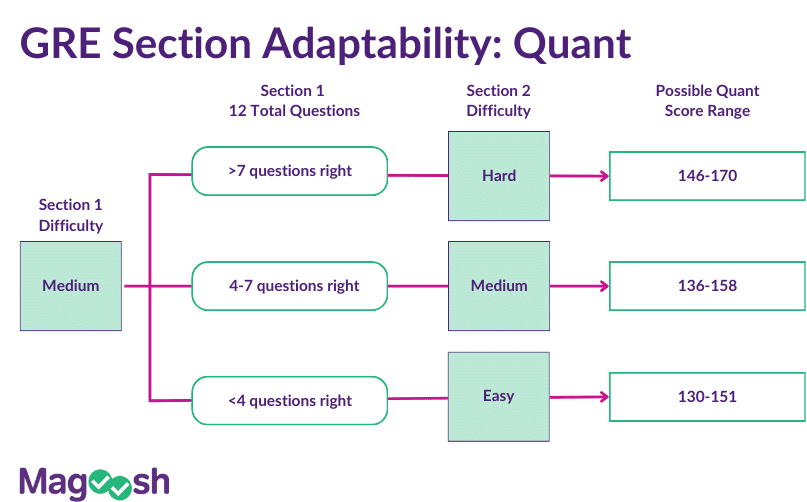
The crucial takeaway is that your primary goal is to maximize the number of correct answers. This leads to a second, equally important rule of the GRE: there is no penalty for incorrect answers.
GRE Verbal Section Order Strategy: Pacing & Tips - Test Ninjas
We have referred to this Test Ninjas article before for pacing; now we will focus on its direct advice about guessing.
In the section "When to Guess and Move On," please read the first paragraph that begins with this critical rule. Internalizing this concept is fundamental to optimizing your score.
Since a blank answer and a wrong answer are both worth zero points, you must answer every single question, even if it's a complete guess in the final seconds. Leaving an answer blank is equivalent to throwing away a free lottery ticket.
The "When": A Triage System for Identifying Skips
In our previous lessons, we introduced the 20-second triage rule. Now, let's refine it. Your goal in the first pass is to identify and solve the "easy" questions while flagging the "hard" ones. But what makes a question hard? It's not just about the concept, but also the time it demands.
The following video offers a memorable way to think about identifying which questions to skip on your first pass.
3 Reasons You Should Skip GRE Test Questions - GRE Test Taking Strategies
This Magoosh video uses a "cheese" analogy to explain which types of questions are often worth skipping on your first pass, framing them as "hard cheeses" that are best saved for later.
Watch the segments on "time is precious" and "not all questions are created equal." Pay close attention to the specific question types the presenter identifies as good candidates for skipping.
Based on the video and common GRE wisdom, here are prime candidates for flagging and skipping on your first pass:
-
Verbal Reasoning:
- Triple-Blank Text Completion: These require you to get all three blanks correct to earn a single point, making them time-intensive with a high risk of error.
- Long or Dense Reading Comprehension Passages: Especially those on unfamiliar topics (e.g., astrophysics, Baroque music theory). The time required to simply understand the passage can be significant.
- Sentence Equivalence with Unfamiliar Vocabulary: If you don't recognize several of the answer choices, your chances of finding the correct pair are low. It's better to guess and move on.
-
Quantitative Reasoning:
- Complex Probability or Combinatorics: These questions are often tricky and prone to logical errors.
- Multi-Step Geometry Problems: If a diagram looks complex and you don't immediately see how the shapes relate, it's a candidate for skipping.
- Any Problem Where the Path isn't Clear: If after 20-30 seconds you still have no idea how to set up the problem, don't get drawn in.
For a high-achiever like yourself, perhaps the biggest challenge is psychological. You're used to solving every problem you encounter. On the GRE, that instinct can be a liability. It requires a mental shift to "let go of your ego," as one high-scorer puts it.
How I Scored GRE 335 (Q168 V167) in 2.5 Weeks | My Best Strategies
In this video from GRE Prep Club, a test-taker who scored 335 shares his personal strategies. His advice on skipping and mindset is particularly valuable for anyone aiming for a top score.
Watch his explanation of his Quant strategy from the beginning, where he discusses skipping questions. Then, listen to his thoughts on letting go of ego. This is a crucial mental adjustment.
The speaker's point is critical: viewing a skip not as a failure but as a strategic decision is what separates good test-takers from great ones.
The "How": The Art of the Educated Guess
"Guessing" on the GRE should rarely be a random click. It's a process of rapid elimination. Your goal is to improve your odds from 20% (on a 5-choice question) to 33% or even 50% before you make your final selection.
Here’s a practical framework for making educated guesses:
For Quantitative Comparison:
- Remember the "plug-in" method. If testing one number (e.g., 2) gives you Quantity A is greater, and testing another (e.g., -2 or 1/2) gives you Quantity B is greater, you can confidently guess D (The relationship cannot be determined) and move on.
For Standard Quant Problems:
- Ballparking: Estimate the answer. If you're calculating the area of a room that's roughly 10x12 feet, any answer choice in the thousands is clearly wrong.
- Check Properties: Can the answer be negative? Must it be an integer? Use these logical constraints to eliminate choices.
For Verbal Questions (TC & SE):
- Analyze the Tone: Read the sentence and decide if the blank needs a positive (+), negative (-), or neutral (=) word. Eliminate all choices that don't match the required tone.
- Look for Synonym Pairs (SE): This is the key to SE. If you find a word that fits the blank perfectly but has no synonym among the other choices, you can eliminate it. Conversely, if you spot a clear synonym pair, check if both words fit the sentence. If they do, you've likely found your answer.
This leads to the Guess, Flag, & Move Protocol, your standard operating procedure for any question that stumps you:
- Triage (20-30 seconds): Read the question. Do you have a clear and immediate plan to solve it within your target time (e.g., ~75s for QC, <60s for SE)?
- Eliminate: If the answer is no, take 10-15 seconds to eliminate any obviously wrong answer choices.
- Guess: Select the most plausible option from the remaining choices.
- Flag: Click the "Mark" button so you can return to it from the review screen.
- Move On: Forget the question and give the next one your full attention.
This entire process should take no more than 45 seconds. It ensures you have an answer recorded while saving the bulk of your time for more solvable problems.
Conclusion
Mastering strategic guessing and skipping is the capstone of your test-day management strategy. It's the engine that powers the two-pass approach and ensures you allocate your time for maximum point gain.
Here are the essential takeaways from this lesson:
- Skipping is a Strategy, Not a Weakness: All questions are worth the same. Prioritize collecting points from easier questions over wrestling with difficult ones.
- Guess on Everything: There is no penalty for wrong answers. A guess gives you a chance; a blank guarantees zero points.
- Triage Ruthlessly: Use the 20-30 second rule to decide whether to solve a question now or to flag it for later. Know your personal "hard questions" and be ready to skip them.
- Use the "Guess, Flag, & Move" Protocol: Make an educated guess, mark the question for review, and move on without hesitation.
With this lesson, we conclude our first module on the strategic foundations of the GRE. You now have a complete framework for pacing, section management, and triage. However, strategy is only half the battle. In our next module, we will begin building the deep content knowledge needed to execute these strategies, starting with the very foundation of the Verbal section: vocabulary. We will start not with memorization, but by learning to decode words through their Greek and Latin roots.