In our previous lesson, we established a clear "map" of the GRE, detailing its structure, section timings, and the types of questions you'll encounter. We now have a solid understanding of the test's static architecture. Today, we shift our focus from the what to the how—specifically, how the GRE dynamically adjusts to your performance and calculates your score.
This lesson is pivotal for your goal of a 335+ score. Elite scores aren't just about knowing the content; they're about understanding and mastering the test's scoring mechanism. The GRE is a "section-level adaptive" test, and by the end of this session, you will be able to explain exactly how this algorithm works and how it directly influences your final score. This knowledge will form the strategic foundation for how we approach every section of the test.
The Core Mechanism: Section-Level Adaptation
Unlike some standardized tests that adapt question by question, the GRE adapts at the section level. This means your performance on the first Verbal section determines the difficulty of the second Verbal section, and the same process happens independently for Quant.
Your first Verbal section and your first Quant section will always be of medium difficulty. Based on how you perform, the test will then assign you a second section that is either easy, medium, or hard.
To understand this core concept, let's hear it from GRE expert Greg Mat.
(2025) Introduction to the GRE + Exam Walkthrough + Tips and Tricks
This video provides a clear, conversational explanation of the section-level adaptive model. Pay close attention to why getting a "hard" second section is not something to fear, but something to aim for.
Please watch the segment from this explanation of the adaptive mechanism. The presenter details the branching paths (easy, medium, hard) based on performance in the first section and explains the crucial implication for your scoring potential.
As you just heard, getting an easier second section may sound appealing, but it actually limits your maximum possible score. To achieve a top-tier score, you must unlock the "hard" second section. This makes your performance on the first sections of Verbal and Quant incredibly important.
Let's reinforce this critical point with a focused reading.
Inside the GRE 2025: Sections, Timing & Adaptive Scoring Explained | PrepAiro - GRE Prep
This article from PrepAiro articulates the strategic importance of the first section with excellent clarity.
In the article, please read the section titled "Section-Level Adaptive Scoring: How It Actually Works." Focus on the paragraph that begins with this sentence. This idea of Section 1 having "disproportionate weight" is a central pillar of advanced GRE strategy.
From Correct Answers to a Scaled Score
Before we look at the specific numbers that trigger each difficulty level, it's important to understand how the GRE converts your performance into the familiar 130-170 score.
Your "raw score" is simply the number of questions you answer correctly. However, your final "scaled score" (the one from 130 to 170) is determined through a statistical process called equating. Equating accounts for the slight variations in difficulty between different test versions and, most importantly, for the adaptive path you followed (easy, medium, or hard second section). This ensures that a 165 on one test means the same as a 165 on another, regardless of the specific questions seen.
GRE Score Calculator: How to Predict Your GRE Score - Magoosh Blog — GRE® Test
This article from Magoosh provides a concise definition of raw scores and scaled scores.
Please read the sections titled "Raw Scores" and "Scaled Scores." Pay attention to the distinction between the raw score and how ETS uses equating to produce the scaled score.
What a "Hard" Section Really Looks Like
A common misconception is that a "hard" section will be filled with impossible questions, while an "easy" section will be a cakewalk. The reality is more nuanced. Each section level is a mix of difficulties; the label (easy, medium, hard) refers to the average difficulty of the questions.
Understanding this is key to managing your mindset on test day. You might encounter a very difficult question in a "medium" section or a surprisingly simple one in a "hard" section.
GRE Score Calculator: How to Predict Your GRE Score - Magoosh Blog — GRE® Test
This part of the Magoosh article offers a fascinating look "under the hood" at the composition of the different section difficulties.
Please review the six breakdowns under the heading The Ins and Outs of GRE Difficulty. Notice, for example, that a "Hard" Quant section still contains around 25% medium-difficulty questions. This shows that even the toughest sections are manageable.
The Numbers: Unlocking Higher Score Ranges
Now, let's connect all these concepts with concrete numbers. How well do you need to do on Section 1 to unlock the hard second section and the path to a 165+ score? The exact algorithm is a secret held by ETS, but analysis of official practice materials gives us very reliable estimates.
Quantitative Reasoning
For the Quant section, the thresholds are fairly clear. Your performance on the first 12-question medium-difficulty section determines your path.

The chart above gives you a powerful visual model. Doing well (getting more than 7 questions right) unlocks the 146-170 scoring bracket. Mediocre or poor performance caps your maximum possible score significantly. Your goal of a high Quant score (likely 168+) makes it essential to land in that top path.
Verbal Reasoning
The logic for the Verbal section is identical, though the thresholds are slightly different. Because you are aiming for an elite overall score and have identified Verbal as your weaker area, understanding this chart is especially important.
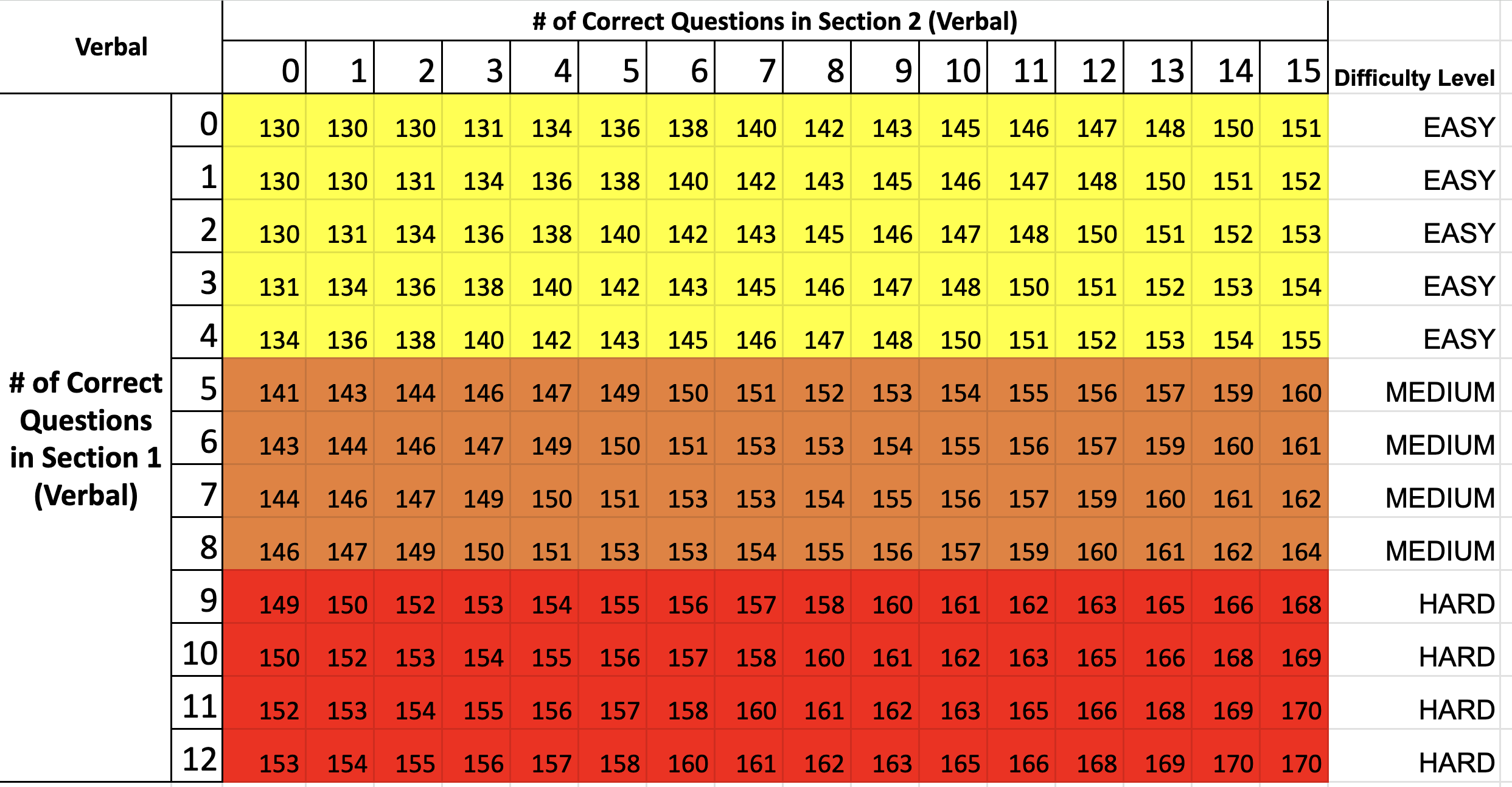
Take a moment to analyze this table. It powerfully illustrates the concept of a "scoring ceiling."
- If you get only 4 questions right in Section 1 (the last row of the yellow "EASY" zone), your maximum possible score is 155, even if you answer all 15 questions in the second section perfectly.
- However, if you get 9 questions right in Section 1 (entering the red "HARD" zone), you have unlocked the potential to score up to 170. A strong performance in Section 1 opens the door to the entire upper range of scores.
To cement these thresholds, let's review them one more time in text format.
GRE Score Calculator: How to Predict Your GRE Score - Magoosh Blog — GRE® Test
This reading solidifies the specific thresholds for both Quant and Verbal that determine your path.
First, read the section on the Quantitative section to see the thresholds that correspond to the flowchart you just saw. Then, read the section on the Verbal section to review the thresholds that determine which band you land in on the score table. For your ambitious goal, you should be aiming for the "Hard Second Section" path in both disciplines.
Conclusion
Today's lesson moved beyond the static format of the GRE and into its dynamic scoring engine. Understanding this system is not an academic exercise; it is the key to unlocking an elite score.
Here are the critical takeaways:
- The GRE is section-level adaptive. Your performance on the first medium-difficulty section of Quant and Verbal determines whether your second section is easy, medium, or hard.
- Your primary goal in Section 1 of each subject is to perform well enough to unlock the "hard" second section. This is not to make the test harder, but to raise your potential scoring ceiling. For a 335+ target, this is non-negotiable.
- Because it functions as a gateway to higher scores, Section 1 carries a disproportionate strategic weight. Small mistakes here can have a larger impact on your final score than mistakes in Section 2.
Now that you understand why your performance in the initial sections is so crucial, our next two lessons will focus on how to execute them with precision. We will begin by developing a pacing strategy for the Verbal Reasoning sections, designed to maximize your accuracy and ensure you hit the performance threshold needed to unlock a top score.