Welcome to your personalized GRE preparation course. Your goal of achieving a 335+ score is ambitious, and over the next six weeks, we will work systematically to build the skills and strategies necessary to reach it. Given your strong academic background in commerce, you already possess a solid foundation in quantitative and logical thinking, which we will leverage throughout this course.
This first lesson serves as the essential starting point for our journey. Before diving into specific strategies for Verbal or Quant, you must understand the structure of the test itself—its sections, timings, and the types of questions you will encounter. Mastering this "map" of the GRE will give you the clarity and confidence needed to navigate the exam effectively on test day.
Understanding the GRE's Architecture
The GRE General Test is a computer-based exam that takes just under two hours to complete. It is designed to assess skills that are broadly applicable to graduate-level work: analytical writing, verbal reasoning, and quantitative reasoning.
The test always begins with the Analytical Writing section. After that, you will face four more sections—two Verbal Reasoning and two Quantitative Reasoning. The order of these four sections is randomized. You might get a sequence like Verbal-Quant-Verbal-Quant, or Quant-Verbal-Quant-Verbal.
Let's begin with a high-level overview. The image below provides a clear visual breakdown of the entire test.
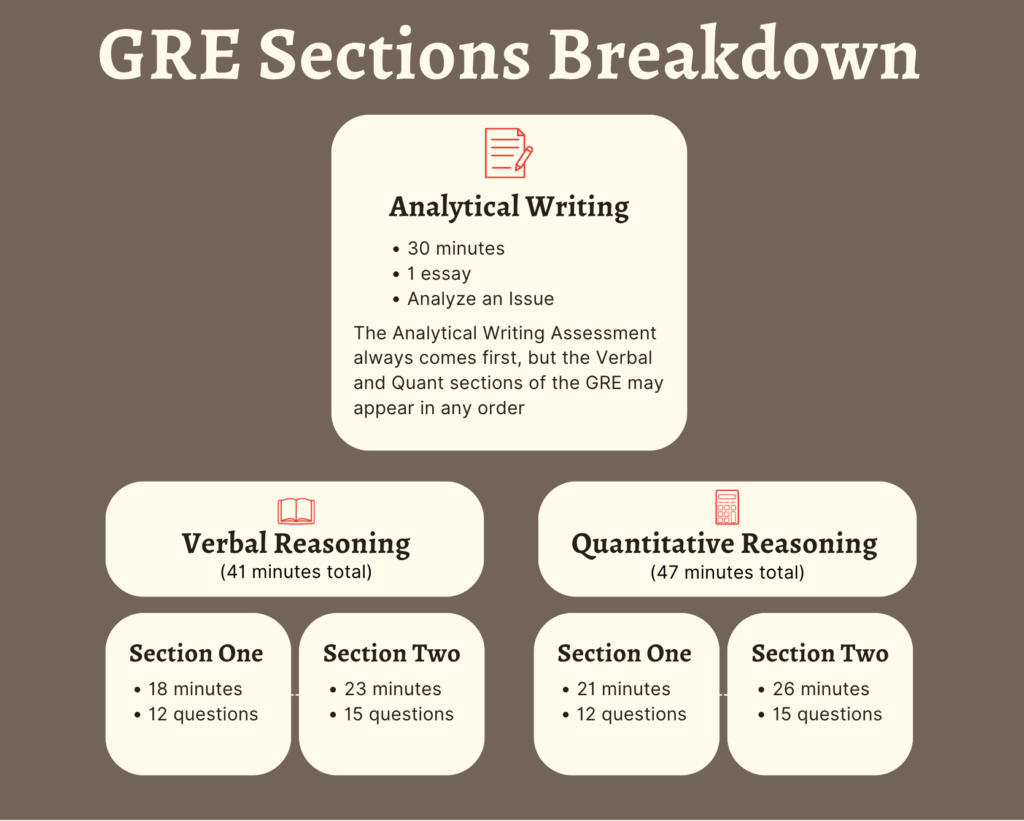
As you can see, the test is divided into three distinct measures, each with its own format and time constraints. There are no scheduled breaks between sections.
To solidify this overview, let's turn to a concise summary.
GRE Format and Section Breakdown (2025)
This reading from the Magoosh GRE Blog will provide a structured breakdown of the test's components. It's a great way to formalize the information from the infographic.
Please start by reading the introductory paragraphs and the summary table under the heading GRE Format: The Test as a Whole. This table is your master reference for timings and question counts. Next, continue to the section GRE Format by Each Section. Read the descriptions for the Analytical Writing, Verbal Reasoning, and Quantitative Reasoning sections to understand the core skills each one is designed to measure.
A Walkthrough of the Test Experience
Now that you have a static picture of the test, let's bring it to life. Nothing clarifies the test format better than seeing it in action. The following video from respected GRE tutor Greg Mat provides an excellent, screen-by-screen walkthrough of the entire exam.
(2025) Introduction to the GRE + Exam Walkthrough + Tips and Tricks
This video will walk you through the test's structure and show you exactly what the interface and question types look like for each section. This will help you build a strong mental model of what to expect on test day.
First, watch the segment from the beginning, where the presenter outlines the overall test structure, the two possible section orders (starting with Verbal or Quant after the essay), and the specific timings. Next, jump to the walkthrough of the Analytical Writing section interface from this segment. Notice the simple layout with the prompt on one side and your writing area on the other. Then, watch the detailed walkthrough of the first Verbal section from this portion. Pay close attention to the different question types he points out: Text Completion (single, double, and triple-blank) Reading Comprehension (including passages with multiple questions) Sentence Equivalence (where you must select two synonymous answers) Finally, watch the walkthrough of the first Quant section from this part. Again, focus on the distinct question formats: Quantitative Comparison (comparing Quantity A and Quantity B) Standard multiple-choice (some attached to graphs or charts) Data Interpretation (a set of 3 questions based on a chart/table) Numeric Entry (where you type in your answer)
Watching this walkthrough gives you a feel for the rhythm of the test and how the question types are typically grouped within a section. For example, you now know that both Verbal sections start with Text Completion and both Quant sections start with Quantitative Comparison. This predictability is something we will use to our advantage when developing pacing strategies in a later lesson.
Question Distribution by Type
To add a layer of quantitative precision to what you just saw, let's look at the typical number of each question type you can expect across the entire exam. Your commerce background has trained you to analyze distributions, and applying that thinking here can help you allocate your study time effectively.
GRE Format and Section Breakdown (2025)
This part of the Magoosh article provides tables that quantify the distribution of question types within the Verbal and Quantitative sections.
Please read the two tables under the heading Typical Number of Each Question Type. Notice the relative frequency of different questions. For instance, Reading Comprehension makes up about half of the Verbal section, and Quantitative Comparison constitutes a significant portion of the Quant section.
A Note on the Shorter GRE
The GRE format you are preparing for was introduced in September 2023. It is significantly shorter than the previous version of the test. You may come across older prep books or online resources that reference a nearly four-hour exam with two essays and an "experimental" section. It's important to know that these features have been removed.
The good news is that the question types and skills tested remain exactly the same. Therefore, older practice questions are still valuable, but practice tests must be based on the new, shorter format to be realistic.
GRE Format and Section Breakdown (2025)
To finalize your understanding of the current test format, this table provides a direct comparison between the old and new GRE.
Focus on the table under the heading GRE Format: Then vs. Now. This clearly summarizes the key changes: the removal of the "Analyze an Argument" essay, the reduction in the number of questions, and the elimination of the unscored experimental section.
Conclusion
In this lesson, we have laid the critical groundwork for your GRE preparation. You now have a comprehensive mental map of the entire exam.
Here are the key takeaways:
- The GRE consists of one Analytical Writing section (a 30-minute "Analyze an Issue" essay), two Verbal Reasoning sections, and two Quantitative Reasoning sections.
- The total test time is just under two hours, with no scheduled breaks.
- Each section has a specific number of questions and a strict time limit. For example, the first Verbal section has 12 questions in 18 minutes, while the first Quant section has 12 questions in 21 minutes.
- The questions within each section appear in a semi-predictable order, with Verbal sections starting with Text Completion and Quant sections with Quantitative Comparison.
- The current, shorter GRE format (post-September 2023) has no experimental section and only one essay task.
Now that we have a solid understanding of the test's static structure, our next lesson will explore its dynamic behavior. We will delve into how the GRE is a "section-level adaptive" test, meaning your performance on the first Verbal and Quant sections determines the difficulty level of your second sections. Understanding this mechanism is the first step toward building an advanced scoring strategy.