Hello! In our last lesson, we delved into ControlNet, a powerful method for guiding image generation using explicit structural conditions like edge maps and human poses. We saw how its architecture cleverly preserves the knowledge of a large pre-trained model while adding this new control.
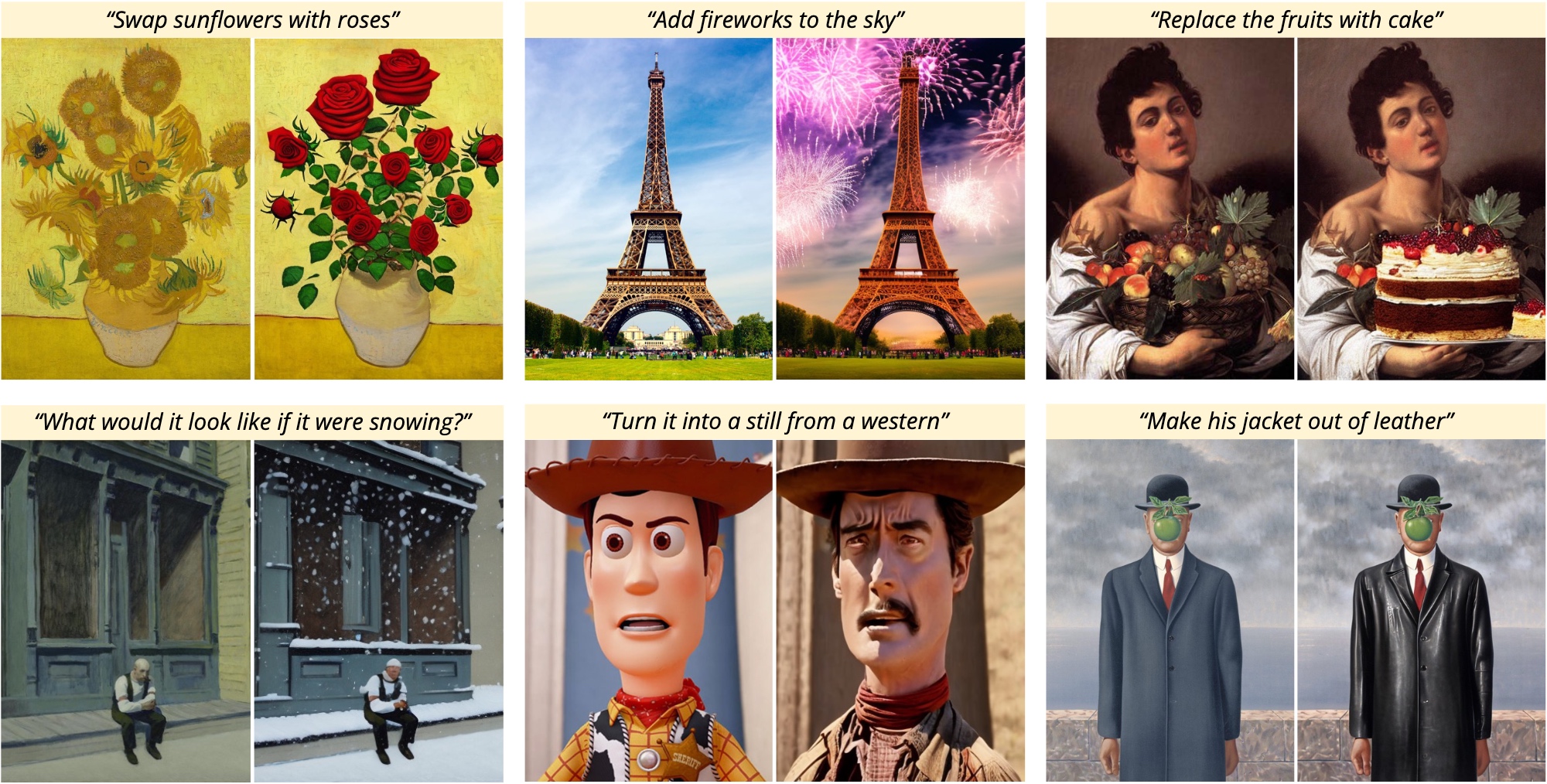
Today, we'll explore a different, yet equally powerful, paradigm for image editing: following natural language instructions. Your learning outcome for this lesson is to adapt an instruction-based image editing pipeline (e.g., InstructPix2Pix). Instead of providing a structural map, you'll provide a command like "make it winter" or "turn the painting into a photograph." We'll dissect the ingenious training strategy, the necessary architectural modifications, and the dual-conditioning inference process that makes this possible.
Part 1: The Dataset Dilemma and the Synthetic Solution
The primary challenge in training a model like this is the lack of data. There isn't a massive, publicly available dataset of (original image, editing instruction, edited image) triplets. Creating one manually would be prohibitively expensive and time-consuming.
The creators of InstructPix2Pix devised a clever, fully synthetic data generation pipeline to overcome this. The process involves two main stages, leveraging other powerful generative models.
InstructPix2Pix Explained - Edit Images with Words!
To understand this two-stage data generation process, watch this segment from the video 'InstructPix2Pix Explained' by DataScienceCastnet. It clearly explains how GPT-3 and another diffusion model technique, Prompt-to-Prompt, were used to create the training set.
Watch from 01:16 to 04:05. Focus on the two key steps: Using a fine-tuned GPT-3 to generate an 'edit instruction' and an 'edited caption' from an original image caption. Using the Prompt-to-Prompt technique with the original and edited captions to generate a consistent pair of images.
To summarize the key steps of this synthetic data factory:
-
Instruction Generation (Text-to-Text):
- Start with an image caption from a large dataset (e.g., "A photo of a castle").
- Use a fine-tuned GPT-3 model to generate a plausible editing instruction (e.g., "make it a sand castle") and the corresponding new caption ("A photo of a sand castle"). This creates a
(caption_1, instruction, caption_2)triplet.
-
Image Pair Generation (Text-to-Image):
- Use a text-to-image diffusion model (like Stable Diffusion) with a technique called Prompt-to-Prompt.
- Generate an image for
caption_1and another forcaption_2. Prompt-to-Prompt ensures structural consistency between the two images by manipulating the cross-attention maps during generation. This is crucial for creating a realistic before-and-after pair. - The result is a complete training sample:
(image_1, instruction, image_2).
This process was used to generate over 450,000 such training examples, all without any human artists.
Part 2: Architectural Adaptation for Dual Conditioning
In the last lesson, we saw ControlNet add a trainable copy of the U-Net's encoder. InstructPix2Pix uses a simpler but equally effective approach to incorporate the conditioning image. It directly modifies the input to the U-Net.
A standard latent diffusion U-Net takes a noisy latent z_t (typically 4 channels) as input. The InstructPix2Pix U-Net is modified to accept an 8-channel input:
- Channels 0-3: The noisy latent of the image being generated,
z_t. - Channels 4-7: The VAE-encoded latent of the original, unedited image,
c_I.
This concatenation allows the model, at every denoising step, to see both the current state of the image it's generating and the original image it's supposed to be editing.
InstructPix2Pix Explained - Edit Images with Words!
The same video provides a clear diagram illustrating this architectural change. This short clip will help visualize how the original image is fed into the U-Net.
Watch from 05:27 to 06:17. Pay attention to the diagram showing the 'Noisy Input' and 'Original Unedited Image' being concatenated and fed into the U-Net.
The training objective remains the familiar noise prediction loss, but now the model's prediction ε_θ is conditioned on three things: the noisy latent z_t, the text instruction c_T, and the original image latent c_I.
This modification is reflected in the Hugging Face diffusers training script for InstructPix2Pix.
InstructPix2Pix Training Documentation
The Hugging Face documentation on training InstructPix2Pix explicitly mentions this architectural change. This brief reading confirms how the U-Net's first layer is adapted.
Read the short section titled 'Training script'. Focus on the first code block that shows the modification of in_channels for the U-Net's first convolutional layer.
Part 3: Inference with Dual Classifier-Free Guidance
You're already familiar with Classifier-Free Guidance (CFG) for text conditioning. InstructPix2Pix extends this concept to handle two conditions: the text instruction and the original image. This allows us to control the strength of the edit (how much it follows the text) and the fidelity to the original image structure.
During inference, we need to make three noise predictions at each step:
- Unconditional:
ε_θ(z_t, ∅, ∅)- Denoise with no guidance. - Image-conditioned:
ε_θ(z_t, ∅, c_I)- Denoise using only the original image. - Image-and-Text-conditioned:
ε_θ(z_t, c_T, c_I)- Denoise using both the image and the text instruction.
These three predictions are then combined to produce the final noise estimate ε̃_θ using two guidance scales: s_I (image guidance) and s_T (text guidance).
The final guided prediction is:
This formula intuitively steers the unconditional prediction first towards the image conditioning, and then steers that result towards the full text-and-image conditioning.
Part 4: Adapting the Pipeline in Practice
Now, let's see how this dual-CFG logic is implemented. The following resource provides a fantastic, in-depth breakdown of a custom Python implementation, which is key to understanding how you can adapt this pipeline.
How to Edit Images using InstructPix2Pix in Python
The article 'How to Edit Images using InstructPix2Pix in Python' from The Python Code is our main resource for this section. It not only provides a high-level diffusers example but also builds the entire pipeline from its core components. This will give you the deep understanding needed for adaptation and debugging.
First, quickly review the 'Huggingface Implementation' section to see the high-level API. Then, spend the majority of your time studying the 'Custom Implementation' section. Pay close attention to the following methods and how they enable the dual-CFG we just discussed: get_prompt_embeds: How are the conditional and unconditional text embeddings concatenated? get_image_latents: How are the conditional and unconditional image latents prepared? denoise_latents: How are the three noise predictions (noise_pred_text, noise_pred_image, noise_pred_uncond) chunked and then combined using the guidance scales?
Let's break down the most critical parts from that custom implementation.
To get our three required noise predictions (ε_uncond, ε_image, ε_text+image) in a single forward pass, the inputs are batched in a very specific way:
- Text Embeddings (
prompt_embeds): Theget_prompt_embedsfunction creates a batch of three embeddings:[text_cond_embeds, text_uncond_embeds, text_uncond_embeds]
- Image Latents (
image_latents): Theget_image_latentsfunction creates a batch of three latent vectors:[image_cond_latents, image_cond_latents, image_uncond_latents](whereimage_uncond_latentsis just zeros).
When the U-Net runs on this combined batch, the inputs for each prediction are aligned correctly:
- Batch item 1:
text_cond_embeds+image_cond_latents->ε_text+image - Batch item 2:
text_uncond_embeds+image_cond_latents->ε_image - Batch item 3:
text_uncond_embeds+image_uncond_latents->ε_uncond
The denoise_latents function then elegantly unpacks these results:
# predict noise residuals
noise_pred = self.unet(latent_model_input, t, encoder_hidden_states=prompt_embeds)['sample']

# separate predictions
noise_pred_text, noise_pred_image, noise_pred_uncond = noise_pred.chunk(3)

# perform guidance
noise_pred = (
    noise_pred_uncond
    + image_guidance_scale * (noise_pred_image - noise_pred_uncond)
    + guidance_scale * (noise_pred_text - noise_pred_image)
)
This code is a direct implementation of the dual-CFG formula. Understanding this mechanism is the key to adapting the pipeline, as you can now confidently trace the flow of conditioning information and tune the guidance parameters (image_guidance_scale and guidance_scale) to achieve your desired effect.
Test your understanding!
In the custom implementation, what is the purpose of setting the unconditional image latents to a tensor of zeros? How does this help the model make the "unconditional" and "image-conditioned" predictions?
Show answer
The U-Net architecture was fine-tuned with zero-initialized weights for the extra 4 input channels corresponding to the conditioning image. When dropout is applied during training, the model sometimes receives these zeroed-out channels, forcing it to learn to behave like a standard text-to-image model.
During inference, passing a tensor of zeros as the unconditional image latent effectively simulates this training condition. It tells the U-Net to "ignore" the image conditioning part of its input.
- For the unconditional prediction, both the text embeddings and image latents are unconditional (empty string/zeros), so the U-Net generates noise based on no guidance.
- For the image-conditioned prediction, the text embedding is unconditional, but the image latent is the real one. The model is guided by the image but not the text.
This allows the pipeline to generate the three distinct predictions required for dual-CFG using a single U-Net architecture.
Conclusion
In this lesson, we dissected the InstructPix2Pix pipeline, a powerful method for instruction-based image editing. You've seen that its success relies on a combination of clever data engineering and specific architectural and inference-time adaptations.
Key Takeaways:
- Synthetic Data is Key: InstructPix2Pix's effectiveness stems from a large, synthetically generated dataset created using GPT-3 and Prompt-to-Prompt.
- Architectural Adaptation: The model conditions on an input image by modifying the U-Net's first layer to accept an 8-channel input (4 for the noisy latent, 4 for the original image's latent).
- Dual Classifier-Free Guidance: At inference time, the model uses an extended version of CFG with two guidance scales—one for the image and one for the text instruction. This is achieved by making three parallel predictions (unconditional, image-conditioned, and image+text-conditioned) in a single forward pass.
- Adaptable Pipeline: By understanding the component functions (
get_prompt_embeds,get_image_latents,denoise_latents), you can trace, debug, and modify the pipeline's behavior, particularly the influence of each conditioning signal.
Next Lesson Preview:
We have now explored guiding diffusion models with masks (inpainting), structural maps (ControlNet), and text instructions (InstructPix2Pix). A common thread in many editing tasks is the use of masks to localize changes. However, this often introduces visual problems. In the next lesson, we will focus on a critical debugging skill: debugging boundary artifacts and consistency issues in masked editing techniques. We will examine why these artifacts appear and explore strategies to mitigate them for seamless, high-quality edits.