Welcome back to our study of PCOS pathophysiology. In our previous lesson, we established a critical part of the puzzle: an abnormal, high-frequency GnRH signal from the brain leads to excessive LH stimulation of the ovaries. This "extrinsic" pressure drives the ovaries to produce more androgens.
Today, we'll look inside the ovary itself and discover that the theca cells—the very cells responsible for androgen production—are not just passive targets. They have their own inherent abnormalities that make them predisposed to overproducing androgens. This is a fundamental concept in understanding why hyperandrogenism is so central to PCOS.
Our learning outcome for this lesson is to explain the intrinsic dysregulation in theca cells that contributes to hyperandrogenism in PCOS.
We will cover:
- The evidence that proves this dysfunction is intrinsic to the cells themselves.
- The specific molecular and genetic changes within PCOS theca cells that make them so efficient at producing androgens.
- How this intrinsic problem interacts with the external signals we discussed previously.
The Concept of an Intrinsic Theca Cell Defect
The idea that the primary problem in PCOS lies within the ovary itself is encapsulated by the term Functional Ovarian Hyperandrogenism (FOH). This means the ovary's function is dysregulated, leading it to secrete excess androgens. This isn't due to a tumor but to an inherent hyperactivity in the steroid-producing machinery.
The strongest evidence for this intrinsic defect comes from laboratory studies where theca cells are physically removed from the body and studied in isolation.
The Pathogenesis of Polycystic Ovary Syndrome (PCOS)
Let's begin with a foundational review article, 'The Pathogenesis of Polycystic Ovary Syndrome (PCOS),' which discusses this concept directly. This section will explain how we know the problem lies within the theca cell itself, independent of the body's hormonal environment.
Please read the section titled 'V. Pathophysiology of PCOS: Abnormal Regulation of Steroidogenesis and Ovarian Function,' down to the end of the paragraph beginning 'Support for an intrinsic theca cell defect...'. Focus on understanding what in vivo and in vitro studies revealed about the nature of theca cell dysfunction.
As the article highlights, the key finding comes from in vitro cell culture studies. When theca cells from women with PCOS are isolated and grown in a laboratory dish—completely removed from the influence of high LH or insulin in the body—they continue to overproduce androgens. This trait is stable and persists even after the cells have divided many times (a process called "long-term passage"). This is compelling proof that the dysfunction is an inherent, programmed characteristic of the cells themselves.
The Molecular Machinery: What's Different Inside a PCOS Theca Cell?
Now that we've established the defect is intrinsic, let's explore what is actually different at the molecular level. The process of making androgens (steroidogenesis) is a multi-step biochemical pathway involving several key enzymes.
Insight into the pathogensis of polycystic ovarian syndrome
To understand the specifics, we'll turn to another paper, 'Insight into the pathogenesis of polycystic ovarian syndrome,' which provides a clear and concise summary of the steroidogenic pathway and its dysregulation in PCOS.
Please read the first paragraph of the main text, which starts 'First, intrinsic steroidogenic dysregulation...'. As you read, trace the pathway from LH stimulation to androgen production and note which enzymes are mentioned as being elevated in PCOS.
This reading confirms two crucial points:
- Hyperplasia of the theca interna: The layer of theca cells in the follicles of women with PCOS is often thicker, meaning there are simply more cells to produce androgens.
- Upregulation of Steroidogenic Enzymes: The enzymes that act as the workers on the androgen assembly line are more active and abundant.
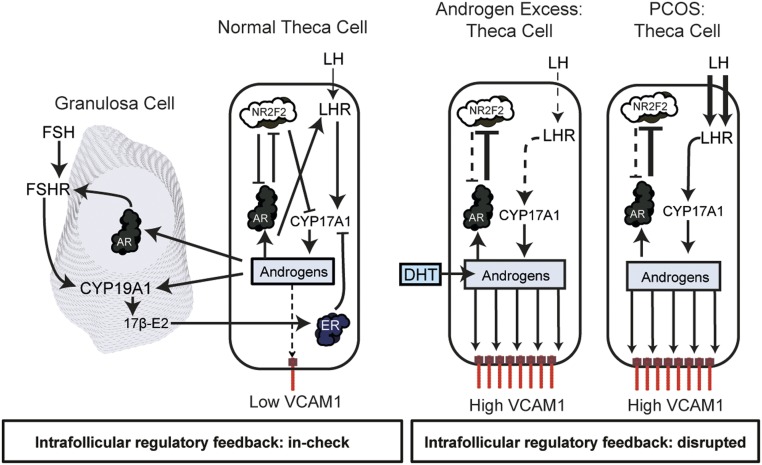
The most critical enzyme in this process is Cytochrome P450c17 (CYP17A1). This enzyme is a pivotal control point because it performs two sequential reactions essential for converting cholesterol-derived precursors into androgens. In PCOS theca cells, the expression and activity of CYP17A1, along with other enzymes like CYP11A and 3β-HSD, are significantly increased. This makes the entire androgen production pathway hyper-efficient.
A Deeper Genetic Driver: The Role of DENND1A.V2
For decades, the cause of this enzymatic upregulation was unclear. Recent genetic research has identified a key player that appears to be a master regulator of this process. This discovery is a prime example of the deep academic insight you are seeking.
The Pathogenesis of Polycystic Ovary Syndrome (PCOS)
Let's return to our main review article, 'The Pathogenesis of Polycystic Ovary Syndrome (PCOS),' to learn about a specific gene variant that helps explain the intrinsic theca cell defect. This is a fascinating piece of molecular evidence.
Please read the subsection titled 'a. Intrinsic theca cell dysfunction.' Focus on the findings related to the gene 'DENND1A' and its variant, 'DENND1A.V2.' Pay attention to what happened when this variant was overexpressed in normal cells and knocked down in PCOS cells.
This research provides powerful, direct evidence for a genetic basis of theca cell dysfunction. Let's break down the key findings:
- DENND1A is a gene, and it produces a protein involved in cellular signaling.
- This gene has a specific splice variant (an alternative version of the protein) called DENND1A.V2, which is found in much higher levels in theca cells from women with PCOS.
- The Experiment:
- When scientists artificially increased DENND1A.V2 in normal theca cells, those cells started behaving like PCOS cells—they ramped up their androgen production.
- Conversely, when they blocked or "knocked down" DENND1A.V2 in PCOS theca cells, their androgen production decreased toward normal levels.
This suggests that the overexpression of DENND1A.V2 is a key upstream event that drives the increased expression of steroidogenic enzymes like CYP17A1, creating the hyperandrogenic phenotype of the PCOS theca cell.
Test your understanding!
Imagine you are a researcher with two sets of theca cells in culture: one from a woman with PCOS and one from a woman without. You provide both cell cultures with the exact same, normal amount of LH.
What would you predict about the amount of androstenedione (an androgen) produced by each culture, and why?
Show answer
You would predict that the theca cells from the woman with PCOS would produce significantly more androstenedione than the cells from the woman without PCOS.
The reason is the intrinsic dysregulation we've just discussed. Even with the same external LH signal, the PCOS theca cells are inherently more efficient at producing androgens due to factors like the overexpression of the enzyme CYP17A1 and the influence of the genetic variant DENND1A.V2.
A Unified View: Intrinsic Defects and External Signals
It is crucial to understand that this intrinsic defect does not operate in a vacuum. It works in a destructive synergy with the other factors we have discussed.
-
Synergy with High LH: The high LH levels (from abnormal GnRH pulsatility, discussed last lesson) provide a constant, strong "go" signal. The intrinsically dysregulated theca cells are hyper-responsive to this signal. It's like pressing the accelerator on a car that already has a souped-up engine.
-
Synergy with High Insulin: As we will explore in detail in a future lesson, many women with PCOS also have high levels of insulin (hyperinsulinemia). Insulin itself can act directly on theca cells, further stimulating their growth and androgen production. This adds a third layer to the problem.
Let's watch a brief video segment that explains this synergistic role of insulin.
The video 'Polycystic Ovarian Syndrome' by Dr. Sarah Xuereb provides a clear explanation of how insulin adds to the problem.
Please watch from 05:38 to 06:27. Note how insulin is described as having its own receptors on theca cells and how it contributes to the problem.
The image below provides a visual summary of the dysregulation within the PCOS theca cell, showing how the exaggerated response leads to a massive increase in androgen output compared to a normal cell.
Conclusion
In this lesson, we have moved our focus from the brain to the ovary to understand a second, equally important cause of hyperandrogenism in PCOS.
Key Takeaways:
- The primary driver of androgen excess in PCOS is often Functional Ovarian Hyperandrogenism (FOH), an intrinsic defect within theca cells.
- Evidence from in vitro cell culture proves this defect is inherent to the cells, as they continue to overproduce androgens even when isolated from the body's hormonal environment.
- At the molecular level, this dysfunction involves the overexpression of key steroidogenic enzymes, most notably CYP17A1.
- A specific genetic variant, DENND1A.V2, has been identified as a key driver that induces this hyperandrogenic state in theca cells.
- This intrinsic defect works in synergy with external signals like high LH and high insulin, creating a powerful drive for androgen overproduction.
Preview of the Next Lesson:
We've now touched on the amplifying role of insulin several times. In our next lesson, we will dedicate our entire focus to this topic. We will explore how insulin resistance and hyperinsulinemia synergistically enhance ovarian androgen production, adding another crucial layer to the complex pathophysiology of PCOS.