Welcome! In our last lesson, we delved into the Developmental Origins of Health and Disease (DOHaD) theory, learning how the prenatal environment can program an individual's physiology and predispose them to PCOS. We saw that this programming can affect the neuroendocrine system, setting the stage for hormonal imbalances later in life.
Today, we will examine the first major pathophysiological consequence of this programming. Our learning outcome is to describe the role of abnormal Gonadotropin-Releasing Hormone (GnRH) pulsatility and excessive Luteinizing Hormone (LH) stimulation in ovarian androgen production. This is a central mechanism driving hyperandrogenism, one of the core features of PCOS.
We will break this down into a clear, cause-and-effect sequence:
- Why the hormonal signal from the brain's hypothalamus (GnRH) becomes abnormal in PCOS.
- How the pituitary gland responds to this abnormal signal, leading to an imbalance in LH and FSH.
- How this imbalance drives the ovaries to produce excess androgens.
By the end of this lesson, you will understand the critical neuroendocrine feedback loop that goes awry in PCOS, laying the groundwork for many of the syndrome's clinical signs.
A Quick Recap: The Normal HPO Axis
Before exploring the abnormality, let's briefly revisit the normal function of the Hypothalamic-Pituitary-Ovarian (HPO) axis, which you studied in Module 3.

The key features to remember are:
- The hypothalamus releases GnRH in discrete pulses.
- The frequency of these GnRH pulses determines how the pituitary responds. Generally, slower pulses favor FSH release, while faster pulses favor LH release.
- After ovulation, the corpus luteum produces progesterone, which acts as a "brake" on the hypothalamus, slowing down the GnRH pulse frequency in the luteal phase.
With this normal process in mind, let's see how it becomes disrupted in PCOS.
1. The Source of the Problem: Abnormal GnRH Pulsatility
In many women with PCOS, the fundamental disturbance begins in the hypothalamus. The GnRH "pulse generator" is stuck in a high-frequency mode, meaning the pulses are faster and more frequent than they should be.
What causes this? The primary reason is a breakdown in the negative feedback system.
Polycystic Ovarian Syndrome (PCOS) - Pathophysiology, Symptoms, Treatment
To understand this breakdown, let's watch a segment of the video 'Polycystic Ovarian Syndrome (PCOS) - Pathophysiology, Symptoms, Treatment' from PhysioPathoPharmaco. It provides a clear, step-by-step explanation.
Please watch from the beginning to 02:00. As you watch, focus on the answer to this question: Why does the GnRH pulse frequency increase in PCOS? Pay close attention to the role of ovulation and progesterone.
As the video explains, the core issue is anovulation (or oligo-ovulation, infrequent ovulation).
- In PCOS, follicular development is often arrested, so ovulation doesn't occur.
- Without ovulation, a corpus luteum is not formed.
- Without a corpus luteum, there is no significant production of progesterone.
- Without progesterone's powerful inhibitory effect (the "brake"), the GnRH pulse generator is free to run at an accelerated frequency.
This creates a persistent, high-frequency GnRH signal that is characteristic of the follicular phase, without the normal shift to the slower luteal phase pattern.
A key paper from the Endotext series on reproductive physiology confirms this finding.
Physiology of GnRH and Gonadotrophin Secretion
Let's read a short excerpt from 'Physiology of GnRH and Gonadotrophin Secretion' to see how this is described in the scientific literature.
Please read the short paragraph under the heading 'Biological and Clinical Relevance of GnRH Pulsatility'. Find the sentence that specifically describes the GnRH/LH pulse pattern in polycystic ovary syndrome.
The reading confirms that in PCOS, "LH pulse frequency and amplitude are higher throughout the menstrual cycle... contributing to chronic anovulation." This establishes the foundational neuroendocrine problem.
2. The Pituitary's Response: A Skewed LH:FSH Ratio
The pituitary gonadotrope cells are exquisitely sensitive to the frequency of the GnRH signal. As we've established, faster GnRH pulses preferentially stimulate the synthesis and secretion of Luteinizing Hormone (LH) over Follicle-Stimulating Hormone (FSH).
To understand the deeper mechanism behind this differential response, we'll turn to a paper that specializes in this topic. This will provide the academic depth you're looking for.
GnRH Pulse Frequency-dependent Differential Regulation ...
The paper 'GnRH Pulse Frequency-dependent Differential Regulation ...' explains how the pituitary decodes the GnRH signal. Reading the introduction will give you a solid overview of the concept and its relevance to PCOS.
Please read the 'INTRODUCTION' section. Focus on how the paper describes the relationship between GnRH pulse frequency and the transcription of the LH and FSH beta-subunits. Note how it explicitly links an accelerated GnRH pulse frequency to PCOS.
This reading clarifies that it's not just about hormone release; it's about gene transcription.
- Fast GnRH pulses preferentially increase the transcription of the
Lhbgene (the unique beta-subunit of LH). - Slow GnRH pulses preferentially increase the transcription of the
Fshbgene (the unique beta-subunit of FSH).
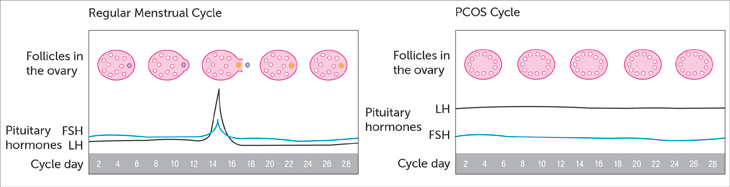
Because women with PCOS have persistently fast GnRH pulses, the pituitary is constantly biased towards producing LH. This results in the classic biochemical signature of PCOS: elevated basal LH levels and a high LH-to-FSH ratio.
This hormonal imbalance is perfectly illustrated in the following diagram.
Test your understanding!
A patient's blood test shows a high LH:FSH ratio. Based on what you've learned so far, what is the most likely upstream cause of this specific hormonal imbalance?
- The ovaries are failing to respond to FSH.
- The pituitary gland has an intrinsic defect causing it to overproduce LH.
- The hypothalamus is releasing GnRH at an abnormally high frequency.
- Progesterone levels are too high, over-stimulating the pituitary.
Show answer
The correct answer is 3. The high LH:FSH ratio is a direct downstream consequence of the pituitary gland responding to high-frequency GnRH pulses from the hypothalamus. High progesterone (option 4) would have the opposite effect, slowing GnRH pulses. While the other options can contribute to reproductive dysfunction, the specific high LH:FSH ratio points directly to an issue with GnRH pulsatility.
3. The Ovary's Reaction: Ovarian Hyperandrogenism
Now we arrive at the final step in this pathological cascade: the effect of high LH on the ovary. Let's recall the Two-Cell, Two-Gonadotropin Theory from Module 3.
- LH stimulates the theca cells of the ovarian follicle to take up cholesterol and convert it into androgens (primarily androstenedione and testosterone).
- FSH stimulates the neighboring granulosa cells to take the androgens produced by the theca cells and convert them into estrogens (like estradiol) using the enzyme aromatase.
In PCOS, this balanced system is thrown into disarray by the high LH:FSH ratio.
- Excessive LH Stimulation: The chronically high levels of LH constantly bombard and "overdrive" the theca cells.
- Overproduction of Androgens: In response, the theca cells produce an excessive amount of androgens.
- Insufficient Estrogen Conversion: At the same time, the relatively low levels of FSH mean that the granulosa cells lack the stimulation needed to efficiently convert the androgen surplus into estrogen.
The net result is a buildup of androgens within the ovary, which then spill over into the general circulation, causing hyperandrogenism—the root of clinical signs like hirsutism and acne.
Let's watch the final segment of the video to see this process summarized.
Polycystic Ovarian Syndrome (PCOS) - Pathophysiology, Symptoms, Treatment
The PhysioPathoPharmaco video concludes by connecting the hormonal imbalance to the ovarian production of androgens.
Please watch from 02:34 to 03:14. Notice how it directly links the excessive LH to theca cell stimulation and the production of androgens.
The Vicious Cycle of Neuroendocrine Disruption
This entire sequence creates a self-perpetuating vicious cycle that maintains the PCOS state:
- Start → Anovulation: The cycle begins with a failure to ovulate.
- → Lack of Progesterone: This leads to low progesterone and a loss of negative feedback on the hypothalamus.
- → Increased GnRH Frequency: The hypothalamus secretes GnRH pulses more rapidly.
- → High LH/FSH Ratio: The pituitary responds by secreting more LH relative to FSH.
- → Ovarian Hyperandrogenism: High LH drives theca cells to produce excess androgens.
- → Follicular Arrest: The high intra-ovarian androgen levels (along with low FSH) disrupt normal follicle maturation, leading to follicular arrest and preventing ovulation.
- Loop → Anovulation: This ensures the cycle repeats, perpetuating the anovulatory, hyperandrogenic state.
Understanding this feedback loop is fundamental to understanding the pathophysiology of PCOS.
Conclusion
In this lesson, we have dissected the central neuroendocrine disturbance that drives hyperandrogenism in many women with PCOS. We traced the problem from its source in the brain all the way to its effect in the ovary.
Key Takeaways:
- A core problem in PCOS is an abnormally fast GnRH pulse frequency, often due to a lack of progesterone feedback from anovulatory cycles.
- The pituitary gland interprets these fast pulses as a signal to preferentially produce LH over FSH, resulting in a characteristic high LH:FSH ratio.
- Excessive LH stimulation overdrives the ovarian theca cells, causing them to produce a surplus of androgens.
- This entire cascade forms a vicious cycle where hyperandrogenism and anovulation reinforce each other.
Preview of the Next Lesson:
The story of hyperandrogenism in PCOS doesn't end here. The overstimulation by LH is just one part of the equation. In our next lesson, we will learn that the theca cells in women with PCOS are not just passive recipients of this signal; they have their own problems. We will explore how intrinsic dysregulation in theca cells contributes to hyperandrogenism, making them inherently more efficient at producing androgens, even independent of LH levels.