Hello! Welcome back to our course on PCOS.
In our last two lessons, we established two major reasons for the hyperandrogenism seen in PCOS:
- Abnormal GnRH signaling, leading to excessive LH stimulation of the ovaries.
- An intrinsic dysregulation within the ovarian theca cells, which makes them "programmed" to overproduce androgens.
Today, we will add the third and final major piece to this puzzle: the powerful role of insulin. As we've briefly touched on, many women with PCOS have insulin resistance, which leads to high levels of insulin in the blood (hyperinsulinemia). This isn't just a separate metabolic issue; it actively and powerfully worsens the hyperandrogenism.
Our learning outcome is to explain how insulin resistance and hyperinsulinemia synergistically enhance ovarian androgen production. We will explore this through three key mechanisms and see how they create a self-perpetuating cycle.
A Quick Recap: Insulin Resistance and Hyperinsulinemia
As we covered in Module 6, insulin resistance is a state where the body's cells (especially muscle, fat, and liver cells) don't respond properly to insulin. To overcome this resistance and keep blood glucose levels normal, the pancreas compensates by producing and releasing much more insulin than usual. This condition of having chronically high levels of insulin in the blood is called compensatory hyperinsulinemia.
Now, let's see how this state of high insulin directly impacts the ovary.
Mechanism 1: Direct Stimulation of Theca Cells
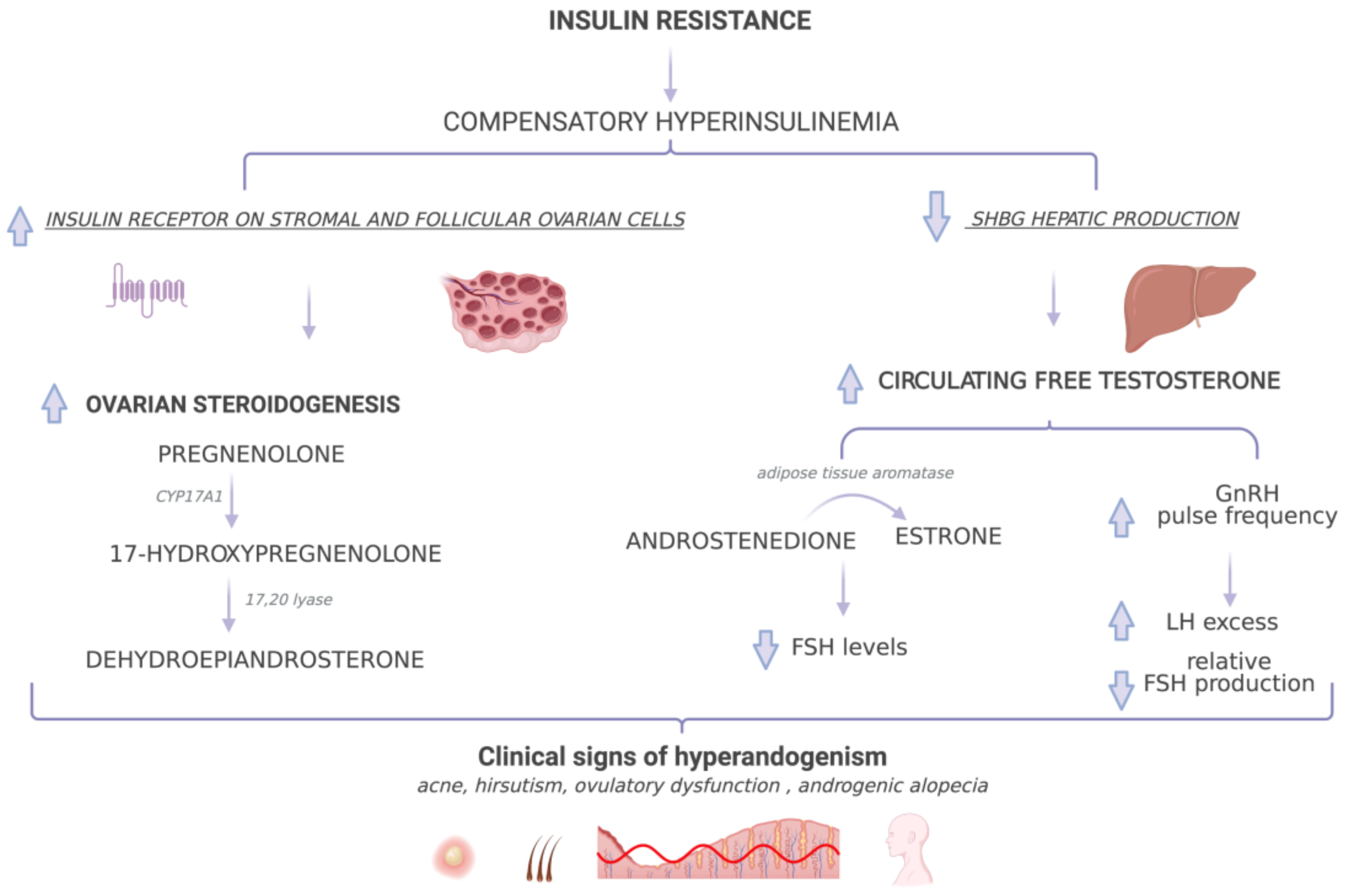
While many tissues in the body become resistant to insulin in PCOS, the ovarian theca cells remain sensitive. In fact, they have insulin receptors and respond robustly to high insulin levels.
High insulin acts as a powerful growth and stimulation signal for theca cells, directly telling them to ramp up androgen production. In this capacity, insulin is sometimes referred to as a "co-gonadotropin" because it acts alongside LH to stimulate the ovary.
To explore the detailed mechanisms, please read the following sections from a research paper on the role of insulin resistance in PCOS.
Recognizing the Role of Insulin Resistance in Polycystic ...
The paper 'Recognizing the Role of Insulin Resistance in Polycystic ...' provides an excellent, in-depth explanation of how insulin acts on the ovary. You'll first see a table summarizing insulin's actions, followed by a detailed breakdown of the molecular pathways.
First, read the section titled '4. Overview of Insulin’s Diverse Biological Actions' and look at Table 1 to find insulin's action on the ovary. Then, read the subsection titled '6.2. Insulin Resistance Disrupts Ovarian Function.' Focus on how insulin directly stimulates androgen production through specific signaling pathways (PI-3K, MAPK) and its synergy with LH.
As the text explains, hyperinsulinemia is a direct driver of ovarian androgen synthesis through several routes:
- It directly stimulates theca cells via their insulin receptors and related IGF-1 receptors.
- It activates specific intracellular signaling pathways (like PI-3K and MAPK) that increase the activity of steroidogenic enzymes.
- Crucially, it acts synergistically with LH. This means the combined effect of high insulin and high LH on theca cells is far greater than the sum of their individual effects. It's a powerful amplification.
This explains why two women with the same level of intrinsic theca cell dysfunction might have very different clinical presentations—the one with co-existing hyperinsulinemia will almost certainly have more severe hyperandrogenism.
Mechanism 2: Increasing Free Androgens by Reducing SHBG
The total amount of androgens produced is only half the story. The biological impact of androgens depends on how much is "free" and available to act on tissues. Most androgens in the blood are bound to a protein called Sex Hormone-Binding Globulin (SHBG), which is produced by the liver. Bound androgens are inactive.
High insulin levels have a suppressive effect on the liver, causing it to produce less SHBG.
- Less SHBG means more unbound, or "free," androgen is available in the circulation.
Therefore, hyperinsulinemia increases androgenic activity in two ways: it tells the ovary to make more androgens, and it ensures that a higher percentage of those androgens are biologically active.
This next video provides a very clear animated summary of these first two mechanisms.
Poly Cystic Ovarian Syndrome (PCOS) / Stein–Leventhal syndrome / Hyperandrogenic anovulation
The video 'Poly Cystic Ovarian Syndrome (PCOS)' by Dr.G Bhanu Prakash offers a great visual explanation of the link between insulin and androgens.
Please watch from 13:01 to 15:30. Pay close attention to how the animation depicts insulin stimulating theca cells and how it separately acts on the liver to suppress SHBG.
Mechanism 3: The Vicious Cycle
We have now established that hyperinsulinemia drives hyperandrogenism. The final piece of the puzzle is that hyperandrogenism, in turn, worsens insulin resistance.
Excess androgens can interfere with insulin signaling in peripheral tissues like skeletal muscle and adipose tissue, making them even more resistant to insulin's effects. This prompts the pancreas to release even more insulin, which then further stimulates the ovaries, creating a self-perpetuating vicious cycle.
This next short video segment does an excellent job of explaining this positive feedback loop.
Polycystic Ovarian Syndrome (PCOS) - Pathophysiology, Symptoms, Treatment
The video 'Polycystic Ovarian Syndrome (PCOS) - Pathophysiology, Symptoms, Treatment' by PhysioPathoPharmaco clearly describes the vicious cycle.
Watch the segment from 03:48 to 05:17. Focus on how the narrator explains the bidirectional relationship: androgens cause insulin resistance, which leads to more insulin, which leads to more androgens.
This cycle is a fundamental reason why PCOS can be a progressive condition and why interventions that target insulin resistance are often effective at managing the hyperandrogenism.
Test your understanding!
A woman with PCOS and significant insulin resistance is prescribed metformin, a medication known to improve insulin sensitivity. This drug has no direct effect on the ovaries or androgen receptors. After several months, her acne and hirsutism begin to improve.
Based on what you've learned, explain the chain of events, starting from improved insulin sensitivity, that leads to this clinical improvement.
Show answer
- Improved Insulin Sensitivity: The metformin helps her muscle and fat cells respond better to insulin.
- Lower Insulin Levels: Because the cells are more sensitive, her pancreas no longer needs to produce excessively high amounts of insulin to manage blood glucose. Her hyperinsulinemia is reduced.
- Reduced Ovarian Stimulation: With lower insulin levels, there is less direct "co-gonadotropin" stimulation of the theca cells, leading to a decrease in total androgen production.
- Increased SHBG Production: The liver is no longer suppressed by high insulin, so it increases its production of SHBG.
- Lower Free Androgens: With more SHBG available to bind androgens, the level of free, biologically active testosterone in her blood decreases.
- Clinical Improvement: The reduction in free androgen levels leads to a decrease in androgenic effects on the skin, resulting in improved acne and hirsutism.
Conclusion
In this lesson, we have integrated the metabolic dysfunction of insulin resistance directly into the pathophysiology of hyperandrogenism. It is not just a concurrent issue but a powerful amplifier of the core reproductive dysfunction in PCOS.
Key Takeaways:
- Hyperinsulinemia (high blood insulin) resulting from insulin resistance is a key driver of androgen excess in PCOS.
- It enhances androgen production through three main mechanisms:
- Direct stimulation of ovarian theca cells, acting as a "co-gonadotropin" alongside LH.
- Synergistic action with LH, greatly amplifying its effect on androgen synthesis.
- Suppression of liver SHBG production, which increases the amount of free, biologically active androgens.
- This relationship forms a vicious cycle, where hyperinsulinemia causes hyperandrogenism, and hyperandrogenism in turn worsens insulin resistance.
Preview of the Next Lesson:
So far, our entire discussion of androgen excess has focused on the ovary. However, the ovaries are not the only source of androgens in females. In our next lesson, we will broaden our scope to describe the contribution of adrenal androgen excess in a subset of women with PCOS, adding another layer of complexity to the syndrome.