Hello! Welcome to the next lesson in our module on Androgen Physiology and Metabolism in Females.
Introduction
In our last lesson, we explored the many essential physiological roles that androgens play in the female body, from maintaining bone density to regulating libido and mood. We established that these hormones are vital for normal function. However, the total amount of a hormone in the bloodstream doesn't tell the whole story. Its biological impact depends on whether it is "free" to interact with target cells.
This brings us to today's crucial topic: the regulation of androgen activity. We will be focusing on the key protein that acts as the primary gatekeeper for androgen bioavailability.
This lesson directly addresses the learning outcome: Explain the function of sex hormone-binding globulin (SHBG) in regulating androgen bioavailability. Understanding this mechanism is fundamental to grasping how androgen excess manifests in conditions like PCOS, even when total androgen levels might appear normal.
1. What is SHBG and Why is it Necessary?
First, let's establish what Sex Hormone-Binding Globulin (SHBG) is and why the body needs it. Androgens, being steroid hormones, are derived from cholesterol. This makes them lipids (fat-soluble), which means they don't mix well with the watery environment of the bloodstream—much like oil and water. To travel through the circulation to their target tissues, they need to be carried by special transport proteins. SHBG is the main, high-affinity carrier for sex hormones.
What IS Sex Hormone Binding Globulin? SHBG
To begin, let's watch a short segment from the video 'What IS Sex Hormone Binding Globulin?' by TheJDocRealMinute. It provides an excellent analogy to explain why these transport proteins are essential.
Please watch from 01:19 to 02:43. Focus on the 'oil and water' analogy and the description of SHBG as a 'protein carrier' or 'bus' produced mainly by the liver.
As the video explained, SHBG is a glycoprotein (a protein with sugar molecules attached) that is primarily synthesized in the liver. It acts as a shuttle, binding to sex hormones and transporting them safely through the blood.
2. Bioavailability: The Difference Between Bound and Free Hormones
The function of SHBG goes far beyond simple transport. By binding to androgens, it renders them biologically inactive. For a hormone like testosterone to exert its effect, it must first detach from SHBG and become "free" to enter a target cell and bind to an androgen receptor.
This leads to a critical concept: the difference between total testosterone and free testosterone.
- Total Testosterone: The total amount of testosterone in the blood, including all three forms below.
- Bound Testosterone: The majority of testosterone (in women, around 66-78%) is tightly bound to SHBG. This portion is considered inactive and acts as a storage reservoir.
- Loosely Bound Testosterone: A smaller portion is weakly bound to another protein called albumin. Because this bond is weak, this testosterone is generally considered bioavailable.
- Free Testosterone: A very small fraction (only 1-2%) circulates freely, unbound to any protein. This is the most active form of the hormone.
The term bioavailable testosterone refers to the free testosterone plus the albumin-bound testosterone—this is the total amount of hormone that is available to act on the body's tissues.
For a more detailed explanation of this concept, please read the 'Physiological Function' section from the 'SHBG Analyte Information' document. It clarifies the different states of circulating hormones.
Please read the full section titled 'Physiological Function'. Focus on the two main roles of SHBG (transporting and regulating bioavailability) and the definition of 'bioavailable' hormones as the combined free and albumin-bound fractions.
3. The Clinical Significance of SHBG in Regulating Androgens
Since the level of SHBG determines how much testosterone is bound up and inactive, the concentration of SHBG in the blood has a profound impact on androgen activity.
- Low SHBG: Fewer "buses" are available to bind testosterone. This results in a higher percentage of free and bioavailable testosterone, leading to increased androgenic effects (like acne or hirsutism) even if total testosterone levels are normal.
- High SHBG: More "buses" are available, binding up more testosterone. This results in a lower percentage of free and bioavailable testosterone, potentially leading to symptoms of low androgen activity.
The following video and table illustrate this crucial point perfectly.
SHBG, PCOS, and Testosterone in Women
Let's watch a segment from Dr. Alexandra Mayer's video, 'SHBG, PCOS, and Testosterone in Women,' which clearly explains why measuring only total testosterone can be misleading.
Please watch from 02:56 to 04:05. Pay close attention to the distinction between total and free testosterone and how high SHBG can lead to symptoms of low androgens.
Now, let's look at a concrete example from a research paper.
Sex Hormone-Binding Globulin (SHBG): Polycystic Ovary ...
The article 'Sex Hormone-Binding Globulin (SHBG): Polycystic Ovary ...' provides a fantastic table comparing two patients. This demonstrates numerically how SHBG levels dictate androgen bioavailability.
Please examine Table 1 and the accompanying text. Notice that both Patient 1 and Patient 2 have similar (and normal) total testosterone levels. However, because Patient 1 has low SHBG, her bioavailable and free testosterone levels are elevated, putting her in a state of functional hyperandrogenism.
This example is the core of what you need to understand. A woman with PCOS often has low SHBG. Her lab report might show a normal total testosterone, but her body is experiencing the effects of high androgens because a larger fraction of that testosterone is free and active.
4. Factors That Regulate SHBG Levels
What causes SHBG levels to be high or low? The liver's production of SHBG is tightly regulated by various hormones and metabolic factors. Understanding these regulators is key to understanding the pathophysiology of PCOS.
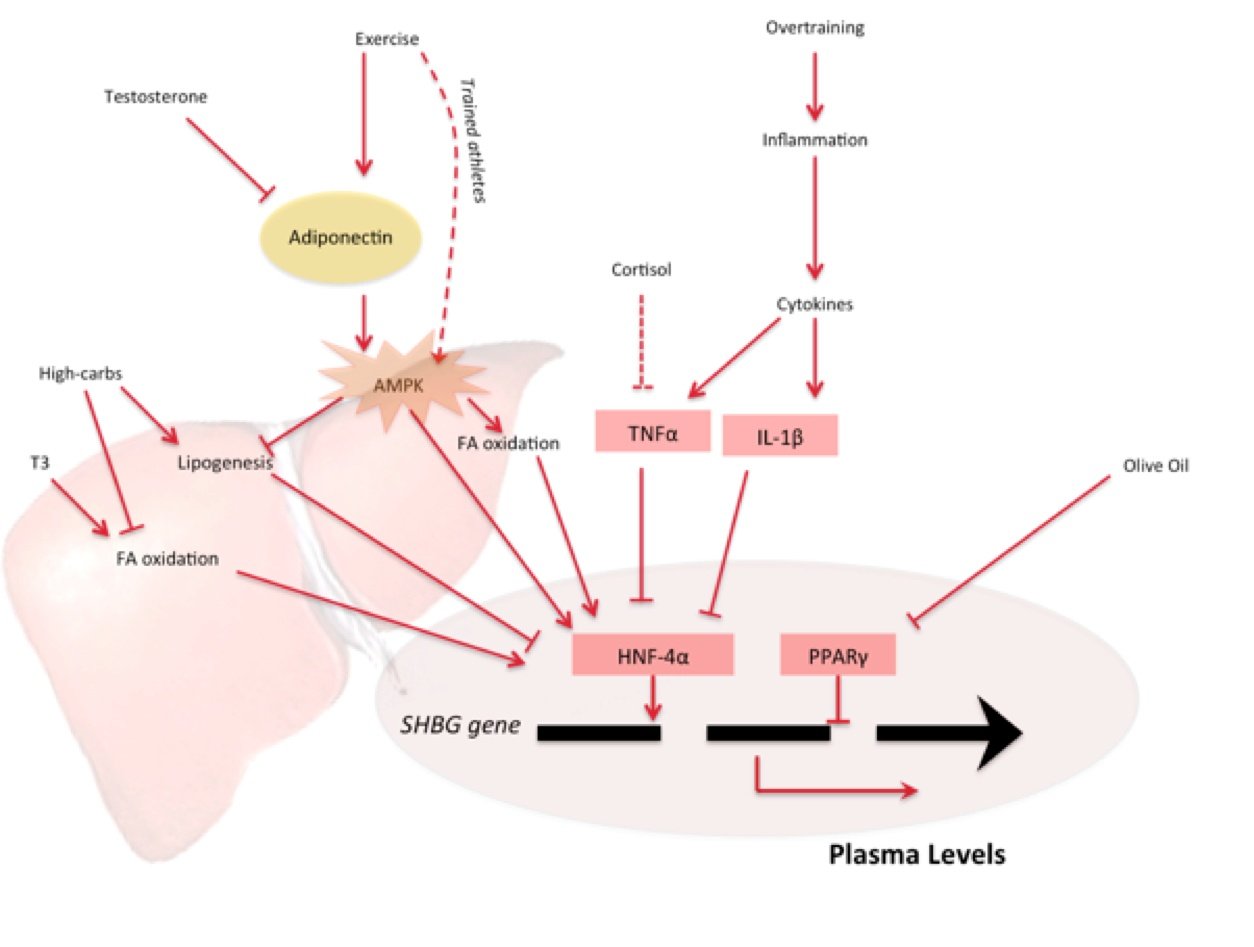
The most important factors to remember are:
-
Factors that DECREASE SHBG production (leading to more free androgen):
- Insulin: High levels of insulin (hyperinsulinemia), a hallmark of insulin resistance, strongly suppress the liver's production of SHBG. This is a primary link between the metabolic and hyperandrogenic features of PCOS.
- Androgens: Testosterone and other androgens create a negative feedback loop, suppressing SHBG production.
- Obesity: Often associated with insulin resistance and inflammation, which both lower SHBG.
- Glucocorticoids (like cortisol).
-
Factors that INCREASE SHBG production (leading to less free androgen):
- Estrogens: This is why women naturally have higher SHBG levels than men, and why oral contraceptives (which contain estrogen) are an effective treatment for hyperandrogenism.
- Thyroid Hormones: Hyperthyroidism increases SHBG, while hypothyroidism decreases it.
For a comprehensive list and further detail on these regulatory factors, please refer back to the 'SHBG Analyte Information' document.
Please read the section titled 'Levels'. Focus on the paragraph beginning 'SHBG serum levels are affected by a number of factors...'. This will reinforce and expand upon the list above.
The suppression of SHBG by insulin is a cornerstone of PCOS pathophysiology. Insulin resistance leads to compensatory hyperinsulinemia (high insulin levels), which directly tells the liver to produce less SHBG. This, in turn, increases the amount of free, active testosterone, driving the clinical signs of hyperandrogenism.
5. Clinical Assessment: The Free Androgen Index (FAI)
Because directly measuring free testosterone can be technically difficult and vary between labs, clinicians often use a calculation to estimate the bioavailable androgen status. This is called the Free Androgen Index (FAI).
It is calculated as a simple ratio:
A high FAI is a strong indicator of androgen excess, as it accounts for the crucial role of SHBG. In women with PCOS, it is common to see a normal total testosterone but a significantly elevated FAI, confirming a state of functional hyperandrogenism.
The 'SHBG Analyte Information' document also introduces and explains the FAI. Let's read the relevant section.
Please read the section titled 'Free Androgen Index (FAI)'. It provides the formula and context for why this ratio is a more accurate reflection of true androgen status than total testosterone alone.
Test your understanding!
You are reviewing the lab results for two female patients:
- Patient A: Total Testosterone = 1.5 nmol/L; SHBG = 20 nmol/L
- Patient B: Total Testosterone = 1.5 nmol/L; SHBG = 75 nmol/L
- Calculate the Free Androgen Index (FAI) for both patients.
- Which patient is more likely to present with clinical signs of hyperandrogenism (e.g., hirsutism, acne), and why?
Show answer
-
Calculations:
- Patient A: FAI = (1.5 / 20) x 100 = 7.5
- Patient B: FAI = (1.5 / 75) x 100 = 2.0
-
Interpretation:
Patient A is much more likely to show signs of hyperandrogenism. Even though both patients have the exact same total testosterone level, Patient A's low SHBG level results in a significantly higher FAI. This indicates that a larger proportion of her testosterone is free and biologically active, leading to more pronounced androgenic effects on tissues like skin and hair follicles.
Conclusion
In this lesson, we have explored the critical role of SHBG as the primary regulator of androgen bioavailability. It is not just a simple transport molecule, but a dynamic controller of hormone activity.
Key Takeaways:
- SHBG is a glycoprotein made by the liver that binds tightly to sex hormones, particularly androgens, rendering them inactive.
- The biological activity of androgens is determined not by total levels, but by the bioavailable fraction (free + albumin-bound).
- Low SHBG levels lead to higher free androgen levels, which can cause hyperandrogenic symptoms even with normal total testosterone. This is a central mechanism in PCOS.
- SHBG production is suppressed by insulin and androgens, and stimulated by estrogens.
- The Free Androgen Index (FAI) is a calculated ratio of total testosterone to SHBG that provides a better assessment of a patient's true androgen status.
Preview of the Next Lesson:
We have now seen how androgens are produced and how their bioavailability is controlled in the bloodstream. However, the story doesn't end there. In the next lesson, we will focus on what happens within the target tissue itself, specifically exploring how testosterone can be converted into an even more potent androgen. We will answer the learning outcome: Describe the conversion of testosterone to dihydrotestosterone (DHT) by 5-alpha reductase.