Hello! Welcome back to our module on Androgen Physiology and Metabolism in Females.
Introduction
In our previous lessons, we established where androgens are produced in the female body (the ovaries and adrenal glands) and how they are synthesized from cholesterol through a series of enzymatic steps. We've built the foundation. Now, it's time to ask the most important question: What do these androgens actually do?
This lesson addresses the learning outcome: Describe the physiological roles of testosterone and its precursors in females. While often labeled "male hormones," androgens play a wide array of vital, normal physiological roles in women. Understanding these functions is absolutely essential before we can explore the consequences of androgen excess in PCOS.
Let's begin by categorizing the key androgenic players and their relative strengths.
1. The Androgen Family: Precursors and Active Hormones
As we've learned, the term "androgens" refers to a group of hormones. It's crucial to distinguish between the weak precursors and the potent, active hormones.
Androgen Excess: Practice Essentials, Pathophysiology, ...
To start, let's clarify which androgens are precursors and which have direct biological effects. The Medscape article 'Androgen Excess: Practice Essentials' provides a concise overview.
Please read the section titled 'Sources and types of androgens in women'. Focus on the list of five androgens and the key distinction it makes between the precursors (DHEAS, DHEA, androstenedione) and the directly active androgens (testosterone and DHT).
To summarize this critical point:
- Pro-androgens (Precursors): Dehydroepiandrosterone (DHEA), its sulfated form DHEA-S, and androstenedione are relatively weak. Their main job is to serve as a reservoir or building block for the more powerful androgens.
- Active Androgens: Testosterone and its metabolite dihydrotestosterone (DHT) are the workhorses. They are the molecules that bind strongly to androgen receptors to produce physiological effects. DHT is significantly more potent than testosterone.
Now that we know who the main actors are, let's see how they perform their roles at the cellular level.
2. Mechanism of Action: The Androgen Receptor
Like other steroid hormones, androgens exert their effects by binding to specific proteins inside target cells called androgen receptors (ARs). This is the lock-and-key mechanism that allows these hormones to influence cellular function.
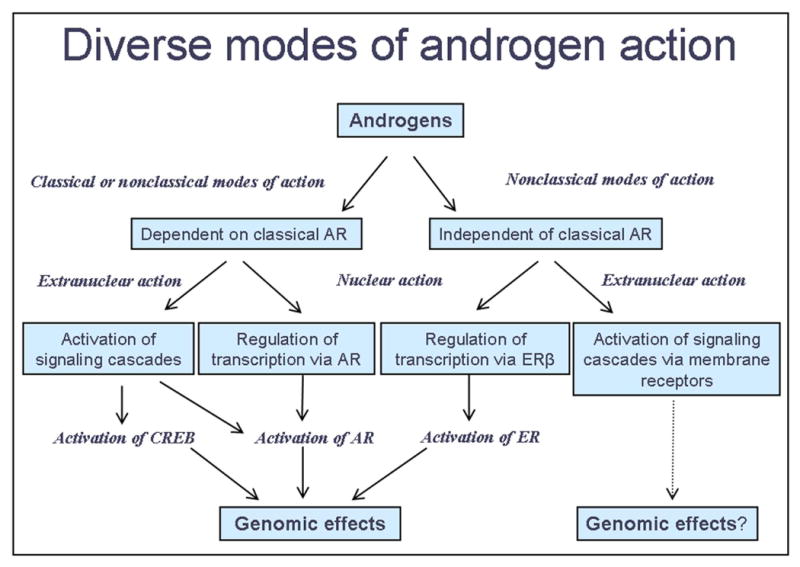
Once an androgen like testosterone binds to its receptor, the hormone-receptor complex travels to the cell's nucleus and acts as a transcription factor—it turns specific genes "on" or "off." This change in gene expression is what ultimately produces the physiological effect, whether it's building muscle tissue or stimulating a hair follicle.
The diverse effects of androgens across the body are possible because androgen receptors are found in a wide variety of tissues.
The Role of Androgens in Health and Disease in Females
Let's read about the distribution of these receptors in the female body from the article 'The Role of Androgens in Health and Disease in Females'. This will set the stage for understanding their specific functions.
Please read the section titled 'Androgen Receptors in Women'. Pay attention to the list of organs where these receptors are located.
As the text highlights, ARs are found in the ovaries, brain, endometrium, bone, heart, and more. This widespread distribution explains why androgens have such a broad range of effects, which we will now explore system by system.
3. The Physiological Roles of Androgens
Let's delve into the specific functions of androgens in maintaining health and normal function in the female body.
A. Reproductive and Sexual Health
While high levels are disruptive, normal androgen levels are essential for reproductive function.
The Role of Androgens in Health and Disease in Females
Using the same article, let's explore the roles of androgens in the ovaries, endometrium, and vulvovaginal tissues.
Please read the sections 'Ovarian Function', 'Endometrial Effect', and 'Vulvo-vaginal Effects'. As you read, focus on these key functions: In the ovary: The stimulatory role of androgens in early follicle development. In the endometrium: Their role in tissue repair and durability. In the vulva and vagina: Their contribution to tissue health.
Beyond tissue health, androgens are well-known for their role in libido (sexual desire). Androgen receptors are dense in areas of the brain that regulate sexual function, and physiological levels of testosterone are crucial for maintaining normal sexual desire in women.
B. Skin and Hair
The effects of androgens on skin and hair are perhaps the most visible. In physiological amounts, they are responsible for normal developmental changes.
Endocrinology | Adrenal Gland: Gonadocorticoids
The Ninja Nerd video 'Endocrinology | Adrenal Gland: Gonadocorticoids' provides a very clear and visual explanation of the normal effects of weak androgens on hair growth and skin.
Please watch from 08:26 to 11:25. Focus on how androgens contribute to the normal development of pubic and axillary (armpit) hair, as well as the function of sebaceous glands in the skin.
To summarize, at normal physiological levels, androgens are responsible for:
- The growth of pubic and axillary hair during puberty.
- The normal function of sebaceous glands, which produce sebum to lubricate the skin.
It is the overstimulation of these same targets (hair follicles and sebaceous glands) by excess androgens that leads to the clinical signs of hirsutism and acne seen in PCOS.
C. Musculoskeletal System and Metabolism
Androgens play a significant role in maintaining the strength and integrity of the body's frame and in regulating metabolism.
The Role of Androgens in Health and Disease in Females
Now, let's examine the non-reproductive roles of androgens on bone, muscle, and metabolism.
Please read the subsections under 'Androgens in Non-Reproductive Health': 'Osteoprotective Effect': Note how androgens help regulate bone metabolism and density. 'Effects on Muscle Mass and Performance': Understand their anabolic role in increasing muscle mass. 'Metabolic Effects': Focus on how androgens influence fat distribution and metabolism. Notice the mention of a potential 'cycle' with insulin resistance, which is a key concept we will return to.
These anabolic and metabolic effects highlight that androgens are crucial for maintaining bone density (helping to prevent osteoporosis), preserving lean muscle mass, and influencing how the body stores and uses energy.
D. Brain Function and Mood
The influence of androgens extends to the central nervous system, where they affect cognition and mood.
The Role of Androgens in Health and Disease in Females
Finally, let's look at the brain. The same article details the neuroprotective and cognitive effects of androgens.
Please read the subsection 'Neuroprotective and Cognition Regulating Effects'. Pay attention to their role in regulating cognition (like verbal learning and memory), mood, and their potential neuroprotective qualities.
This demonstrates that the feeling of well-being, mental clarity, and even certain types of memory can be influenced by maintaining a healthy androgen balance.
4. Visual Summary
We have covered a wide range of functions. The image below provides a great visual summary of the many physiological roles of testosterone in women.

Test your understanding!
A new medication is developed that completely blocks androgen receptors throughout the body. Based on the physiological roles we've discussed, what are two potential side effects a woman taking this drug might experience? Explain your reasoning for each.
Show answer
Here are a few possible answers. Any two of these (or similar logical conclusions) would be correct:
- Decreased Libido: Androgen receptors in the brain are crucial for regulating sexual desire. Blocking these receptors would likely lead to a noticeable decrease in libido.
- Reduced Bone Density: Androgens play an "osteoprotective" role by stimulating osteoblasts and contributing to bone mineralization. Blocking their action over the long term could increase the risk of bone loss or osteoporosis.
- Loss of Muscle Mass/Strength: Androgens have an anabolic effect on muscle tissue. Blocking ARs would interfere with this, potentially leading to a gradual loss of muscle mass and strength.
- Changes in Mood or Cognition: Since androgens affect mood and cognitive functions like verbal memory, a patient might experience changes in mood, a sense of low well-being, or difficulties with memory.
Conclusion
In this lesson, we have established that androgens, particularly testosterone, are far from being exclusively "male" hormones. They are indispensable for normal female physiology.
Key Takeaways:
- Androgens act by binding to androgen receptors (ARs) found in numerous tissues, including the ovaries, brain, bone, muscle, and skin.
- Their physiological roles are diverse, including:
- Reproductive: Stimulating early follicular development and maintaining libido.
- Musculoskeletal: Promoting bone density and muscle mass.
- Dermatological: Regulating the growth of axillary/pubic hair and sebum production.
- Neurological: Influencing mood, cognition, and overall well-being.
- The key to these functions is balance. The beneficial effects occur within a normal physiological range; it is when this balance is disrupted that pathology, such as in PCOS, begins.
Preview of the Next Lesson:
Just because a hormone is present in the blood doesn't mean it's active. The body has a sophisticated system for controlling how much androgen is "bioavailable" to the tissues. In our next lesson, we will explore this crucial regulatory mechanism by learning about sex hormone-binding globulin (SHBG) and its role in controlling androgen activity.