Hello! Welcome to your next lesson on androgen physiology.
Introduction
In our last lesson, we focused on the bloodstream, exploring how Sex Hormone-Binding Globulin (SHBG) acts as a crucial regulator of androgen bioavailability. We learned that the amount of "free" testosterone available to tissues is just as important, if not more so, than the total amount produced.
Now, we will follow that free testosterone molecule as it arrives at a target cell. The story doesn't end there; within certain tissues, testosterone can undergo a powerful transformation. This lesson will focus on a key step in androgen metabolism that dramatically amplifies its hormonal signal.
We will be addressing the learning outcome: Describe the conversion of testosterone to dihydrotestosterone (DHT) by 5-alpha reductase. Understanding this conversion is essential because it explains how even normal levels of testosterone can lead to potent androgenic effects in specific parts of the body, a mechanism highly relevant to the clinical signs of PCOS.
1. From Potent to "Super-Potent": An Introduction to DHT
While testosterone is correctly known as a potent androgen, it is not the most powerful androgen in the body. That title belongs to a related molecule: dihydrotestosterone, or DHT.
The conversion of testosterone to DHT is a critical process of amplification. As you'll see, DHT has a much stronger effect on target tissues than testosterone does.
Steroidogenesis | The Biosynthesis of Steroids from Cholesterol
Let's start with a short video clip from Catalyst University that introduces this concept. It clearly explains the hierarchy of androgen potency and the enzyme responsible for creating the most powerful one.
Please watch from 11:31 to 12:19. Focus on the name of the enzyme, the molecule it acts on, and the dramatic increase in androgenic power that results from this conversion.
As the video highlights, the simple removal of a double bond in the testosterone molecule increases its androgenic power by 20 to 100 times. This makes DHT a "super-potent" androgen.
2. The Conversion Process: 5-Alpha Reductase at Work
This powerful conversion is catalyzed by a specific enzyme called 5-alpha reductase.
A key concept to grasp is that this is a peripheral conversion. This means it doesn't happen where testosterone is primarily made (the ovaries and adrenal glands). Instead, it occurs locally, within the target tissues that are sensitive to androgens.
Biochemistry, Dihydrotestosterone
For a clear explanation of this peripheral conversion, please read the 'Fundamentals' section of the StatPearls article on Dihydrotestosterone.
Read the first paragraph under the 'Fundamentals' heading. Pay close attention to the statement that DHT is formed primarily in 'peripheral tissues' and how this makes it a 'paracrine' hormone (meaning it acts locally on cells near its site of synthesis).
This local production is crucial. It means that tissues like skin, sebaceous glands, and hair follicles can create their own highly potent androgen supply, amplifying the signal from the testosterone circulating in the blood.
3. A Closer Look at the Biochemical Reaction
Let's examine the chemical transformation from testosterone to DHT. The overall process of steroid hormone synthesis, which you've seen before, provides context for where this reaction fits.
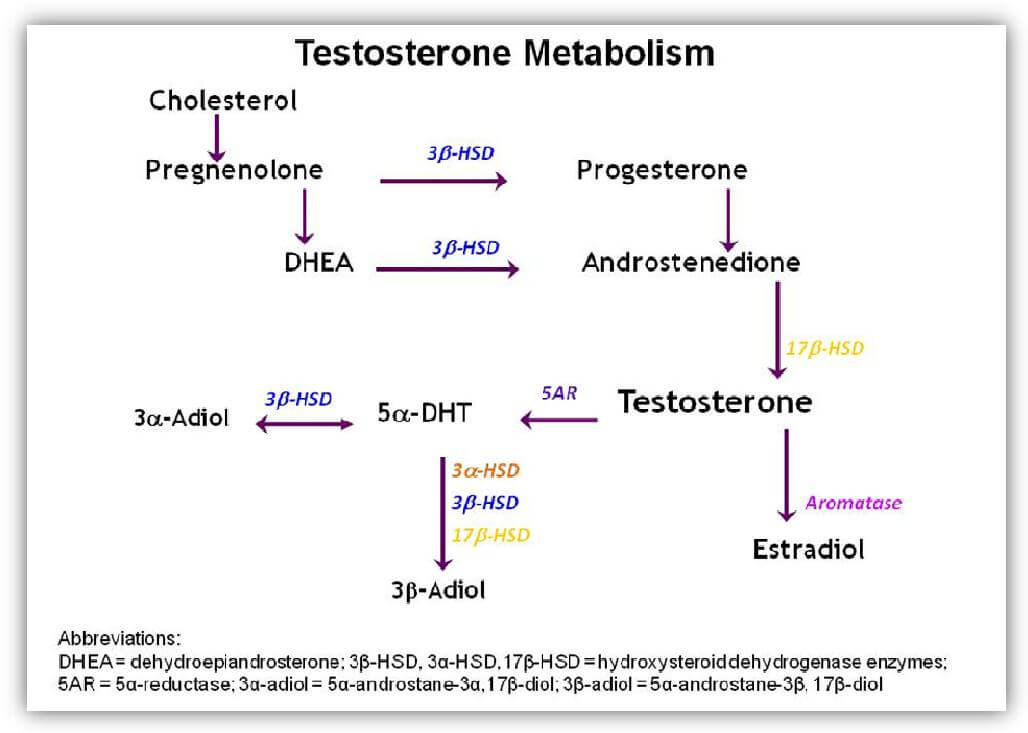
Now, let's zoom in on that specific reaction. The enzyme 5-alpha reductase modifies the "A" ring of the steroid structure.
The Wikipedia article on 5α-Reductase has a section that clearly illustrates the structural change. The side-by-side diagrams are very helpful for visualization.
Please read the short section titled 'Testosterone'. Examine the two diagrams and note the only difference: the double bond (Δ4,5) on the leftmost 'A' ring of testosterone is absent in dihydrotestosterone.
This is a reduction reaction, meaning electrons (in the form of a hydride ion) are added to the molecule. This process requires a helper molecule, or cofactor.
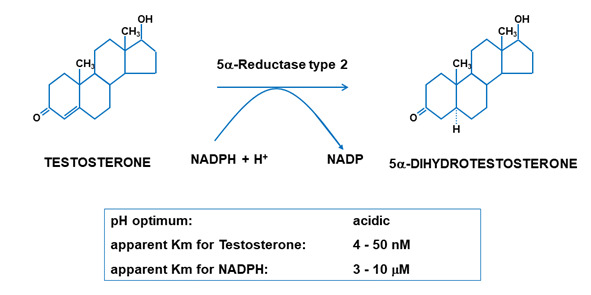
The complete chemical reaction can be written as:
4. A Family of Enzymes: The 5-Alpha Reductase Isoenzymes
It's also important to know that "5-alpha reductase" is not a single entity, but rather a family of at least three different but related enzymes, known as isoenzymes or isozymes.
Biochemistry, Dihydrotestosterone
Let's return to the StatPearls article, which details these isoenzymes and their relevance.
Please read the first paragraph under the 'Molecular Level' heading. Note the mention of the three isoenzymes (type 1, 2, and 3) and the particular importance of type 2.
The key points about the isoenzymes are:
- 5-alpha reductase type 1 (SRD5A1): Found in sebaceous glands and the scalp.
- 5-alpha reductase type 2 (SRD5A2): The most biologically active isoenzyme for this conversion. It is found in hair follicles, the prostate, and is crucial for male sexual development.
- 5-alpha reductase type 3 (SRD5A3): Its role in androgen metabolism is less clear, and it is more involved in other cellular processes.
The presence and activity level of these enzymes in different tissues (like skin and hair follicles) can significantly influence how an individual's body responds to androgens, which is a key factor in the development of PCOS symptoms like hirsutism and acne.
Test your understanding!
A patient has total testosterone levels at the upper end of the normal range. However, she presents with significant hirsutism (excessive hair growth in a male-like pattern). Based on today's lesson, what is a likely biochemical explanation for this clinical picture at the level of the hair follicle?
Show answer
A likely explanation is an increased activity of the 5-alpha reductase enzyme (particularly type 2) within the hair follicles. This heightened enzymatic activity would convert the available testosterone into excessive amounts of the much more potent DHT. The high local concentration of DHT would then strongly stimulate the hair follicle, causing the visible signs of hirsutism, even though the circulating testosterone level is not dramatically elevated.
Conclusion
In this lesson, we have uncovered a critical mechanism of androgen action: the peripheral amplification of testosterone's signal into the super-potent androgen, DHT.
Key Takeaways:
- Testosterone is converted into the more potent androgen, dihydrotestosterone (DHT), within target tissues.
- This conversion is an irreversible reduction reaction catalyzed by the enzyme 5-alpha reductase.
- The reaction requires the cofactor NADPH.
- There are different isoenzymes of 5-alpha reductase, with type 2 being particularly important for androgen action in tissues like hair follicles.
- This peripheral conversion explains how potent androgenic effects, such as those seen in PCOS, can occur locally in the skin and hair.
Preview of the Next Lesson:
We've now seen how androgens are produced, how their bioavailability is regulated by SHBG, and how testosterone can be converted to the more potent DHT. The final piece of the puzzle is understanding how these hormones actually deliver their message to the cell. In the next lesson, we will explore the last learning outcome in this module: Explain the mechanisms of androgen action through androgen receptors in target tissues. We will see how DHT and testosterone bind to these receptors to change gene expression and produce their physiological effects.