Hello! Welcome back to our study of endocrinology.
In our last lesson, we traced the final steps of a hormone's life, from its metabolism in the liver to its clearance from the body. We saw how this process is essential for turning off hormonal signals. This naturally leads to a critical question: how does the body decide when to secrete a hormone and when to stop? The answer lies in the elegant control systems that govern the endocrine system.
This lesson addresses the learning outcome: Describe the principles of negative and positive feedback in endocrine regulation. We will explore the two fundamental types of feedback loops that act as the master regulators of hormone secretion. Understanding these principles is absolutely essential, as they form the foundation for comprehending both normal physiology, like the menstrual cycle, and the hormonal dysregulation that defines PCOS.
1. The Core Principle: Feedback Loops
In endocrinology, a feedback loop is a self-regulating biological pathway where the output of the system (a hormone) influences its own production. Think of it as a conversation between the glands. This regulation is the key to homeostasis, the body's ability to maintain a stable internal environment.
There are two main types of feedback loops: negative and positive.
2. Negative Feedback: The Body's Thermostat
Negative feedback is by far the most common regulatory mechanism in the body. Its primary goal is to maintain stability and prevent hormone levels from becoming too high or too low.
The principle is simple: the final product of a pathway inhibits an earlier step in that same pathway.
Imagine a thermostat in your home. When the room gets too warm (the "product"), the thermostat sends a signal to turn the heater off (inhibiting the "pathway"). When the room cools down, the inhibition is removed, and the heater turns back on.
To see this principle applied to human physiology, let's start with a foundational text.
Concepts of Hormone Secretion – Human Physiology
The textbook chapter 'Concepts of Hormone Secretion' from Human Physiology offers a clear, structured explanation of feedback loops. We'll start with its definition of negative feedback and its excellent example using blood glucose.
Please read the section titled 'Negative Feedback Loops'. Pay close attention to the diagrams showing how both high and low blood glucose are corrected by insulin and glucagon, respectively. Notice that in both cases, the restoration of normal glucose levels inhibits the secretion of the hormone that caused the change. This is the essence of negative feedback.
Multi-level Endocrine Axes and Feedback Loops
In complex endocrine systems involving the brain, like the one controlling your ovaries, feedback occurs at multiple levels. We can classify these loops by the distance the hormonal signal travels.
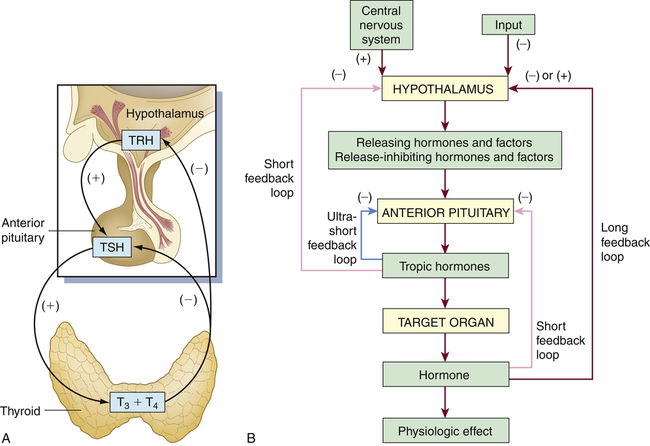
Using Diagram B above, we can define:
- Long-loop negative feedback: The final hormone produced by the target gland (e.g., the ovaries) travels all the way back to the brain to inhibit the hypothalamus and the pituitary gland. This is the most important type of feedback for overall regulation.
- Short-loop negative feedback: The hormone from the pituitary gland travels a short distance back to inhibit the hypothalamus.
- Ultra-short-loop negative feedback: A hormone from the hypothalamus or pituitary acts on its own cells to inhibit its own secretion.
For a dynamic video explanation of negative feedback using the thyroid axis as an example, please watch the following clip.
Principles of Endocrine Physiology
The video 'Principles of Endocrine Physiology' by Dr. Matt & Dr. Mike provides a very clear and concise summary of negative feedback.
Watch the segment from 00:16:53 to 00:17:58. The presenters use a whiteboard to illustrate how rising T3/T4 hormones from the thyroid gland turn off the stimulating signals from the hypothalamus and pituitary.
3. Positive Feedback: The Amplifier
Positive feedback is much rarer in the body. Instead of promoting stability, it creates an explosive, self-amplifying cascade. In this loop, the product of a pathway stimulates an earlier step, causing the process to accelerate until an external event stops it.
Because it is inherently destabilizing, positive feedback is reserved for specific, time-limited events that must be driven to completion. The classic example is childbirth.
Principles of Endocrine Physiology
The same video from Dr. Matt & Dr. Mike also explains positive feedback using the classic example of oxytocin during childbirth.
Now watch from 00:17:58 to 00:18:56. Notice how the baby's head stretching the cervix triggers oxytocin release, which causes stronger contractions, which leads to more stretching, and thus more oxytocin. The loop is only broken when the baby is delivered, removing the initial stimulus.
4. Feedback in Action: Regulating the Menstrual Cycle
The normal menstrual cycle is a masterful display of both negative and positive feedback loops working in perfect harmony, orchestrated by the Hypothalamic-Pituitary-Ovarian (HPO) axis. Understanding this is critical, as its disruption is at the heart of PCOS.
The following video from Khan Academy Medicine provides an excellent walkthrough of how these feedback mechanisms drive the cycle.
Physiological concept of positive and negative feedback | Behavior | MCAT | Khan Academy
The video 'Physiological concept of positive and negative feedback' explains how estrogen and progesterone regulate the HPO axis during the menstrual cycle. This is a perfect introduction to the specific feedback loops we need to understand for this course.
Please watch the entire video (00:00:02 - 00:06:31). Pay close attention to the dual role of estrogen: how low levels create one effect, while high levels create the opposite effect (the positive feedback switch). Also, note the clear inhibitory role of progesterone.
Let's summarize and solidify what you saw in the video.
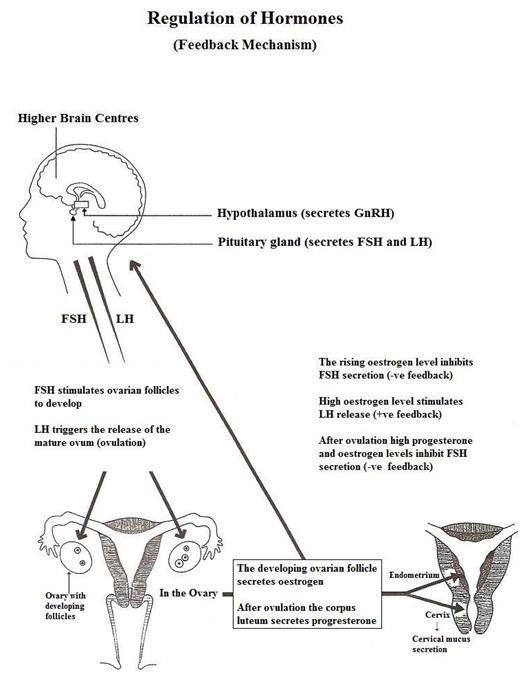
As the diagram and video illustrate:
-
Negative Feedback (Dominant throughout most of the cycle):
- In the first part of the cycle (follicular phase), rising estrogen levels from the developing follicle exert negative feedback on the pituitary to suppress FSH. This helps ensure only one dominant follicle continues to grow.
- In the second part of the cycle (luteal phase), after ovulation, the corpus luteum produces high levels of progesterone (and estrogen). Progesterone exerts powerful negative feedback on both the hypothalamus and pituitary, strongly suppressing GnRH, LH, and FSH. This prevents another ovulation from occurring within the same cycle.
-
Positive Feedback (The pre-ovulatory switch):
- Just before ovulation, the mature follicle produces a very large amount of estrogen. Once estrogen levels surpass a certain high threshold and are sustained for about 2-3 days, the system flips. Estrogen's effect on the hypothalamus and pituitary switches from inhibitory to stimulatory.
- This initiates a positive feedback loop: high estrogen stimulates the pituitary to release a massive amount of LH (the "LH surge"). This LH surge is the direct trigger for the follicle to rupture and release the egg (ovulation). This is the only time in the cycle that positive feedback occurs.
Test your understanding!
A patient is given a drug that blocks progesterone receptors throughout her body during the luteal phase. What would you expect to happen to her LH and FSH levels, and why?
Show answer
Blocking progesterone receptors would prevent the powerful negative feedback signal from the corpus luteum from reaching the hypothalamus and pituitary. The brain would no longer be inhibited. As a result, GnRH secretion would increase, leading to a rise in both LH and FSH levels, even though it is the luteal phase. This demonstrates the critical role of progesterone in maintaining suppression of the HPO axis after ovulation.
5. When Feedback Fails: A Prelude to PCOS
The precise, rhythmic switching between negative and positive feedback is what drives a normal ovulatory cycle. A core problem in PCOS is that this regulatory system is disrupted. The "conversation" between the ovaries and the brain becomes dysfunctional.
To connect this to your ultimate goal, let's look at how these feedback loops are altered in PCOS.
Hypothalamic–pituitary–gonadal axis
The Wikipedia article on the 'Hypothalamic–pituitary–gonadal axis' contains a section that directly addresses how feedback disruption contributes to PCOS. This provides a glimpse into the pathophysiology we will cover in later modules.
Please read the short section titled 'Disruptions in the HPO axis'. Focus on understanding the key concept: in PCOS, the GnRH pulse generator in the hypothalamus becomes less sensitive to the normal inhibitory (negative feedback) effects of estrogen and progesterone. We will explore the consequences of this in detail later.
This impaired negative feedback is a crucial piece of the puzzle. It leads to the hypothalamus sending out GnRH pulses too frequently, which in turn causes the pituitary to secrete too much LH relative to FSH. This hormonal imbalance is a hallmark of PCOS and a primary driver of both androgen excess and failed ovulation, topics we will explore in depth later in the course.
Conclusion
In this lesson, we have demystified the body's primary hormonal control systems. These feedback loops are not just abstract concepts but are the active, dynamic processes that govern our physiology every second.
Key Takeaways:
- Negative feedback is the body's primary tool for maintaining homeostasis. The end-product of a pathway inhibits its own production, ensuring stability.
- Positive feedback is a less common mechanism used to amplify a signal and drive a process to completion, such as ovulation or childbirth.
- The normal menstrual cycle is orchestrated by a sophisticated interplay between negative feedback (from moderate estrogen and high progesterone) and a brief, critical period of positive feedback (from very high estrogen) that triggers the LH surge.
- A fundamental defect in PCOS is the disruption of these feedback loops, particularly a reduced sensitivity to the negative feedback of ovarian hormones.
Preview of the Next Lesson:
Now that we understand how these feedback loops are supposed to work, how do clinicians assess their function? In our next lesson, we will explore the principles of endocrine testing. You will learn how stimulation tests and suppression tests are cleverly designed to probe the integrity of these very positive and negative feedback mechanisms, allowing us to diagnose endocrine disorders.