Hello! Welcome back to the final lesson in our first module on the fundamentals of the endocrine system.
In our last session, we explored the elegant principles of negative and positive feedback loops, which act as the master regulators of hormone secretion. We saw how negative feedback maintains stability and how a brief, powerful switch to positive feedback can trigger major events like ovulation. You learned that a disruption in these feedback mechanisms is a core aspect of PCOS.
Today, we will build directly on that knowledge to address the learning outcome: Explain the principles of endocrine testing, including basal levels, stimulation tests, and suppression tests. We will investigate how clinicians can intelligently probe the endocrine system to assess its function. These tests are not just lab values; they are dynamic experiments designed to reveal whether the feedback loops we just discussed are working correctly. Understanding these principles is the final step before we begin our deep dive into the specific anatomy and physiology of the female reproductive system.
1. Basal Hormone Levels: The Starting Point
The simplest way to assess an endocrine gland is to measure the concentration of its hormone in the blood, urine, or saliva in a resting state. This is known as a basal level measurement.
However, as we've learned, many hormones are not secreted at a constant rate. Their release can be:
- Pulsatile: Released in short bursts.
- Diurnal: Following a 24-hour rhythm (e.g., cortisol is highest in the morning and lowest around midnight).
Because of this variability, a single random blood test can be misleading. A normal value might be caught during a trough, and a high value during a pulse. To address this, clinicians use several strategies for basal testing.
Endocrine Testing Protocols: Hypothalamic Pituitary Adrenal ...
The following text, from a chapter on endocrine testing protocols, provides an excellent overview of non-stimulated (basal) hormone measurements and their limitations. It will introduce you to the different methods used to get a more accurate picture of hormone levels.
Please read the section titled 'NONSTIMULATED HORMONE MEASUREMENTS'. As you read, focus on: Why a single 'static' measurement of cortisol or ACTH is often insufficient. The different types of samples used for basal cortisol measurement: serum, 24-hour urinary free cortisol (UFC), and late-night salivary cortisol (LNSC). The rationale for choosing each type of sample (e.g., why UFC and LNSC help overcome the problem of pulsatile secretion).
As you've just read, while a simple blood test (like a morning cortisol level) can be a useful first screening step, it's often just the beginning of the diagnostic journey. When basal levels are abnormal or inconclusive, or when we need to understand how the system responds under pressure, we turn to dynamic testing.
2. Dynamic Testing: Probing the Feedback Loops
Dynamic tests are designed to actively challenge an endocrine axis and observe its response. They are a direct, practical application of the feedback principles we discussed in the last lesson. There are two main categories: suppression tests and stimulation tests.

Let's explore each of these in detail.
3. Suppression Tests: Testing Negative Feedback
A suppression test is used to determine if a hormone is being produced autonomously (i.e., without proper regulation). It directly challenges the integrity of a negative feedback loop.
Principle:
- Administer a synthetic hormone (or a substance that acts like one).
- This substance should trigger the negative feedback loop and suppress the body's natural production of that hormone.
- Measure the hormone levels after administration.
Interpretation:
- Normal Response: Hormone levels are suppressed. This indicates the negative feedback mechanism is intact.
- Abnormal Response: Hormone levels fail to suppress. This suggests that the gland is overproducing the hormone autonomously, ignoring the negative feedback signals. This is often caused by a hormone-secreting tumor.
Example: The Dexamethasone Suppression Test (DST)
The classic example is the DST, used in the diagnosis of Cushing's syndrome (a condition of excess cortisol). Dexamethasone is a powerful synthetic glucocorticoid that mimics cortisol.
To see how this test works in practice, watch this clear, animated explanation.
Dexamethasone Suppression Test - EXPLAINED CLEARLY!
The video 'Dexamethasone Suppression Test - EXPLAINED CLEARLY!' from AJmonics breaks down this key suppression test. It will help you visualize how the test differentiates a normal response from an abnormal one.
Please watch the video from the beginning to 03:54. Pay close attention to: The normal HPA axis feedback loop. The purpose of the low-dose test: to confirm the diagnosis of Cushing's syndrome (failure to suppress). The purpose of the high-dose test: to help locate the source of the excess hormone (pituitary vs. ectopic source).
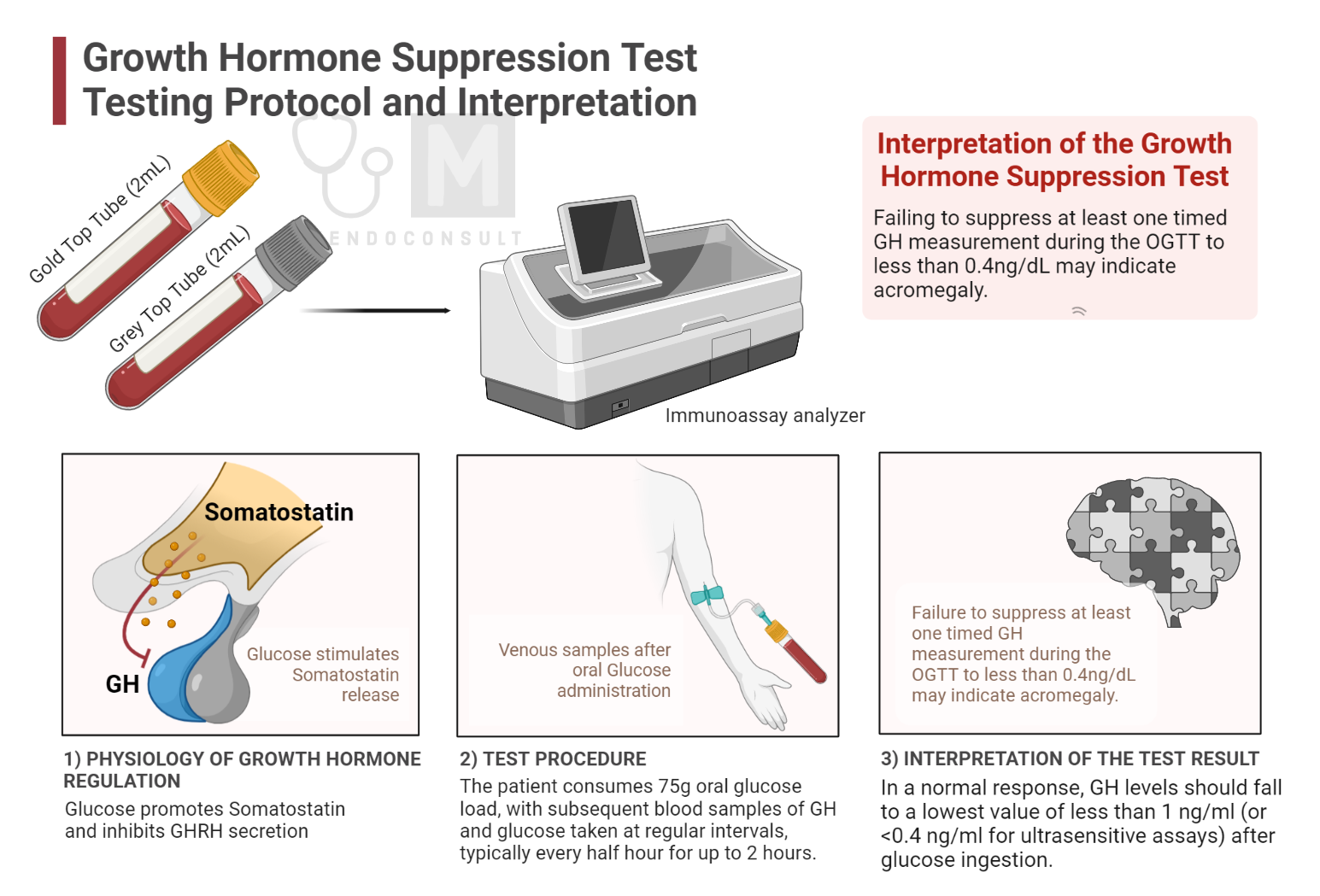
Another Example: Growth Hormone (GH) Suppression Test
This test is used to diagnose acromegaly (a condition of excess GH). In a healthy person, a high blood glucose load stimulates the hypothalamus to inhibit GH release. In acromegaly, a GH-secreting pituitary tumor continues to produce GH despite high glucose.
4. Stimulation Tests: Testing Glandular Reserve
A stimulation test is used to assess if a gland is capable of producing its hormone when prompted. It directly challenges the secretory reserve of the target gland.
Principle:
- Administer a tropic hormone (or a synthetic version) that normally stimulates a target gland.
- This substance should provoke the gland to produce and release its hormone.
- Measure the target hormone levels after administration.
Interpretation:
- Normal Response: The target hormone level rises appropriately. This indicates the gland has adequate functional reserve.
- Abnormal Response: The target hormone fails to rise. This suggests the gland itself is damaged or dysfunctional (primary insufficiency).
Example: The ACTH Stimulation Test (Synacthen Test)
This is the gold standard test for diagnosing adrenal insufficiency (Addison's disease), a condition where the adrenal glands don't produce enough cortisol.
The following guide provides a detailed protocol for this and other dynamic tests. We'll focus on the ACTH stimulation test, which has direct relevance to the diagnostic workup of PCOS.
Practical Guide to Endocrine Dynamic Tests
The 'Practical Guide to Endocrine Dynamic Tests' provides detailed, real-world protocols. We will examine the Short Synacthen® Test (SST), also known as the ACTH stimulation test.
Please read section '2. Short Synacthen® Test (SST)' (pages 10-14). Focus on understanding: The indication for the standard dose test (diagnosing adrenal insufficiency). The method: a baseline cortisol level is taken, synthetic ACTH (Synacthen®) is injected, and cortisol is measured again at 30 and 60 minutes. The interpretation: a normal response is a significant rise in cortisol (e.g., to ≥500 nmol/L), while a flat response indicates adrenal failure. Crucially for this course, note the specific indication for congenital adrenal hyperplasia (CAH) on page 13. This is a key differential diagnosis for PCOS. Here, instead of cortisol, the hormone 17-hydroxyprogesterone (17-OHP) is measured. An exaggerated 17-OHP response points to CAH.
The application of the ACTH stimulation test for diagnosing non-classical CAH is a perfect example of how these tests are used to distinguish between conditions that look similar clinically. Both PCOS and CAH can present with high androgen levels and menstrual problems, but the underlying cause is different, and this stimulation test helps uncover it.
Test your understanding!
A patient presents with clinical signs of excess cortisol (weight gain, high blood pressure). A single morning blood test shows a high cortisol level. To confirm a diagnosis of Cushing's syndrome, which type of dynamic test would you perform next, and what result would you expect?
Show answer
The next logical test would be a suppression test, specifically the low-dose dexamethasone suppression test. The goal is to see if the high cortisol production can be shut down by negative feedback. In Cushing's syndrome, you would expect an abnormal result: the patient's cortisol level would remain high despite the administration of dexamethasone, confirming autonomous cortisol production.
Conclusion
Today, we've transitioned from the theory of feedback loops to their practical application in clinical diagnostics. You've learned that evaluating the endocrine system is often more complex than a single blood draw and requires clever tests that challenge the system's regulatory circuits.
Key Takeaways:
- Basal Levels are baseline hormone measurements that can be useful for screening but are often limited by the pulsatile and diurnal nature of hormone secretion.
- Suppression Tests assess the integrity of negative feedback loops. They are used to diagnose conditions of hormone excess, like Cushing's syndrome, by checking if production can be shut down.
- Stimulation Tests assess the functional reserve of a gland. They are used to diagnose conditions of hormone deficiency, like adrenal insufficiency, by checking if a gland can produce its hormone when prompted.
- These tests are crucial for differential diagnosis, such as using the ACTH stimulation test to distinguish between PCOS and congenital adrenal hyperplasia (CAH).
Preview of the Next Module:
With this foundational module now complete, you have a solid understanding of hormone chemistry, action, regulation, and testing. You are now fully equipped to tackle the specific systems involved in PCOS. In our next lesson, we will begin Module 2: "Female Reproductive Anatomy and Physiology." We will start by exploring the anatomical structure and cellular organization of the ovary, the primary site of the hormonal dysfunction seen in PCOS.