Hello! Welcome to the fifth lesson in our module on insulin and glucose metabolism.
Introduction
In our previous lesson, we unraveled the molecular basis of insulin resistance, identifying it as a state of cellular "deafness" to insulin's signal, primarily due to post-receptor defects. We concluded with the idea that to overcome this deafness, the pancreas must "shout" louder.
Today, we will explore this "shouting" in detail. This lesson is dedicated to our learning outcome: Explain the concept of compensatory hyperinsulinemia in the context of insulin resistance. We will examine what happens when the pancreas ramps up insulin production to overcome resistance, a critical step that bridges cellular dysfunction to the systemic problems seen in PCOS.
1. The Compensation: More Insulin for the Same Job
Let's begin by visualizing the core problem. In an insulin-sensitive state, a small amount of insulin is sufficient to manage blood glucose. In an insulin-resistant state, the target tissues are less responsive, so the pancreas must produce significantly more insulin to achieve the same effect.
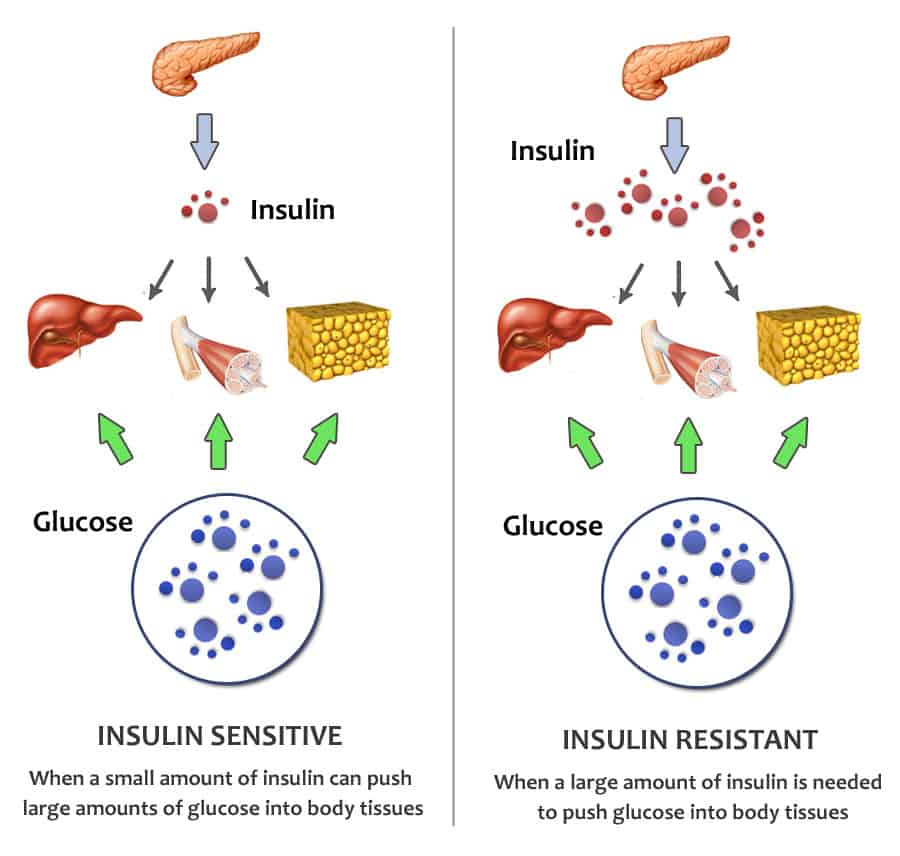
This increased secretion of insulin to counteract resistance is known as compensatory hyperinsulinemia.
- Hyperinsulinemia: A higher-than-normal level of insulin in the blood.
- Compensatory: It occurs to compensate for the reduced effectiveness of insulin at the cellular level.
To understand this better, let's watch a short video that defines insulin resistance and immediately introduces the compensatory response.
Hyperinsulinemia causes by Benjamin Bikman
In this clip, Dr. Benjamin Bikman provides a concise explanation of how diminished insulin action (resistance) directly leads to the body producing an 'angry mob' of insulin to restore the effect.
Please watch from 04:28 to 06:20. Focus on how insulin resistance and hyperinsulinemia are presented as two sides of the same coin.
This dynamic creates a reciprocal relationship: as insulin sensitivity goes down, insulin secretion must go up. The pancreas works overtime to maintain balance.
Insulin Resistance: Background, Pathophysiology, Etiology
This relationship is a fundamental principle of metabolic regulation. Let's read a short section from a Medscape article that formally describes this interplay.
Please read the first three paragraphs of the 'Pathophysiology' section. Pay close attention to the sentence starting with 'Insulin sensitivity and secretion are reciprocally related...'.
2. The Goal of Compensation: Maintaining Normal Blood Glucose
You might wonder, if someone is severely insulin resistant, shouldn't their blood glucose be very high? Not necessarily, and this is the key to understanding the "compensatory" part of the term.
The body's immediate and highest priority is to maintain euglycemia (normal blood glucose levels). The pancreatic beta cells are so efficient at sensing the need for more insulin that they can successfully overcome the resistance for months, or even years. This leads to a common clinical scenario: a person can have normal fasting glucose levels but dangerously high insulin levels. The compensation is working, but the system is under immense strain.
Let's look at two powerful examples of this.
The Missing Diabetes Blood Test: How and Why to Measure Beta-Cell Function
First, we will watch a segment from a Nourished by Science video that presents the case of 'Jane.' Her bloodwork provides a striking real-world example of how massive hyperinsulinemia can keep blood glucose in the normal range despite extreme insulin resistance.
Please watch from 14:31 to 16:20. Notice how Jane's fasting glucose is normal, but her fasting insulin is extraordinarily high, showing that her beta cells are working overtime to compensate.
Hyperinsulinemia causes by Benjamin Bikman
Next, let's return to Dr. Bikman's lecture. He presents data from a human study demonstrating how quickly this compensatory mechanism kicks in.
Please watch from 22:51 to 24:16. The key finding here is that after just one week of overeating carbohydrates, subjects' fasting insulin levels more than doubled, while their fasting glucose remained completely normal. This highlights the body's powerful drive to maintain euglycemia through hyperinsulinemia.
These examples show that measuring only blood glucose can be misleading. The high insulin level is the hidden sign of the underlying metabolic problem.
3. The Vicious Cycle: Hyperinsulinemia Worsens Insulin Resistance
So far, we've seen hyperinsulinemia as a consequence of insulin resistance. However, a crucial and damaging aspect of this condition is that hyperinsulinemia also becomes a cause of further insulin resistance. This creates a vicious cycle.
This phenomenon is based on a fundamental biological principle: when a cell is chronically overstimulated by a signal (in this case, insulin), it protects itself by becoming less sensitive to that signal. The constant bombardment of high insulin levels causes the target cells to downregulate their response, making them even more insulin resistant.
Hyperinsulinemia causes by Benjamin Bikman
Dr. Bikman explains this vicious cycle clearly, describing hyperinsulinemia as both a cause and a consequence of insulin resistance.
Please watch from 11:55 to 13:13. Focus on his concept of 'making the circle complete' and how the body attempts to resist a stimulus that is present in excess.
This cycle is the engine that drives the progression of metabolic disease. A state of mild insulin resistance, if met with factors that promote high insulin levels (like a diet high in refined carbohydrates), can spiral into severe resistance.
Hyperinsulinemia: A unifying theory of chronic disease?
For a more detailed look at this mechanism, let's read from a review article on hyperinsulinemia. It describes how persistent high glucose and insulin levels can deplete insulin receptors and turn a temporary state of resistance into a chronic one.
Please read the section titled 'Etiology,' specifically points 5 through 8. This section outlines the positive feedback cycle where hyperinsulinemia aggravates and prolongs insulin resistance.
Test your understanding!
A patient has moderate insulin resistance but follows a diet that keeps their insulin levels relatively low (e.g., a low-carbohydrate diet). Another patient with similar baseline insulin resistance follows a diet high in sugar and refined starches, which keeps their insulin levels chronically high.
Based on the concept of the vicious cycle, how would you expect their insulin sensitivity to change over the next year?
Show answer
The first patient, by avoiding chronic hyperinsulinemia, is less likely to fuel the vicious cycle. Their insulin resistance might stay the same or even improve.
The second patient, however, is constantly "stoking the fire." The chronic hyperinsulinemia caused by their diet will likely make their cells even more resistant over time, worsening their overall metabolic health, even if their blood sugar remains normal for a while.
4. Hyperinsulinemia: The Problem Itself
While compensatory hyperinsulinemia is a brilliant short-term fix to manage blood sugar, chronic hyperinsulinemia is far from benign. It has its own widespread, detrimental effects on the body, independent of blood glucose levels. In the context of PCOS, this chronically high insulin is a primary driver of ovarian androgen production, which we will explore in great detail in a future module.
For now, it's crucial to understand that even if blood glucose is normal, the high insulin level itself is a major pathological factor.
The Missing Diabetes Blood Test: How and Why to Measure Beta-Cell Function
The narrator of the Nourished by Science video makes this point explicitly, stating that chronically elevated insulin levels are a risk factor for many chronic diseases, even if someone does not have diabetes.
Please watch from 20:54 to 22:29. The main takeaway is that hyperinsulinemia is not just a marker of insulin resistance; it is an independent risk factor for disease.
Conclusion
Today we have bridged the gap between a cell being "deaf" to insulin and the systemic hormonal consequences. We established that the pancreas compensates for insulin resistance by secreting excess insulin, a state known as compensatory hyperinsulinemia.
Key Takeaways:
- Compensatory hyperinsulinemia is the secretion of high levels of insulin by the pancreas to overcome insulin resistance in target tissues.
- The primary goal of this compensation is to maintain normal blood glucose levels (euglycemia). This is why a person can be severely insulin resistant yet have a normal blood sugar test.
- Hyperinsulinemia is both a consequence and a cause of insulin resistance, creating a vicious cycle that worsens metabolic health over time.
- Chronically high insulin is not a harmless compensatory state; it is a pathological condition in its own right and a major driver of other diseases, including the hormonal imbalances of PCOS.
Preview of the Next Lesson:
We've now established a powerful link: cellular defects lead to resistance, which leads to hyperinsulinemia, which worsens resistance. But what is the role of body fat in this story? Our next lesson will explore the relationship between obesity, the function (and dysfunction) of adipose tissue, and insulin resistance, adding another critical layer to our understanding of PCOS pathophysiology.