Hello! Welcome to the first lesson in our module on the clinical aspects of PCOS.
In our last lesson, we put all the pieces of the puzzle together, synthesizing the complex interplay between hyperandrogenism, insulin resistance, and ovulatory dysfunction into a unified model of PCOS pathophysiology. We established the "why" behind the syndrome.
Today, we transition from the underlying mechanisms to the observable clinical picture. The learning outcome for this lesson is to describe the clinical manifestations of hyperandrogenism in PCOS, including hirsutism, acne, and androgenic alopecia. We will explore how the excess androgens we've been discussing translate into the visible signs that are often the most distressing for patients and serve as critical clues for diagnosis.
From Hormones to Symptoms: The Pilosebaceous Unit
Before diving into the specific signs, let's briefly revisit the link between the pathophysiology and the clinical presentation. In PCOS, there is an increase in biologically active androgens (like testosterone) due to two main factors:
- Increased production by the ovaries (stimulated by LH and insulin).
- Increased bioavailability, as high insulin levels reduce the liver's production of Sex Hormone-Binding Globulin (SHBG), leaving more "free" testosterone to act on tissues.
The primary target for these androgens in the skin is the pilosebaceous unit, which consists of the hair follicle and its associated sebaceous (oil) gland. The different clinical signs of hyperandrogenism are simply different responses of this single anatomical unit to androgen stimulation in various parts of thebody.
This short video provides a quick overview of the symptoms we will be discussing today.
Polycystic Ovary Syndrome (PCOS) | Overview of Associated Conditions, Diagnosis & Treatments
The video 'Polycystic Ovary Syndrome (PCOS) | Overview of Associated Conditions, Diagnosis & Treatments' by JJ Medicine offers a concise summary of the clinical features related to high androgen levels.
Watch the segment from 04:05 to 04:58. This will give you a brief introduction to acne, hirsutism, and alopecia as key signs of hyperandrogenism.
Now, let's examine each of these manifestations in detail. We'll rely on a comprehensive review article that provides excellent explanations.
Deciphering the Role of Androgen in the Dermatologic ...
We will be using the paper 'Deciphering the Role of Androgen in the Dermatologic Manifestations...' as our main guide for this lesson. It clearly explains how androgens affect the skin and details each of the major clinical signs.
First, read the introduction (the first three paragraphs of the article) to understand the significance and psychological impact of these dermatological symptoms. Then, read Section 4, 'Physiological Effect of Androgen on Skin and Phaneres in Women,' to ground your understanding of how androgens exert their effects on hair follicles and sebaceous glands.
1. Hirsutism: Male-Pattern Hair Growth
Hirsutism is often the most specific clinical sign of hyperandrogenism. It is defined as the excessive growth of thick, dark, terminal hairs in a male-pattern distribution on a woman's body.
- Key sites: Upper lip, chin, chest, upper and lower abdomen, back, and inner thighs.
- Mechanism: In these androgen-sensitive areas, excess androgens (particularly the potent androgen dihydrotestosterone, or DHT) stimulate the transformation of fine, short, unpigmented vellus hairs into coarse, long, pigmented terminal hairs.
This is not to be confused with hypertrichosis, which is a generalized increase in hair growth all over the body and is not androgen-dependent. Hirsutism is estimated to affect 65-75% of women with PCOS.
For a detailed explanation of the mechanism and its clinical evaluation, please refer to our main resource.
Deciphering the Role of Androgen in the Dermatologic ...
Let's dive deeper into hirsutism using our reference paper.
Please read Section 6.1, 'Hirsutism.' Pay close attention to: The definition and anatomical sites. The explanation of how androgen excess drives the transition from vellus to terminal hairs. The important concept that the severity of hirsutism may not correlate perfectly with blood androgen levels, highlighting the role of local 'Sensitivity of Hair Follicles to Androgens.'
Assessing Hirsutism
As the reading mentions, the severity of hirsutism doesn't always match the level of androgens in the blood. This is because the hair follicles themselves can have varying sensitivity to androgens, influenced by genetics and local enzyme activity (like 5-alpha reductase, which converts testosterone to the more potent DHT).
Therefore, clinical assessment relies on direct visual scoring. The gold standard is the modified Ferriman-Gallwey (mFG) score. This system grades terminal hair growth in nine androgen-sensitive body areas on a scale of 0 to 4.

A total score is calculated, and a value above a certain threshold (which varies by ethnicity, typically ≥4 to ≥8) is considered indicative of hirsutism. We will discuss the diagnostic use of this score in more detail in a future lesson.
Test your understanding!
A patient presents with significant hirsutism (an mFG score of 12) but her blood tests show normal levels of total and free testosterone. Based on what you've just learned, what are two possible explanations for this discrepancy?
Show answer
- Increased End-Organ Sensitivity: The patient's hair follicles may be genetically more sensitive to normal levels of androgens. This could be due to a higher number of androgen receptors or variations in the genes that control receptor function.
- Increased Local Androgen Metabolism: There may be heightened activity of the enzyme 5-alpha reductase within the pilosebaceous units of her skin. This would convert normal levels of circulating testosterone into the much more potent dihydrotestosterone (DHT) locally, driving hair growth without raising systemic androgen levels significantly.
2. Androgenic Alopecia: Female Pattern Hair Loss (FPHL)
Here we encounter the "androgen paradox." While androgens promote hair growth on the body, in genetically predisposed individuals, they have the opposite effect on the scalp, leading to hair loss.
- Definition: Androgenic alopecia, or Female Pattern Hair Loss (FPHL), is characterized by a non-scarring, diffuse thinning of hair over the central part of the scalp, with the frontal hairline typically being spared. Patients often report that their hair part is becoming wider or that they can see more of their scalp.
- Mechanism: This is not due to hair falling out, but rather to a process called follicular miniaturization. High levels of DHT in the scalp cause hair follicles to shrink. This shortens the anagen (growth) phase of the hair cycle. Over successive cycles, large, pigmented terminal hairs are replaced by smaller, thinner, vellus-like hairs, creating the appearance of thinning.
Let's turn to our resource for a detailed breakdown.
Deciphering the Role of Androgen in the Dermatologic ...
The section on Female Pattern Hair Loss in our reference paper explains this paradoxical effect of androgens very well.
Now, read Section 6.2, 'Female Pattern Hair Loss (FPHL).' Focus on: The description of the paradoxical effect of DHT on the scalp. The concept of follicular miniaturization. The discussion of genetic susceptibility and local factors. The description of clinical patterns (e.g., Ludwig pattern) and evaluation tools.
Assessing Female Pattern Hair Loss
The most common way to classify the severity of FPHL is using the Ludwig Scale, which categorizes the hair loss into three stages of increasing severity.
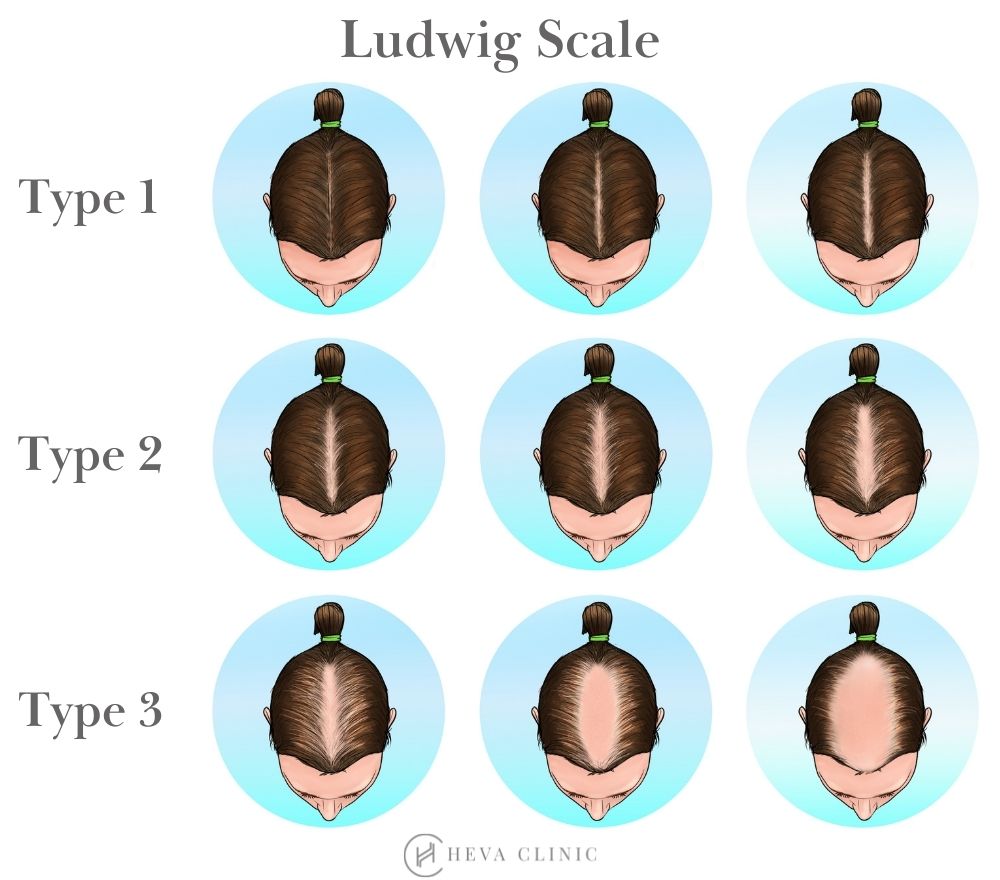
Other patterns exist, such as the "Christmas tree" pattern (wider thinning at the front of the scalp, tapering back) and, in cases of severe hyperandrogenism, a more male-like pattern with bitemporal recession.
3. Acne and Seborrhea
Acne is a very common skin condition, but in the context of PCOS, it often has specific characteristics: it tends to be more inflammatory, persistent beyond the teenage years, located on the lower third of the face (jawline, chin, neck), and may be resistant to standard treatments. It is often accompanied by seborrhea (oily skin).
- Mechanism: The pathogenesis is multifactorial, but androgens are a key driver.
- Excess Sebum Production: Androgens stimulate sebaceous glands to enlarge and produce more sebum.
- Follicular Hyperkeratinization: Androgens also contribute to the abnormal shedding of skin cells lining the hair follicle, causing the follicle to become blocked.
- Bacterial Proliferation & Inflammation: The blocked, sebum-rich follicle creates an ideal environment for the bacterium Cutibacterium acnes to thrive. The bacteria and the breakdown of sebum trigger an inflammatory response from the immune system, leading to papules (red bumps) and pustules (pus-filled bumps).
The following reading explains this process in more detail.
Deciphering the Role of Androgen in the Dermatologic ...
Finally, let's examine acne. Our reference paper outlines the four key factors in acne development and the central role of androgens.
Please read Section 6.3, 'Acne and Seborrhea.' Note the four pivotal factors in acne pathogenesis and how 'Androgen Excess' contributes to them. Also, take note of the prevalence data comparing women with and without PCOS.
Just as with hirsutism and alopecia, the severity of acne does not always correlate with blood androgen levels, again pointing to the importance of local androgen metabolism and receptor sensitivity within the pilosebaceous unit.
Conclusion
Today, we have bridged the gap between pathophysiology and clinical practice by describing the three main cutaneous signs of hyperandrogenism in PCOS. These manifestations are not merely cosmetic; they are direct outward signs of the underlying hormonal imbalance and have a profound impact on a patient's quality of life.
Key Takeaways:
- The clinical manifestations of hyperandrogenism in PCOS—hirsutism, androgenic alopecia, and acne—all stem from the effect of excess androgens on the pilosebaceous unit.
- Hirsutism is the growth of coarse, male-pattern hair, caused by the androgen-driven transformation of vellus to terminal hair follicles.
- Androgenic alopecia (FPHL) is paradoxical scalp hair loss caused by androgen-driven miniaturization of hair follicles in genetically susceptible individuals.
- Acne is driven by androgen-stimulated sebum production and subsequent blockage and inflammation of the pilosebaceous unit.
- The clinical severity of these signs is determined by a combination of systemic androgen levels and local tissue sensitivity.
Preview of the Next Lesson:
Now that we can describe what hirsutism looks like, our next step is to learn how to formally measure and grade it. In the next lesson, we will focus on the practical application of the assessment tool we introduced today, where you will learn to explain the use of the Ferriman-Gallwey score for the clinical assessment of hirsutism. This is a fundamental skill in the diagnosis and management of PCOS.