Hello! Welcome to the final lesson in our module on the pathophysiology of PCOS.
Over the past few lessons, we've dissected the complex machinery of PCOS piece by piece. We've explored:
- Hyperandrogenism, driven by abnormal HPO axis signaling and intrinsic ovarian dysfunction.
- Metabolic dysfunction, centered on selective insulin resistance and the resulting hyperinsulinemia.
- Chronic low-grade inflammation, acting as an accelerator for both insulin resistance and hyperandrogenism.
Today, we will assemble all these components. Our learning outcome is to synthesize the interrelationships between hyperandrogenism, insulin resistance, and ovulatory dysfunction in a unifying model of PCOS. This lesson will tie together everything we've learned about the "why" of PCOS into a single, coherent picture, showing how these elements feed into one another to create the self-perpetuating cycles that define the syndrome.
The Interlocking Pillars of PCOS
At its heart, the pathophysiology of PCOS can be understood as a vicious cycle involving three core components. Think of them as three interlocking pillars that support and reinforce each other.

Let's break down how these pillars are built and how they connect.
The Core Cycle: Hyperandrogenism and Insulin Resistance
A foundational concept in understanding PCOS is that it involves an intrinsic predisposition that is then amplified by metabolic factors. This is sometimes called a "two-hit" model.
1. The First "Hit": Intrinsic Ovarian Hyperandrogenism
As we've discussed, evidence suggests that the ovaries in many women with PCOS have an intrinsic, often genetic, predisposition to overproduce androgens. This is called Functional Ovarian Hyperandrogenism (FOH). The theca cells are inherently more efficient at making androgens and may be hypersensitive to LH stimulation.
2. The Second "Hit": Insulin Resistance and Hyperinsulinemia
This intrinsic tendency is then powerfully amplified by a second "hit": insulin resistance. As you know, when peripheral tissues become resistant to insulin, the pancreas compensates by producing more, leading to hyperinsulinemia.
Crucially, while muscle and fat cells are resistant to insulin's metabolic effects, the ovarian theca cells are not. High levels of insulin act synergistically with LH to dramatically increase androgen production in theca cells.
This creates the first, and perhaps most central, vicious cycle of PCOS:
- Insulin resistance leads to hyperinsulinemia.
- Hyperinsulinemia stimulates theca cells to produce more androgens.
- Excess androgens can then worsen insulin resistance, particularly in fat and muscle tissue, completing the loop.
The following video provides a concise explanation of how insulin drives this process.
Dr. Nadia Pateguana & Dr. Jason Fung - 'Polycystic Ovary Syndrome'
Dr. Jason Fung, in the video 'Polycystic Ovary Syndrome', explains how excess insulin is a key driver for both increased testosterone production and reduced levels of its binding protein, SHBG, which further contributes to hyperandrogenism.
Watch the segment from 20:38 to 23:04. Pay close attention to how Dr. Fung links high insulin levels to two distinct problems: increased testosterone production by the ovary and decreased sex hormone-binding globulin (SHBG) from the liver, both of which increase active androgen levels.
Connecting the Core Cycle to Ovulatory Dysfunction
Now, how does this cycle of hyperandrogenism and insulin resistance lead to the hallmark ovulatory dysfunction of PCOS? There are two main pathways.
1. The Disrupted HPO Axis and LH/FSH Imbalance
Anovulation means no ovulation, which means no corpus luteum formation and, critically, no progesterone production in the second half of the cycle. Progesterone is essential for providing strong negative feedback to the hypothalamus to slow down GnRH pulses.
Without this progesterone-driven feedback:
- The GnRH pulse generator in the hypothalamus runs too fast.
- A fast GnRH pulse frequency preferentially stimulates the pituitary to secrete LH over FSH.
- This results in the characteristic elevated LH:FSH ratio seen in PCOS.
This hormonal imbalance wreaks havoc on the ovary:
- High LH further stimulates the already hyper-responsive theca cells to produce even more androgens.
- Relatively low FSH means there isn't a strong enough signal to drive a dominant follicle to full maturity and trigger ovulation.
This creates a second vicious cycle: Anovulation → No Progesterone → Fast GnRH Pulses → High LH/FSH Ratio → More Androgens & Follicular Arrest → Anovulation.
This video explains this neuroendocrine loop very clearly.
Polycystic Ovarian Syndrome (PCOS) - Pathophysiology, Symptoms, Treatment
The video 'Polycystic Ovarian Syndrome (PCOS) - Pathophysiology, Symptoms, Treatment' from the PhysioPathoPharmaco channel provides an excellent animation of this feedback loop.
Watch from 01:06 to 03:14. Notice how the lack of progesterone leads to faster GnRH pulses, creating the LH/FSH imbalance. See how this imbalance both drives androgen production and prevents follicles from maturing, thus perpetuating the anovulatory state.
2. Follicular Arrest and High AMH
The high-androgen, low-FSH environment within the ovary leads to follicular arrest. Many follicles begin to grow but stall at the small antral stage, unable to achieve dominance. This results in the "polycystic" appearance of the ovaries on ultrasound.
This crowd of arrested follicles produces excessive amounts of Anti-Müllerian Hormone (AMH). As we've learned, high AMH further contributes to anovulation by:
- Inhibiting the selection of a dominant follicle.
- Decreasing the sensitivity of the remaining follicles to FSH.
Dr. Fung also provides a clear explanation for how hyperinsulinemia directly contributes to this follicular arrest.
Dr. Nadia Pateguana & Dr. Jason Fung - 'Polycystic Ovary Syndrome'
Let's return to Dr. Fung's talk. Here, he explains how high insulin levels cause 'follicular arrest', leading to the formation of cysts and preventing ovulation.
Please watch from 23:04 to 25:24. Focus on the concept that high insulin makes follicles overly sensitive to hormones, causing them to stall in development before they are large enough to ovulate.
Test your understanding!
A young woman with lean PCOS (not overweight) has a genetically-driven, intrinsic overproduction of androgens from her theca cells. Explain, step-by-step, how this single issue could lead to anovulation and a high LH level, even without significant baseline insulin resistance.
Show answer
- Initial Hyperandrogenism: The intrinsic problem causes elevated androgen levels.
- Follicular Disruption: The high-androgen environment in the ovary disrupts normal follicular development, leading to follicular arrest and anovulation.
- Loss of Progesterone Feedback: Because she is not ovulating, she does not form a corpus luteum and does not produce progesterone in the luteal phase.
- HPO Axis Disruption: The absence of progesterone's negative feedback causes the GnRH pulse generator in the hypothalamus to speed up.
- Elevated LH: The faster GnRH pulses preferentially stimulate the pituitary to release LH over FSH, resulting in a high LH level and an elevated LH:FSH ratio. This high LH then feeds back to the ovary, stimulating even more androgen production and perpetuating the cycle.
The Unifying Model: A Complete Picture
We have now traced the major feedback loops. The final step is to combine them into a single, unified model. The complexity of PCOS means that different factors can be the primary driver in different individuals, which helps explain the varied clinical presentations (phenotypes) of the syndrome.
This diagram provides a simplified but powerful overview of the multifactorial nature of PCOS.
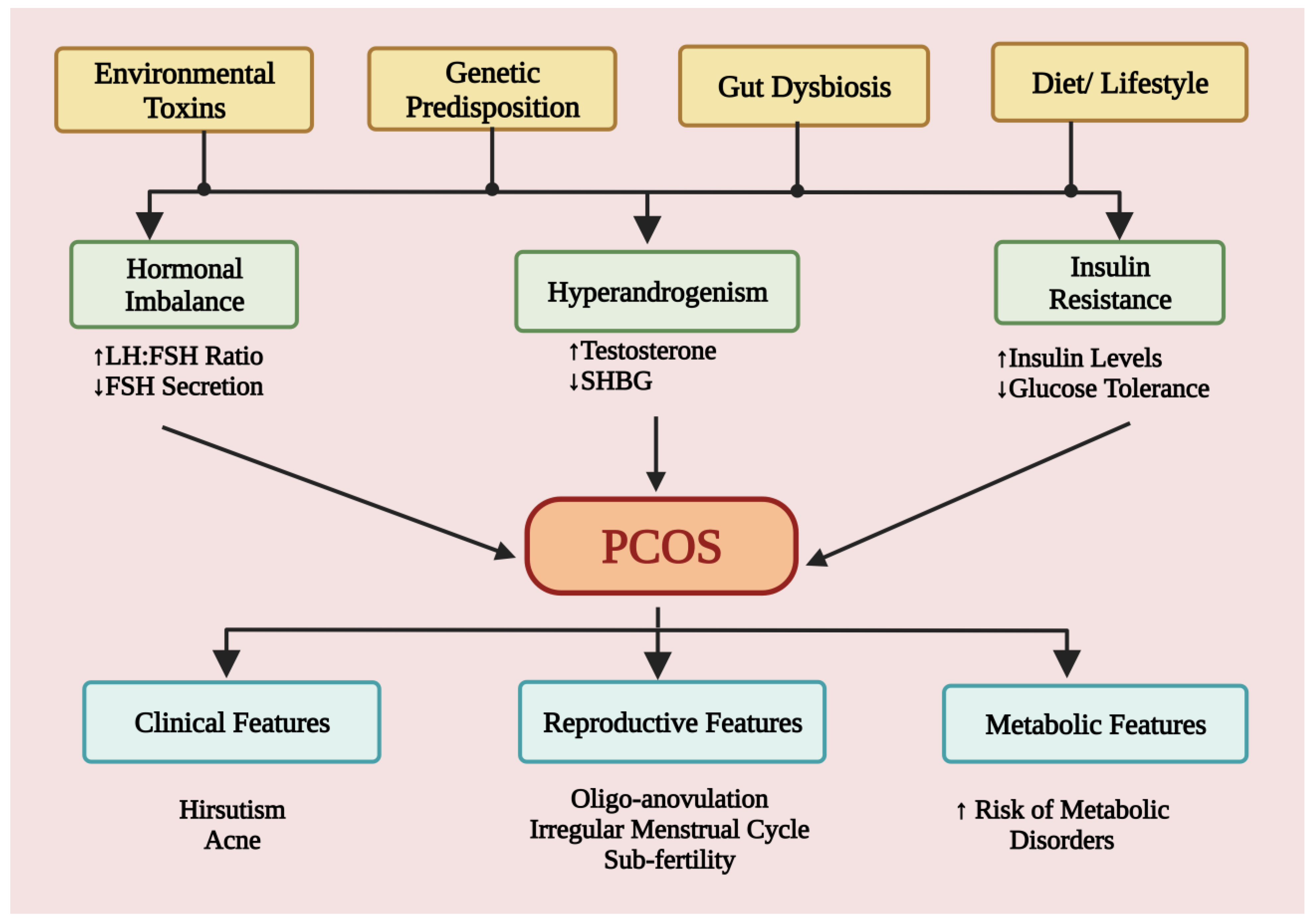
For a truly deep synthesis, we can turn to a comprehensive "wiring diagram" that illustrates the numerous connections we've studied throughout this course.
A review of the hormones involved in the endocrine ...
The paper 'A review of the hormones involved in the endocrine ...' presents a detailed 'unifying diagram' that visualizes almost all the pathophysiological connections in PCOS. This is the synthesis we have been working towards.
Carefully study 'Figure 15: Unifying diagram...' in Section 4. Do not try to memorize it. Instead, use it to trace the key pathways we've discussed today: Find 'Insulin resistance' and trace its path through 'Hyperinsulinemia' to the 'Theca Cell' to see how it drives 'Testosterone' production. Find 'Testosterone' and see its arrow pointing back towards 'Adipose Tissue', which connects to insulin resistance, closing that loop. Find the 'Hypothalamus' and note the impaired negative feedback from progesterone (represented by the 'X' over the arrow). Trace this to the increased 'LH' release from the pituitary. Follow the 'LH' arrow to the 'Theca Cell', showing how it drives androgen production. Then, read the brief '5. Discussion and conclusions' to understand the clinical implications of this interconnected model.
By studying that diagram, you can see how a problem starting in one area—be it the hypothalamus, the theca cell, or adipose tissue—can cascade through the entire system, creating the complex web of dysfunction that is PCOS.
Conclusion
Today we have synthesized the core components of PCOS pathophysiology into a unified model. We have moved beyond looking at individual hormones or processes and can now see the bigger picture of how they interact in a self-perpetuating system.
Key Takeaways:
- PCOS is driven by a web of interconnected feedback loops, not a single linear cause.
- The three central, mutually reinforcing pillars of PCOS are hyperandrogenism, insulin resistance, and ovulatory dysfunction.
- A core vicious cycle exists where insulin resistance and hyperandrogenism amplify each other.
- A second key cycle involves anovulation, which disrupts HPO axis feedback, leading to an elevated LH:FSH ratio that further drives androgen production and prevents ovulation.
- Factors like genetics, obesity, and inflammation can act as triggers or amplifiers within this system, explaining the different phenotypes of PCOS.
Preview of the Next Lesson:
Having established a deep understanding of the pathophysiology—the why of PCOS—we are now perfectly positioned to move into the next module. In our next lesson, we will begin to explore the clinical side, starting with the clinical manifestations of hyperandrogenism in PCOS, including hirsutism, acne, and androgenic alopecia. We will see how the hormonal imbalances we've just studied translate into the signs and symptoms observed in patients.