Hello! Welcome to our next lesson.
In our previous session, we delved into the specific molecular reasons for insulin resistance in PCOS, focusing on the concept of selective insulin resistance. We saw how a post-receptor defect (serine phosphorylation) impairs insulin's metabolic actions while leaving its hormone-producing effects in the ovary intact. This established a vicious cycle between hyperinsulinemia and hyperandrogenism.
Today, we will introduce the third major player in PCOS pathophysiology. Our learning outcome is to describe the role of chronic low-grade inflammation in the pathogenesis of PCOS. Evidence now strongly suggests that PCOS is not just an endocrine or metabolic disorder, but also an inflammatory one. We will explore what this inflammation is, where it comes from, and most importantly, how it interacts with and worsens both insulin resistance and hyperandrogenism, tightening the vicious cycle that drives the syndrome.
PCOS as an Inflammatory State
Historically, inflammation was associated with acute conditions like infection or injury, marked by redness, heat, and swelling. However, we now understand that a different kind of inflammation—a persistent, low-level, and systemic state—is a key driver of many chronic diseases, including PCOS. This is often called Systemic Low-Grade Chronic Inflammation (SLCI).
In women with PCOS, there is clear evidence of this inflammatory state. This isn't based on symptoms, but on measurable biomarkers in the blood and tissues.
To get a foundational understanding of SLCI and the evidence for its presence in PCOS, let's start with a recent review article.
Systematic low-grade chronic inflammation and intrinsic ...
The review 'Systematic low-grade chronic inflammation and intrinsic ...' provides an excellent overview of this topic. We'll begin by establishing the concept of SLCI and seeing the evidence for it in PCOS.
Please read the '1. Introduction' section, focusing on how SLCI is introduced as a pivotal player. Then, read the first paragraph of section '2. SLCI in PCOS' and review 'Table 1'. Pay attention to the types of immune cells (lymphocytes, macrophages) and inflammatory markers (hs-CRP, TNF-α, IL-6) that are elevated. You don't need to memorize the whole table, just recognize the key players.
As you've just read, women with PCOS consistently show higher levels of:
- Pro-inflammatory cytokines: These are signaling molecules that promote inflammation. Key examples include Tumor Necrosis Factor-alpha (TNF-α), Interleukin-6 (IL-6), and Interleukin-18 (IL-18).
- C-reactive protein (CRP): This is a protein produced by the liver in response to inflammation. A specific, highly sensitive test (hs-CRP) is often used to detect low-grade inflammation.
- Immune cells: Increased numbers of activated immune cells like monocytes, macrophages, and lymphocytes are found circulating in the blood and within tissues like the ovary and fat.
Now that we have established that inflammation is present, the next logical questions are: Where is it coming from, and what is it doing?
The Sources of Chronic Inflammation in PCOS
The inflammatory state in PCOS isn't caused by a single factor but is fueled by several interconnected elements of the syndrome.
1. Adipose Tissue Dysfunction
Visceral fat—the fat stored around your internal organs—is a major source of inflammation, especially when it becomes excessive (obesity). Unlike subcutaneous fat, visceral fat is more metabolically active and, when dysfunctional, becomes a factory for pro-inflammatory cytokines.
Here's how it happens:
- As fat cells (adipocytes) enlarge (hypertrophy), they can outgrow their blood supply, leading to a state of low oxygen called hypoxia.
- Stressed and dying adipocytes send out distress signals that recruit immune cells, particularly macrophages.
- These macrophages surround the dying fat cells and begin releasing a constant stream of pro-inflammatory cytokines like TNF-α and IL-6 into the circulation, creating the state of SLCI.
This process is a primary link between obesity, insulin resistance, and inflammation. The article "The role of immunity in insulin resistance in patients with..." provides a great, detailed explanation of this macrophage-driven inflammation.
The role of immunity in insulin resistance in patients with ...
Let's explore the role of immune cells, especially macrophages in adipose tissue, in generating this inflammation and linking it to insulin resistance.
Please read the section '2.1 Macrophage immune regulation in IR'. Focus on the description of how adipocyte growth leads to macrophage accumulation and the release of pro-inflammatory cytokines like TNF-α. This explains how fat tissue becomes a source of inflammation.
2. Gut Microbiome Imbalance (Dysbiosis)
A fascinating and relatively new area of research points to the gut as another major source of inflammation in PCOS. The theory, known as the Dysbiosis of Gut Microbiota (DOGMA), proposes the following:
- An unhealthy diet or other factors (like hyperandrogenism) can alter the balance of bacteria in the gut, reducing beneficial species and promoting harmful ones.
- This imbalance can damage the intestinal barrier, making it more permeable (a condition often called "leaky gut").
- With a leaky barrier, bacterial components, most notably Lipopolysaccharide (LPS), can pass from the gut into the bloodstream.
- LPS is a potent trigger for the immune system, activating inflammatory pathways throughout the body and contributing significantly to SLCI.
3. Hyperandrogenism
This brings us to another vicious cycle. Not only does inflammation contribute to hyperandrogenism (as we'll see shortly), but androgens themselves are pro-inflammatory. Excess androgens can directly stimulate immune cells to produce inflammatory cytokines, thus fueling the fire.
Let's quickly go back to our first resource to see how these different sources fit together.
Systematic low-grade chronic inflammation and intrinsic ...
This section of the review article neatly summarizes the key drivers of SLCI that we've just discussed.
Please read the introductions to sections '3. Intrinsic mechanisms affecting SLCI in PCOS', '3.1. Obesity and IR in PCOS', '3.2.1. Androgen', and '3.3. Intestinal microecological imbalance in PCOS'. This will consolidate your understanding of where the inflammation originates.
This diagram provides a great visual summary of the drivers and consequences of SLCI in PCOS.
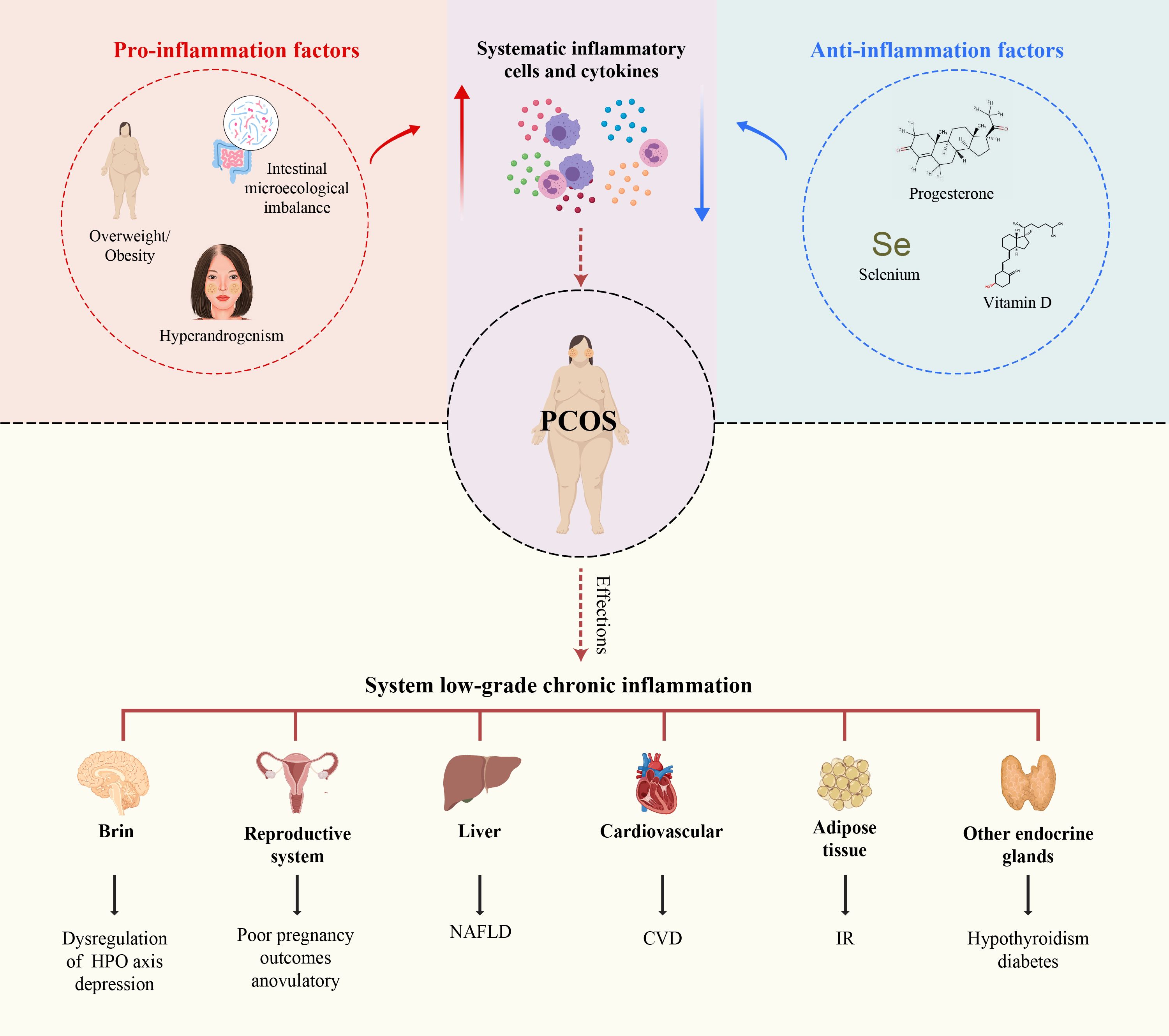
How Inflammation Drives PCOS Pathophysiology
Now we connect the dots. How does this chronic inflammatory state contribute to the core features of PCOS?
Worsening Insulin Resistance
Inflammatory cytokines like TNF-α and IL-6 are major culprits in causing and worsening insulin resistance. They interfere directly with the insulin signaling pathway you learned about in the last lesson.
Specifically, TNF-α promotes the activity of serine kinases, the very enzymes that cause the problematic serine phosphorylation of the insulin receptor and IRS-1. This action directly blocks the metabolic (PI3K) pathway, making muscle and fat cells resistant to insulin's signal to take up glucose.
So, inflammation originating from fat tissue or the gut circles back to make insulin resistance in that same fat tissue even worse.
Driving Ovarian Dysfunction
The ovary itself is not immune to this inflammatory environment. In fact, it is a key target.
Systematic low-grade chronic inflammation and intrinsic ...
Let's examine how inflammation specifically damages ovarian function.
Please read section '2.1.1. Ovary'. Focus on how pro-inflammatory cytokines like TNF-α and IL-6 affect granulosa cells and androgen production. This is the direct link between inflammation and the reproductive features of PCOS.
As the text explains, within the ovary, pro-inflammatory cytokines:
- Induce Granulosa Cell Apoptosis: They can cause premature death of the granulosa cells that are essential for nurturing the developing egg. This contributes to follicular arrest and atresia (the breakdown of follicles).
- Inhibit Aromatase: They suppress the activity of the aromatase enzyme in granulosa cells. Since aromatase converts androgens into estrogens, inhibiting it leads to a buildup of androgens within the follicle, contributing to hyperandrogenism.
- Stimulate Theca Cells: Cytokines, along with insulin and LH, can synergistically stimulate theca cells to produce even more androgens.
This image shows how the inflammatory environment from fat, blood, and the ovary itself converges to disrupt normal follicle development.

Test your understanding!
A researcher observes that women with PCOS and high levels of the inflammatory marker TNF-α have more severe insulin resistance and higher androgen levels.
Based on what you've learned, explain the two distinct mechanisms by which TNF-α could be contributing to both of these problems.
Show answer
- Worsening Insulin Resistance: TNF-α interferes with insulin signaling in peripheral tissues like muscle and fat. It activates serine kinases that inappropriately phosphorylate the insulin receptor substrate (IRS-1) on serine residues. This blocks the normal signaling pathway (the PI3K pathway), preventing glucose uptake and thus worsening insulin resistance.
- Driving Hyperandrogenism: Within the ovary, TNF-α contributes to a pro-inflammatory environment that disrupts follicular development. It can inhibit the aromatase enzyme in granulosa cells, which reduces the conversion of androgens to estrogens. This leads to an accumulation of androgens, contributing to the state of hyperandrogenism.
Conclusion
Today we've added the crucial third pillar—chronic inflammation—to our understanding of PCOS pathophysiology. It is not a separate issue but is deeply interwoven with insulin resistance and hyperandrogenism in a complex, self-perpetuating web.
Key Takeaways:
- PCOS is characterized by Systemic Low-Grade Chronic Inflammation (SLCI), evidenced by elevated inflammatory markers like CRP, TNF-α, and IL-6.
- This inflammation originates from multiple sources, primarily dysfunctional adipose tissue (especially in obesity), an imbalanced gut microbiome, and hyperandrogenism itself.
- Inflammation acts as a powerful driver of the disease by creating a vicious cycle:
- It worsens insulin resistance by interfering with insulin signaling pathways (e.g., promoting serine phosphorylation).
- It exacerbates ovarian dysfunction by promoting granulosa cell death, inhibiting aromatase, and contributing to a hyperandrogenic microenvironment.
Preview of the Next Lesson:
We have now investigated the three central pathophysiological pillars of PCOS:
- Abnormal GnRH pulsatility and LH excess.
- Selective insulin resistance and compensatory hyperinsulinemia.
- Systemic low-grade chronic inflammation.
In our next and final lesson of this module, we will achieve a major goal of the course: we will synthesize the interrelationships between hyperandrogenism, insulin resistance, and ovulatory dysfunction in a unifying model of PCOS. We will bring all these pieces together to see how they create a comprehensive, interconnected picture of the syndrome.