Hello! Welcome back.
In our previous lessons, we've explored several key aspects of PCOS pathophysiology, including the abnormal gonadotropin secretion, the mechanisms of follicular arrest, and the active role that elevated Anti-Müllerian Hormone (AMH) plays in this process. A recurring theme has been the damaging influence of high insulin levels (hyperinsulinemia).
Today, we will address the learning outcome: Explain the mechanisms of insulin resistance specific to PCOS, including post-receptor defects in target tissues. You'll recall from Module 6 that insulin resistance (IR) is a state where cells don't respond properly to insulin, forcing the pancreas to secrete more of it. Now, we will uncover the unique molecular defects that cause IR in PCOS and explain a fascinating paradox: why some tissues become resistant to insulin's metabolic effects while others, like the ovary, remain highly sensitive to its steroid-producing effects.
The Problem Isn't the Lock, It's the Wiring
To begin, let's quickly recap insulin's primary metabolic job. When you eat carbohydrates, your blood glucose rises. The pancreas releases insulin, which acts like a key, binding to receptors on cells, primarily in your muscles, fat, and liver. This binding event triggers a signal that tells the cell to move glucose transporters (called GLUT4) to its surface, allowing glucose to enter and be used for energy.

In many forms of insulin resistance, the problem might be with the receptor itself. However, in PCOS, the defect is primarily a post-receptor issue. This means insulin binds to its receptor just fine, but the signal gets lost or corrupted inside the cell. The "key" fits the "lock," but the "wiring" that connects the lock to the door-opening mechanism is faulty.
The Molecular Glitch: Serine Phosphorylation
To understand this "faulty wiring," we need to look at the insulin signaling pathway at the molecular level.
Normally, when insulin binds its receptor, the receptor activates itself by adding phosphate groups to specific sites called tyrosine residues. This is called tyrosine phosphorylation. This activation then allows the receptor to phosphorylate other proteins inside the cell, particularly a family called Insulin Receptor Substrates (IRS), also on their tyrosine residues. This chain of tyrosine phosphorylation carries the signal forward to orchestrate insulin's effects, like moving GLUT4 to the surface.
In PCOS, this process is sabotaged. Studies have found that in tissues from women with PCOS, there is excessive activity of enzymes called serine kinases. These enzymes add phosphate groups to the wrong sites—to serine residues on both the insulin receptor and the IRS proteins.
This inappropriate serine phosphorylation acts as a "jamming" signal. It physically blocks the ability of the receptor and IRS proteins to be properly phosphorylated on their tyrosine residues, thus terminating the insulin signal before it can do its job.
The following article provides a concise and clear explanation of this post-receptor defect.
Insulin Metabolism in Polycystic Ovary Syndrome
The paper 'Insulin Metabolism in Polycystic Ovary Syndrome' clearly describes the molecular basis of insulin resistance in PCOS.
Please read the section titled '4. Mechanisms of Insulin Resistance' (you can skip the first introductory paragraph of the section). Focus on the explanation of the post-receptor abnormality, the role of serine phosphorylation, and the mention of the two different signaling pathways (PI3K and MAPK). The text also references a figure that illustrates how serine phosphorylation impairs the metabolic pathway. Also, read the final summary paragraph of this section.
The Paradox of "Selective" Insulin Resistance
Here we arrive at the most crucial and unique aspect of insulin resistance in PCOS. Insulin doesn't just have one job; it triggers multiple intracellular pathways to cause different effects. The two most important are:
- The PI3K (Phosphoinositide 3-kinase) Pathway: This is the primary metabolic pathway. It controls glucose uptake, glycogen synthesis (storing glucose), and fat metabolism.
- The MAPK (Mitogen-activated protein kinase) Pathway: This is a mitogenic pathway, meaning it regulates cell growth, proliferation, and differentiation. In the ovary, it also plays a key role in steroidogenesis (hormone production).
The defining feature of IR in PCOS is that the serine phosphorylation defect is selective. It primarily impairs the metabolic PI3K pathway, while the mitogenic MAPK pathway remains largely unaffected and responsive to insulin.
This creates the central paradox of PCOS:
- In muscle and fat, the cells are resistant to insulin's signal to take up glucose.
- In the ovary, theca cells are sensitive to insulin's signal to produce androgens.
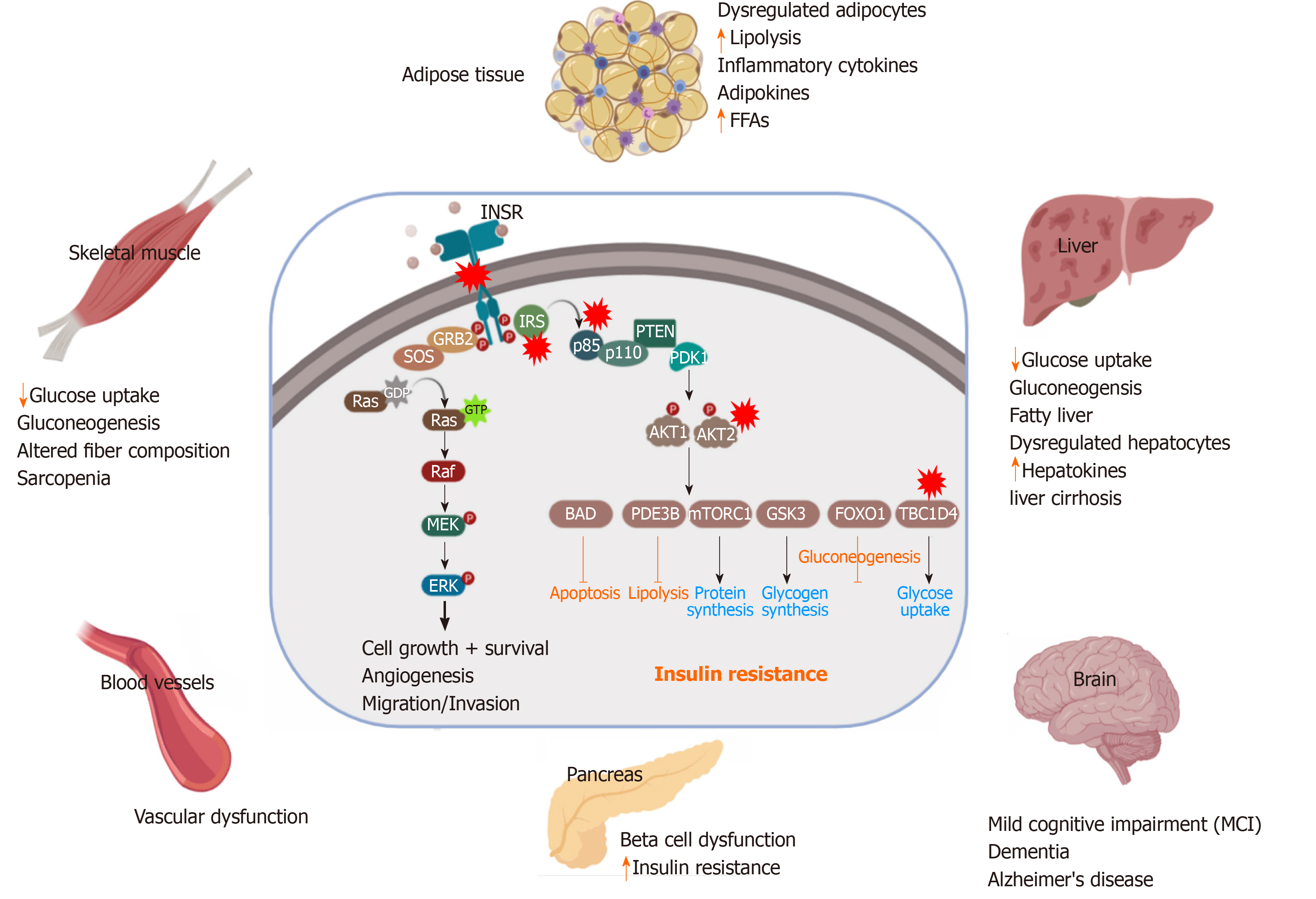
Tissue-Specific Consequences
Let's break down how this selective resistance plays out in the key tissues involved in PCOS. For a deep dive into this, we will use a comprehensive review article.
Insulin resistance in polycystic ovary syndrome across various ...
The review 'Insulin resistance in polycystic ovary syndrome across various tissues' provides a detailed, tissue-by-tissue explanation of these mechanisms. We will read it section by section.
First, please read the section 'Insulin signal transduction pathway' to solidify your understanding of the two main pathways (metabolic and mitotic/MAPK) and how post-binding defects lead to dysfunction.
Skeletal Muscle and Adipose Tissue
These are the main sites for glucose disposal. In PCOS, the PI3K pathway in these tissues is resistant to insulin.
- Effect: Insulin fails to properly stimulate GLUT4 translocation.
- Result: Glucose uptake is reduced. Blood glucose remains high, forcing the pancreas to secrete even more insulin (compensatory hyperinsulinemia).
Insulin resistance in polycystic ovary syndrome across various ...
Now, let's see how this plays out in fat and muscle.
Please read the subsections 'Adipose tissue' and 'Skeletal muscle'. Note how in both tissues, the mechanisms point to impaired glucose metabolism (e.g., reduced GLUT-4, decreased PI3-K activation) and how androgens themselves can worsen this resistance.
The Ovary
This is where the paradox becomes clear. Ovarian theca cells have intact mitogenic/steroidogenic signaling.
- Effect: Theca cells remain highly responsive to insulin. In the face of systemic hyperinsulinemia, these cells are bombarded with a powerful growth and hormone-production signal.
- Result: Insulin acts synergistically with LH to upregulate the key androgen-producing enzyme, P450c17. This dramatically increases the production of androgens, driving the hyperandrogenism of PCOS. The ovary is sensitive to insulin's "bad" effects while the rest of the body is resistant to its "good" effects.
Insulin resistance in polycystic ovary syndrome across various ...
This next section is the most important for understanding the paradox at the heart of PCOS.
Please read the subsection 'The ovaries and uterus'. Pay close attention to the sentences that describe how insulin's effect on glucose metabolism is reduced, while its effect on steroid production is unchanged or enhanced. This is the definition of selective insulin resistance in the ovary.
Test your understanding!
A scientist is studying theca cells isolated from a woman with PCOS. When she adds insulin to the cell culture, she observes two things:
- Glucose uptake into the cells does not increase significantly.
- The production of androstenedione (an androgen) increases dramatically.
Explain this seemingly contradictory result using the concept of selective insulin resistance.
Show answer
This is a classic demonstration of selective insulin resistance.
- The lack of increased glucose uptake shows that the metabolic PI3K pathway is resistant to insulin's signal, which is a characteristic defect in PCOS.
- The dramatic increase in androgen production shows that the mitogenic/steroidogenic MAPK pathway is still sensitive and responsive to insulin. The high insulin levels are successfully stimulating the cellular machinery for hormone synthesis, even while failing to stimulate glucose transport.
The Vicious Cycle Revisited
These mechanisms lock the system into a vicious cycle.
- Peripheral IR in muscle and fat causes compensatory hyperinsulinemia.
- Hyperinsulinemia acts on the non-resistant pathways in the ovary, driving hyperandrogenism.
- The resulting excess androgens then circulate and further worsen insulin resistance in muscle and fat, completing the loop.
This video provides a simple, high-level summary of this destructive feedback loop.
Polycystic Ovarian Syndrome (PCOS) - Pathophysiology, Symptoms, Treatment
The video 'Polycystic Ovarian Syndrome (PCOS) - Pathophysiology, Symptoms, Treatment' offers a great visual summary of the vicious cycle between insulin and androgens.
Please watch from 02:51 to 05:17. Notice how it explains that insulin drives androgen production, and androgens, in turn, cause decreased insulin sensitivity, creating what the narrator calls 'one big vicious cycle'.
Conclusion
You now have a deep understanding of the specific molecular defects that underpin insulin resistance in PCOS. It is this unique, selective nature of the resistance that directly links the metabolic dysfunction (hyperinsulinemia) to the reproductive dysfunction (hyperandrogenism).
Key Takeaways:
- Insulin resistance in PCOS is primarily a post-receptor defect, meaning the problem lies in the intracellular signaling pathways.
- The core molecular mechanism is excessive serine phosphorylation of the insulin receptor and its substrates (IRS), which blocks the normal tyrosine phosphorylation required to transmit the signal.
- This resistance is selective: the metabolic (PI3K) pathway is impaired, while the mitogenic/steroidogenic (MAPK) pathway remains fully responsive to insulin.
- This selectivity explains the central paradox of PCOS: muscle and fat are resistant to insulin's glucose-lowering effects, while the ovary remains sensitive to its androgen-producing effects.
- This creates a powerful vicious cycle where hyperinsulinemia drives hyperandrogenism, and hyperandrogenism worsens insulin resistance.
Preview of the Next Lesson:
We have now examined all the individual pillars of PCOS pathophysiology: neuroendocrine dysfunction (GnRH/LH), intrinsic ovarian dysfunction (hyperandrogenism, follicular arrest), the role of AMH, and now the specific mechanisms of insulin resistance. In the next lesson, we will achieve a major goal of this course: synthesize the interrelationships between hyperandrogenism, insulin resistance, and ovulatory dysfunction in a unifying model of PCOS. We will assemble all these pieces to see the complete, interconnected picture of the syndrome.