Hello! Welcome back to our study of PCOS pathophysiology.
In our last lesson, we uncovered the "perfect storm" that causes follicular arrest: a developing follicle is starved of growth-promoting FSH, bombarded by premature "stop" signals from LH and insulin, and trapped in a local androgen-rich environment. We noted that the accumulation of these arrested follicles is the source of another key hormone, which is our focus today.
This lesson addresses the learning outcome: Describe the role of elevated anti-Müllerian hormone (AMH) in PCOS pathophysiology. We will see that AMH is not just a passive marker of this follicular pile-up but an active and powerful contributor to the vicious cycles that drive PCOS.
What is AMH and Why is it Elevated in PCOS?
Anti-Müllerian Hormone (AMH) is a glycoprotein hormone belonging to the transforming growth factor-beta (TGF-β) superfamily. In females, it is produced exclusively by the granulosa cells of ovarian follicles, specifically the pre-antral and small antral follicles—the exact stages where follicles become arrested in PCOS.
A defining feature of PCOS is that serum AMH levels are typically two to four times higher than in women with normal ovaries. There are two primary reasons for this dramatic increase:
- More Follicles: As we've learned, the PCOS ovary contains a large number of small, developing follicles. Since these follicles are the "factories" that produce AMH, having more of them naturally leads to higher overall production.
- Higher Production Per Follicle: More importantly, research indicates that the granulosa cells within each individual follicle in a polycystic ovary are intrinsically "hyperactive," producing significantly more AMH than their counterparts in a normal ovary.
To understand the evidence behind this, let's turn to a detailed review.
Role of Anti-Müllerian Hormone in the Pathogenesis ...
The article 'Role of Anti-Müllerian Hormone in the Pathogenesis of Polycystic Ovary Syndrome' provides an excellent discussion on whether AMH is overexpressed at the follicle level.
Please read the subsection titled 'Is AMH Overexpressed at the Follicle Level?'. Pay attention to the two competing (but not mutually exclusive) explanations for high AMH: the 'granulosa mass' theory (more follicles) versus the 'intrinsic dysfunction' theory (more production per follicle). Note the evidence cited for each, such as the AMH/AFC ratio and in vitro studies.
This dual contribution—an increased number of follicles and increased output from each one—results in the profoundly elevated AMH levels seen in PCOS. Now, let's explore what this excess AMH does.
How Elevated AMH Worsens Ovarian Dysfunction
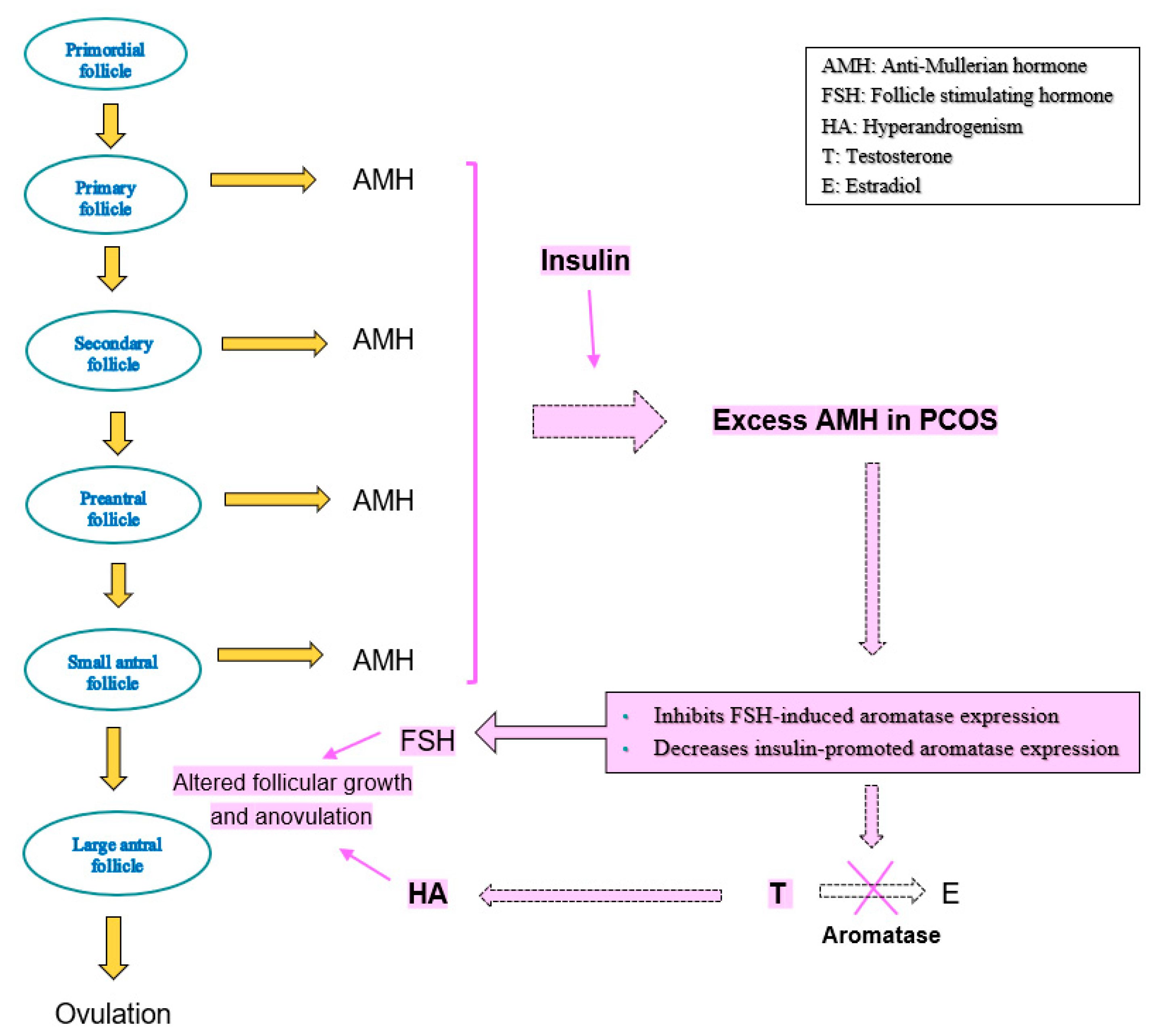
Elevated AMH directly exacerbates the follicular arrest we discussed in the previous lesson through two primary mechanisms within the ovary.
1. Worsening FSH Insensitivity
AMH's normal physiological role is to act as a "brake" on follicular development, preventing too many follicles from being recruited at once and modulating their sensitivity to FSH. In the context of PCOS, where AMH levels are pathologically high, this braking action becomes excessive.
High AMH further suppresses the sensitivity of granulosa cells to FSH. This means the follicles become even more resistant to the already relatively low levels of FSH, making it nearly impossible for one to be selected for dominance.
2. Inhibiting Aromatase Activity
As we learned, a healthy follicle must be able to convert androgens into estrogens, a process driven by the enzyme aromatase. Estrogen is critical for the follicle's own maturation. High AMH levels strongly inhibit the expression and activity of aromatase.
This creates a destructive feedback loop within the follicle:
- High AMH blocks aromatase.
- Theca cell androgens (like testosterone) cannot be efficiently converted to estradiol.
- The local environment becomes increasingly androgen-dominant and estrogen-deficient.
- This toxic environment further contributes to stalling follicular growth.
The following diagram clearly illustrates this disruptive action.
This article provides more detail on the interplay between AMH and FSH in the context of PCOS.
Anti-Müllerian hormone in PCOS: Molecular regulation and ...
The review 'Anti-Müllerian hormone in PCOS: Molecular regulation and ...' succinctly explains this crucial interaction.
Please read the section titled 'Interplay between AMH and FSH'. Focus on how the normally delicate balance is disrupted in PCOS, with elevated AMH leading to heightened FSH insensitivity and contributing directly to follicular arrest.
How Elevated AMH Disrupts the Brain (Neuroendocrine Dysfunction)
Perhaps one of the most significant recent discoveries in PCOS pathophysiology is that AMH's influence extends beyond the ovary. AMH receptors (AMHR2) have been found on the GnRH neurons in the hypothalamus.
As you'll recall, the fundamental neuroendocrine problem in PCOS is an abnormally high GnRH pulse frequency, which leads to the skewed LH:FSH ratio. Research has shown that AMH can directly stimulate these GnRH neurons, increasing their firing rate.
This creates a major, self-perpetuating vicious cycle:
- Ovarian dysfunction leads to a build-up of small follicles.
- These follicles produce excess AMH.
- The high levels of AMH travel to the brain and stimulate GnRH neurons.
- This increases GnRH pulse frequency, which worsens the LH/FSH ratio.
- The altered gonadotropin ratio further impairs follicular development, leading to more follicular arrest and even more AMH production.
This finding establishes AMH as a key link that couples the dysfunction in the ovary back to the primary disruptor in the brain.
Role of Anti-Müllerian Hormone in the Pathogenesis ...
Let's return to the 'Role of Anti-Müllerian Hormone in the Pathogenesis...' article, which has an excellent section on this neuroendocrine role.
Please read the section 'Role of AMH In The Gonadotropin Dysregulation of PCOS.' Focus on the subsection 'There Is a Positive Link Between AMH and LH.' Understand the experimental evidence that suggests AMH acts on GnRH neurons to increase LH pulsatility.
The AMH-Androgen Feedback Loop
The relationship between AMH and androgens is a two-way street, creating another feedback loop that drives PCOS pathology.
- Androgens stimulate AMH production: Hyperandrogenism, a core feature of PCOS, appears to directly stimulate granulosa cells to produce even more AMH.
- AMH increases androgen levels: As we discussed, high AMH inhibits aromatase, preventing the conversion of androgens to estrogens and thus increasing the effective concentration of androgens within the ovary.
This interplay ensures that high androgen levels and high AMH levels reinforce each other, further entrenching the pathological state of the ovary.
Anti-Müllerian hormone in PCOS: Molecular regulation and ...
To explore this relationship, let's read the relevant section from the 'Anti-Müllerian hormone in PCOS: Molecular regulation and ...' review.
Please read the section titled 'Androgens and their role in AMH regulation'. Note how androgens can modulate AMH levels and how, in the context of PCOS, this contributes to a feedback loop that impairs follicle maturation.
Test your understanding!
Based on what you've learned, how does elevated AMH contribute to the following core features of PCOS?
- Anovulation (Follicular Arrest):
- Hyperandrogenism:
- Abnormal LH:FSH Ratio:
Show answer
- Anovulation (Follicular Arrest): AMH worsens anovulation by making granulosa cells insensitive to FSH and by inhibiting the aromatase enzyme needed for estrogen production, thereby stalling follicle growth.
- Hyperandrogenism: AMH contributes to hyperandrogenism by inhibiting aromatase, which prevents the conversion of androgens to estrogens, leading to a build-up of androgens within the ovary.
- Abnormal LH:FSH Ratio: AMH worsens the ratio by acting on GnRH neurons in the hypothalamus, increasing their pulse frequency, which preferentially stimulates LH secretion over FSH.
The Molecular Mechanism: The SMAD Pathway
To understand how AMH exerts these effects at a cellular level, we need to look at its signaling pathway. Since you appreciate detailed mechanisms, this is a key piece of the puzzle.
When AMH binds to its receptor (AMHR2) on a granulosa cell, it activates an intracellular signaling cascade known as the SMAD pathway. Specifically, it triggers the phosphorylation of proteins called SMAD1, SMAD5, and SMAD8. These activated SMADs then enter the cell nucleus and regulate the expression of target genes. It is this change in gene expression that mediates AMH's biological effects, such as inhibiting aromatase and reducing FSH receptor expression.
In PCOS, the pathologically high levels of AMH lead to hyper-activation of this SMAD1/5/8 pathway, which intensifies the inhibition of follicular growth and sensitivity to FSH.
Anti-Müllerian hormone in PCOS: Molecular regulation and ...
The 'Anti-Müllerian hormone in PCOS...' review provides a concise description of this signaling pathway.
Please read the two short sections 'Regulation of AMH by signaling pathways' and the following subsection 'The SMAD-dependent signaling pathway'. Focus on understanding the sequence: AMH binds AMHR2 -> SMAD1/5/8 are phosphorylated -> they enter the nucleus to modulate genes. See how excess AMH in PCOS leads to heightened activation of this pathway, intensifying follicular arrest.
Conclusion
Elevated AMH is far more than just a consequence of having many small follicles; it is a central driver of PCOS pathophysiology. It acts at multiple levels to create and sustain the hormonal and ovarian dysfunction that defines the syndrome.
Key Takeaways:
- AMH is 2-4 times higher in PCOS, both because there are more AMH-producing follicles and because each follicle produces more AMH.
- Within the ovary, high AMH worsens follicular arrest by decreasing FSH sensitivity and inhibiting the aromatase enzyme, creating an androgen-dominant microenvironment.
- Within the brain, high AMH acts on GnRH neurons to increase their pulse frequency, exacerbating the high LH:FSH ratio.
- AMH and androgens are locked in a vicious feedback loop, where each stimulates the other, further disrupting folliculogenesis.
- These effects are mediated at the cellular level by the hyper-activation of the AMH-SMAD signaling pathway.
Preview of the Next Lesson:
We have now examined the key components of PCOS pathophysiology in detail: hyperandrogenism, insulin resistance, abnormal gonadotropin secretion, follicular arrest, and the role of AMH. In our next and final lesson for this module, we will put all the pieces together. Our goal will be to synthesize the interrelationships between hyperandrogenism, insulin resistance, and ovulatory dysfunction in a unifying model of PCOS, creating a complete picture of this complex syndrome.