Hello! Welcome back to our exploration of PCOS pathophysiology.
In our last lesson, we established the central neuroendocrine disruption in PCOS: an abnormally fast GnRH pulse frequency leading to an elevated LH-to-FSH ratio. This creates an ovarian environment with too much LH and not enough FSH.
Today, we will connect that hormonal imbalance directly to its consequences within the ovary. Our learning outcome is to explain the mechanisms of follicular arrest and anovulation in PCOS. We will answer the critical question: Why do the follicles in a polycystic ovary start to grow but then get "stuck," failing to produce a dominant follicle and ovulate?
The "String of Pearls": A Visual of Follicular Arrest
Before diving into the mechanisms, let's look at the outcome. The term "polycystic" is actually a misnomer; the "cysts" are not true cysts but rather small, immature ovarian follicles that have been halted in their development.
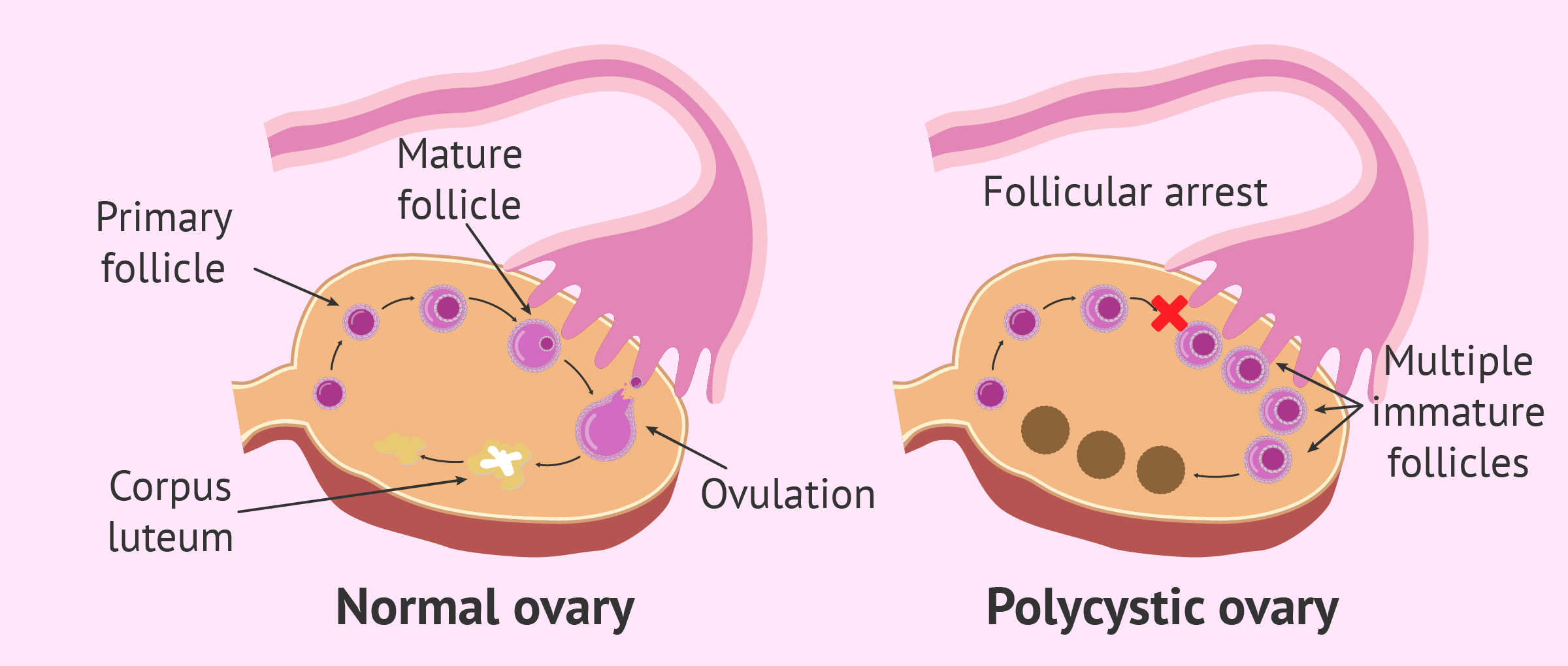
Our goal in this lesson is to understand the cellular and hormonal reasons for the stalled development seen on the right.
Mechanism 1: Insufficient Follicle Stimulation (The FSH Deficit)
The most straightforward reason for follicular arrest is the relative lack of Follicle-Stimulating Hormone (FSH). As its name implies, FSH is the primary hormone that drives the growth of antral follicles and is essential for the selection of a single dominant follicle.
In the low-FSH environment of PCOS:
- Many follicles are recruited and begin to grow.
- However, none of them receive a strong enough or sustained enough FSH signal to achieve dominance.
- They grow to a small antral stage (typically 2-8 mm) and then stall because they lack the critical "go" signal to continue maturation.
The following short video clip provides a concise explanation of this crucial point.
Polycystic Ovarian Syndrome (PCOS) - Pathophysiology, Symptoms, Treatment
The video 'Polycystic Ovarian Syndrome (PCOS) - Pathophysiology, Symptoms, Treatment' by PhysioPathoPharmaco clearly explains how the altered LH:FSH ratio impacts the follicle.
Please watch from 01:57 to 02:34. Focus on how the narrator links the relatively lower FSH level directly to the failure of follicles to mature into a Graafian follicle capable of ovulation.
While the FSH deficit explains why a dominant follicle isn't selected, it doesn't fully explain why the follicles get actively arrested. For that, we need to consider the other side of the hormonal imbalance: excess LH and insulin.
Mechanism 2: Premature Growth Arrest (The LH and Insulin Excess)
Follicular growth is a delicate balance. While FSH provides the "grow" signal, the LH surge provides the "stop growing and ovulate" signal. In PCOS, follicles are exposed to a high "stop" signal far too early in their development.
This is due to a combination of factors, which are explained in detail in the following academic text.
Polycystic Ovary Syndrome - download
The chapter 'Folliculogenesis in Polycystic Ovaries' from the book 'Polycystic Ovary Syndrome' offers a sophisticated explanation of this process. It details how the abnormal endocrine environment actively halts follicle growth.
Please read the section titled '3. MECHANISMS OF ARRESTED ANTRAL FOLLICLE GROWTH IN PCOS'. Focus on these key concepts: The cAMP 'ceiling': The idea that once a certain threshold of the intracellular messenger cAMP is reached, the granulosa cell switches from growth to terminal differentiation (arrest). Premature Responsiveness: Note the evidence that granulosa cells from small PCOS follicles (4 mm) respond to LH in a way that normal follicles only do when they are much larger (9–10 mm). Synergy of LH and Insulin: Understand how hyperinsulinemia can amplify the LH signal, pushing the follicle toward this premature arrest.
Let's summarize the crucial points from this reading:
- Premature Luteinization: The granulosa cells in the small PCOS follicles are prematurely exposed to high levels of LH and insulin. This causes them to start behaving like the cells of a mature, post-LH-surge follicle. They begin to produce progesterone and stop proliferating—a process called luteinization—which effectively arrests their growth.
- Insulin's Role: Hyperinsulinemia acts as a powerful co-factor. It amplifies the LH signal on the granulosa cells, meaning even women with normal LH levels can experience this premature arrest if they are insulin resistant. This explains why obesity and insulin resistance so strongly exacerbate the anovulatory symptoms of PCOS.
Mechanism 3: The Hostile Intra-Ovarian Environment
The problems aren't limited to external hormone signals. The local chemical environment within the PCOS ovary and its follicles is also altered in a way that prevents healthy development. A key factor is the excess of androgens.
Polycystic Ovary Syndrome - download
Let's return to the 'Polycystic Ovary Syndrome' text, this time to a chapter that focuses on the factors contributing to follicular arrest.
Please read the section titled '4. FOLLICULAR ARREST'. Focus specifically on the subsection '4.1. Elevated 5α-Reduced Androgens'. This explains how certain types of androgens, which are high in PCOS follicles, can inhibit a key enzyme needed for estrogen production.
As the text explains, follicles in PCOS have elevated activity of the enzyme 5α-reductase. This converts androgens into more potent forms, such as dihydrotestosterone (DHT). These potent androgens can inhibit the aromatase enzyme in granulosa cells.
Why is this important? Aromatase is the enzyme, stimulated by FSH, that converts androgens (from theca cells) into estrogens. Estrogen is essential for the follicle's own growth and for creating a healthy environment for the oocyte. By inhibiting aromatase, the excess androgens create a vicious cycle:
- High LH and insulin drive theca cells to produce excess androgens.
- These androgens are converted to potent forms that inhibit aromatase within the follicle.
- The follicle cannot produce the estrogen it needs to continue growing and mature.
- This contributes to its arrest in an androgen-dominant, estrogen-deficient state.
Test your understanding!
A small antral follicle in a woman with PCOS is attempting to grow. Match the following hormones/factors to their primary role in causing its arrest.
Factors:
- Relatively low FSH
- Persistently high LH
- Hyperinsulinemia
- Intra-follicular 5α-reduced androgens
Roles:
A. Provides an insufficient "grow" signal, preventing the follicle from being selected as dominant.
B. Acts as a premature "stop" signal, causing the granulosa cells to terminally differentiate too early.
C. Inhibits the production of estrogen within the follicle, creating a toxic, androgen-dominant microenvironment.
D. Amplifies the premature "stop" signal, making the follicle even more sensitive to arrest.
Show answer
- Relatively low FSH -> A. Provides an insufficient "grow" signal.
- Persistently high LH -> B. Acts as a premature "stop" signal.
- Hyperinsulinemia -> D. Amplifies the premature "stop" signal.
- Intra-follicular 5α-reduced androgens -> C. Inhibits the production of estrogen.
Conclusion: A Perfect Storm for Anovulation
Follicular arrest in PCOS is not due to a single defect but a combination of powerful forces working against follicle maturation. A developing follicle finds itself in a "perfect storm":
- Starved of the growth-promoting FSH it needs to become dominant.
- Bombarded by premature growth-arresting signals from high LH, amplified by high insulin.
- Poisoned by a local androgen-rich environment that prevents it from making the estrogen essential for its survival and growth.
The result is inevitable: the follicle stalls. It does not die immediately (undergo atresia) but it cannot progress. The accumulation of dozens of these arrested follicles is what creates the characteristic polycystic ovarian morphology and is the direct cause of the chronic anovulation that defines the syndrome.
Key Takeaways:
- Follicular arrest in PCOS is caused by a combination of insufficient growth signals (low FSH) and premature growth-arresting signals (high LH, high insulin).
- Granulosa cells in small PCOS follicles are prematurely responsive to LH, causing them to stop proliferating and begin differentiating far too early.
- Hyperinsulinemia synergizes with LH to amplify this growth-arresting effect.
- The intra-follicular environment is hostile, with high levels of potent androgens inhibiting aromatase and local estrogen production, which is essential for follicle health.
- This process of follicular arrest is the direct cause of anovulation and the "polycystic" appearance of the ovaries.
Preview of the Next Lesson:
The vast number of small, arrested follicles in the PCOS ovary is the source of another key hormone: Anti-Müllerian Hormone (AMH). In our next lesson, we will describe the role of elevated anti-Müllerian hormone (AMH) in PCOS pathophysiology, exploring how this marker of ovarian reserve becomes a key player in the syndrome's complex feedback loops.