Hello! Welcome to the first lesson in our module on the genetic and epigenetic basis of PCOS.
In our previous discussions, we've explored the clinical signs, diagnostic criteria, and the specific hormonal and metabolic imbalances that characterize PCOS. We've answered what is happening in the body. Now, we begin to explore why it might be happening. Evidence strongly suggests that genetics play a significant role in a person's susceptibility to developing PCOS. To understand this evidence, we must first build a solid foundation in the language of modern genetics.
Today's lesson addresses the learning outcome: Explain the central dogma of molecular biology (DNA to protein) and the concept of gene expression. This might seem like a step back from PCOS itself, but these fundamental principles are the building blocks we need to understand the complex genetic factors we will discuss in upcoming lessons.
We will cover:
- The Central Dogma: The process by which the genetic code stored in your DNA is used to create the functional proteins that run your body.
- Gene Expression: The mechanism that controls which genes are "turned on" or "off" in any given cell at any given time.
1. The Blueprint of Life: From DNA to Protein
Every cell in your body contains a complete set of instructions for building and operating you. This master blueprint is a molecule called Deoxyribonucleic Acid (DNA).
- DNA: Imagine a vast instruction manual. DNA is a long, double-helix molecule made of four chemical bases: Adenine (A), Guanine (G), Cytosine (C), and Thymine (T). The specific sequence of these bases contains all the genetic information.
- Gene: A gene is like a single recipe within that giant instruction manual. It is a specific segment of DNA that holds the instructions for making one specific product, most often a protein.
But how does the cell read this recipe and cook the dish? The information stored in DNA isn't used directly. It flows through a two-step process known as the central dogma of molecular biology.
The flow is: DNA → RNA → Protein
- Transcription: An intermediate copy of the gene's recipe is made. This copy is called messenger RNA (mRNA).
- Translation: The mRNA copy is read by the cell's machinery to build the final protein.
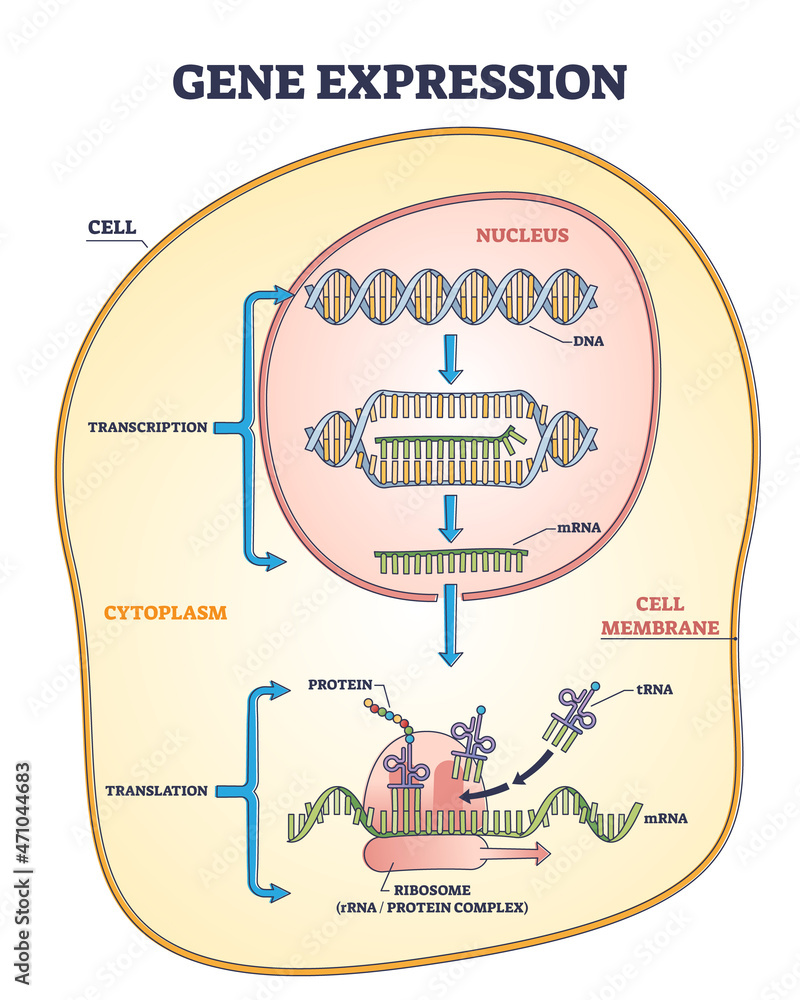
Let's break down each of these steps.
2. The Central Dogma in Detail
To get a clear and dynamic view of this entire process, we'll watch a video that walks through it step-by-step.
Transcription and Translation: From DNA to Protein
The video 'Transcription and Translation: From DNA to Protein' by Professor Dave Explains provides an excellent, concise overview of the central dogma. It visualizes how the molecular machinery works.
Please watch the entire video (about 6 minutes). As you watch, focus on distinguishing between the two main processes: Transcription (01:15 - 03:01): Note how DNA is used as a template to create mRNA and how the base Uracil (U) replaces Thymine (T). Translation (03:01 - 05:25): Pay attention to the roles of the ribosome, mRNA codons, and tRNA in building the protein chain.
Now, let's review those steps with some more detail.
Step 1: Transcription (DNA → mRNA)
Transcription is the process of creating a portable copy of a gene. Think of it like photocopying a recipe from a rare book in a library that you're not allowed to remove.
- Location: The nucleus of the cell (the "library").
- Process:
- The DNA double helix unwinds at the location of the gene to be copied.
- An enzyme called RNA polymerase binds to the DNA and reads one of the strands (the template strand).
- As it moves along the DNA, it assembles a complementary strand of messenger RNA (mRNA).
- The base-pairing rule is similar to DNA, with one key change: Adenine (A) in the DNA pairs with Uracil (U) in the RNA, instead of Thymine (T). Guanine (G) still pairs with Cytosine (C).
- Result: A single-stranded mRNA molecule that carries the gene's code. This mRNA is small and mobile enough to leave the nucleus.
In human (eukaryotic) cells, this new mRNA molecule undergoes some processing, including a step called splicing, where non-coding sections are removed before it's ready for the next step.
Test your understanding!
Imagine a short segment of a DNA template strand has the following sequence:
3' - T A C G G T C A T - 5'
During transcription, what would be the sequence of the corresponding mRNA molecule that is created?
Show answer
The corresponding mRNA sequence would be:
5' - A U G C C A G U A - 3'
Remember these key points:
- The mRNA is built in the 5' to 3' direction.
- Adenine (A) pairs with Uracil (U).
- Thymine (T) pairs with Adenine (A).
- Cytosine (C) pairs with Guanine (G).
Step 2: Translation (mRNA → Protein)
Translation is the process of converting the information from the language of nucleic acids (bases) into the language of proteins (amino acids).
- Location: The cytoplasm, on a structure called a ribosome (the "kitchen counter").
- Process:
- The mature mRNA molecule travels out of the nucleus and binds to a ribosome.
- The ribosome reads the mRNA sequence in groups of three bases called codons. Each codon specifies one particular amino acid (the building blocks of proteins). For example, the codon AUG signals the start of the protein and codes for the amino acid Methionine.
- Another type of RNA, transfer RNA (tRNA), acts as a shuttle. Each tRNA molecule carries a specific amino acid and has an "anticodon" that matches an mRNA codon.
- As the ribosome moves along the mRNA, the correct tRNA molecules arrive, and the amino acids they carry are linked together in a chain, called a polypeptide.
- Result: A polypeptide chain that folds into a complex, three-dimensional shape to become a functional protein. These proteins then go on to perform countless jobs in the cell, acting as enzymes, structural components, hormones, and more.
To solidify these concepts, let's read a short article that summarizes the process.
From DNA to Protein; The Central Dogma of Molecular ...
The article 'From DNA to Protein; The Central Dogma of Molecular Biology' provides a clear textual summary of these steps. Reading about it can help reinforce what you saw in the video.
Please read the sections titled 'DNA to Protein: The Steps of Central Dogma,' 'Transcription,' 'Splicing,' and 'Translation.' Focus on the description of each stage and the key molecules involved.
3. Gene Expression: Controlling the Flow of Information
Your body contains trillions of cells, and almost every one contains the exact same set of genes. However, a brain cell is clearly different from a muscle cell or a skin cell. If they all have the same DNA, how is this possible?
The answer lies in gene expression.
Gene expression is the entire process of using a gene to create a functional product, like a protein. It's the "on switch" for a gene. Cells are highly selective about which genes they "express." A muscle cell expresses genes for contractile proteins, while a pancreatic cell expresses the gene for insulin. The genes for insulin exist in the muscle cell, but they are "turned off."
This regulation is essential for cells to develop specialized functions and to respond to their environment. It would be incredibly wasteful and chaotic if every cell made every protein all the time.
This next video provides a great introduction to this concept.
Gene Expression and Regulation
The Amoeba Sisters video 'Gene Expression and Regulation' explains why gene regulation is so important and introduces the key players involved in turning genes on and off.
Please watch from the beginning to 01:34, and then from 02:17 to 03:21. Focus on understanding why gene regulation is necessary and the role of transcription factors.
How is Gene Expression Controlled?
As the video explained, gene expression can be regulated at many points, but one of the most critical control points is the very first step: transcription.
The cell can control whether or not an mRNA copy of a gene is even made. The key players here are proteins called transcription factors. These proteins can bind to specific DNA sequences near a gene and act like a switch:
- Activators: These transcription factors help RNA polymerase bind to the DNA, turning the gene ON and promoting transcription.
- Repressors: These transcription factors block RNA polymerase, turning the gene OFF and preventing transcription.
The presence or absence of these transcription factors is often influenced by signals from other parts of the body (like hormones) or from the environment. This complex regulatory network is what allows our cells to function dynamically and appropriately. Understanding this is crucial, as many genetic studies of PCOS look for variations in genes that code for these regulatory proteins.
Test your understanding!
A theca cell in the ovary produces androgens, but a skin cell does not, even though both cells contain the exact same genes, including those for androgen synthesis. Based on the concept of gene expression, what is the most likely reason for this difference?
Show answer
The most likely reason is that in the theca cell, the genes required for androgen synthesis are expressed (turned on), likely by specific transcription factors that are active in that cell type. In the skin cell, those same genes are not expressed (they are turned off or repressed), so the proteins needed to make androgens are not produced.
Conclusion
In this lesson, we have built a foundational understanding of how the genetic code translates into functional life. This knowledge is indispensable as we move forward to investigate the genetic underpinnings of PCOS.
Key Takeaways:
- The Central Dogma describes the flow of genetic information: DNA → RNA → Protein.
- Transcription is the synthesis of a messenger RNA (mRNA) copy from a DNA gene in the nucleus.
- Translation is the synthesis of a protein from the mRNA code on a ribosome in the cytoplasm.
- Gene Expression is the process of activating ("turning on") a gene to produce its protein. It is what allows cells to specialize and function correctly.
- This expression is often controlled at the level of transcription by regulatory proteins called transcription factors.
Preview of the Next Lesson:
Now that we understand the basic mechanism of how a gene works, our next lesson will address the learning outcome: Define genetic variation and explain its role in disease susceptibility, supported by evidence from familial and twin studies in PCOS. We will explore how small differences in the DNA sequence from person to person (genetic variations) can influence whether someone is more or less likely to develop a condition like PCOS.